Why We Turn Down Cold-Chain Projects: An ODM’s Reverse RFQ Checklist
This article describes how one ODM screens cold-chain RFQs before quoting. The three scenarios are composites of recurring patterns; none describes a single customer, project or purchase order. Nothing here commits Eelink to quote, or to decline, any specific programme.
The hardest cold-chain RFQs to answer are the ones that contradict themselves. A pattern we keep meeting: page one asks for product-core temperature records. Page four prohibits any probe touching the product. Those two requirements cannot both survive. An enclosure-air sensor cannot testify to core temperature, whatever the firmware claims. A quote that pretends otherwise is not a quote — it is a deferred renegotiation.
So this article publishes the screen we run before we price anything. It exists because unearned certainty is expensive on both sides. Engineering-change loops, certification re-runs and warranty exposure all land after the contract is signed. Read the screen forwards and it explains why a factory sometimes says no. Read it backwards and it is a design review a buyer can run before locking a BOM — one nobody sends an invoice for.
Every RFQ Leaves This Screen With One of Four Dispositions
Decline is real, but it is the last of four outcomes, not the first. Most incomplete RFQs go back with questions, not a rejection. The four dispositions we use:
Return to clarify. The document contradicts itself or leaves the measurand undefined. We send back a question set instead of a price. No fee, no commitment.
Paid feasibility. The requirement is coherent but unproven — the evidence does not yet exist on either side. A bounded study answers it before anyone commits tooling.
Conditional quote. Part of the programme is quotable now. The rest waits — usually on market scope or on test results.
No-bid. Physics, certification or line throughput cannot meet the written requirement at the written economics. We say so and stop.
On a large programme the dispositions combine by scope: one part of the requirement can earn a conditional quote while another part goes into feasibility. The screen sorts scope, not just whole projects.
The motive is not virtue. A programme accepted past a failed gate always comes back. It returns as unpaid NRE loops, a failed test campaign or a warranty claim. Declining early is cheaper for the factory and, less obviously, for the buyer. A field failure at scale costs the brand far more than a slipped RFQ round.
What Makes a Factory Say No to a Cold-Chain RFQ?
A factory issues a no-bid when a veto gate fails and the RFQ does not permit the changes needed to close it. Typical failures: cold-soaked transmit-pulse margin that never closes, antenna performance unresolved in the final installation, or a calibration workload that exceeds what the permitted ramp can absorb.
Those three failure surfaces deserve unpacking, because none of them appears on a spec sheet.
1. Cold-soaked power budgets
Battery datasheets quote capacity. Cellular modems spend current in short, high bursts — attach attempts, retries, store-and-forward flushes after coverage gaps. At low temperatures, primary lithium cells lose pulse capability as their effective impedance rises. Lithium thionyl chloride cells add a second trap: a passivation layer that builds during storage and causes voltage delay under the first load. The pulse budget has to use the chosen chemistry’s temperature, storage-age and discharge-profile data. The question is never “how many milliamp-hours”. It is whether the voltage stays above brownout during the worst transmit burst of the coldest, oldest day. Solving that often needs a pulse capacitor and layout room. A thin enclosure, a deep-freeze profile and frequent reporting can be mutually exclusive, and no unit price fixes physics. This is why we treat battery life as a route property, not a number. The full argument runs through our piece on why long battery life is not a bigger battery.
2. The antenna meets the payload
Initial antenna matching happens on a bench, in a reference configuration. Final performance only exists in the production enclosure, in the real installation. Cold-chain devices work strapped to dense, wet, sometimes metal-walled loads. Payload dielectrics, condensation films and reefer walls all detune a radio that measured beautifully on the bench. An external probe adds a feed-through that changes sealing and antenna behaviour at once. Certification measures the result on the final device configuration, not the evaluation board: PTCRB and GCF certification rely on recognized laboratories, and PTCRB programmes can add over-the-air performance requirements. None of it replaces FCC authorization, EU RED conformity assessment or carrier acceptance. Some RFQs freeze the industrial design — material, dimensions, antenna position — before any of that is measured. There, the RF engineer holds a veto, and uses it.
3. Calibration is line time
A temperature record that must survive an audit needs calibration evidence. Standards make that concrete. EN 12830:2018 specifies tests, performance and suitability for temperature recorders used in the transport, storage and distribution of temperature-sensitive goods. Tolerance classes for industrial platinum resistance thermometers come from IEC 60751. Depending on the product and the required evidence, multi-point verification runs in a chamber, a bath or a dry block, one unit at a time or in batch fixtures. Either way the stabilization time, the number of points and the batch size turn into minutes of equipment time. Multiply those minutes by a monthly forecast and the result is line arithmetic, not philosophy. The 101,000 m² campus in Yibin, China runs five SMT lines and 28 assembly lines, with current output of approximately 300,000 devices per month. When the required calibration workload cannot fit the agreed ramp and no schedule or fixture change is permitted, the project is a throughput no-bid. The honest alternatives are a different verification level, custom multi-unit fixtures, or a slower ramp.
The list of questions a factory sends back instead of a quote is a design review nobody bills you for.
The Screen Itself: Four Veto Gates, Two Weighted Rows
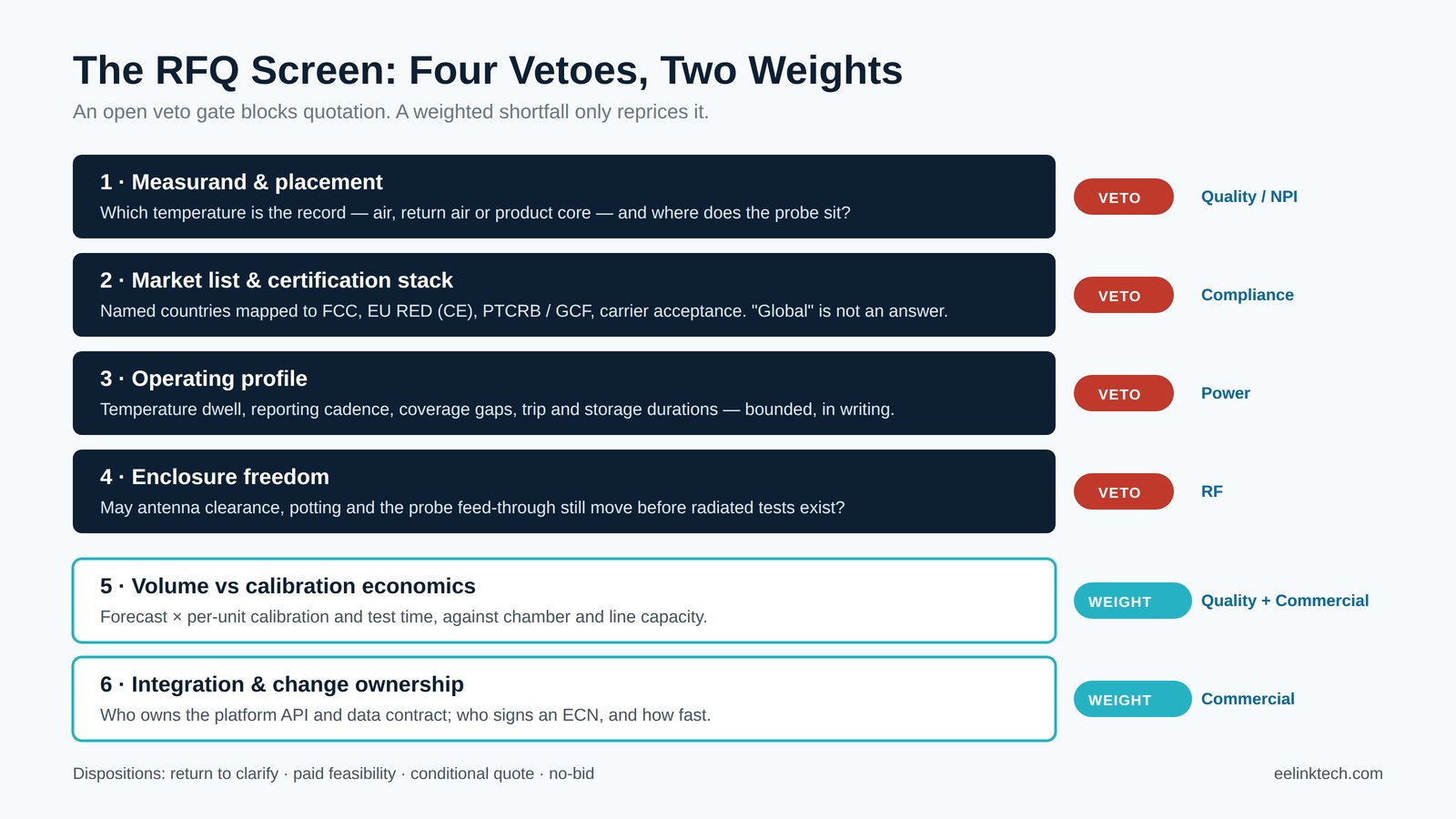
The screen is deliberately not a symmetric scorecard. Four criteria are gates and carry vetoes, because no price compensates for leaving them open. Two are weighted rows, because they only move risk and margin. Each line has a named owner — RF, power, compliance, quality/NPI and commercial do not always agree, which is the point.
| Gate | What it asks | Type | Sign-off |
|---|---|---|---|
| Measurand & placement | Which temperature is the record — enclosure air, return air or product core — and where does the sensor or probe sit? Our probe-placement comparison shows why these are three different records. | Veto | Quality / NPI |
| Market list & certification stack | Named launch countries, with the deliverable each triggers: FCC equipment authorization, EU RED conformity behind the CE marking, PTCRB and GCF, carrier acceptance. “Global” is not an answer. | Veto | Compliance |
| Operating profile | Temperature range and dwell, reporting cadence, expected coverage gaps, trip and storage durations. A bounded profile beats a named lane; a blank beats neither. | Veto | Power |
| Enclosure freedom | May antenna clearance, potting and the probe feed-through still move, or is the industrial design frozen before radiated tests exist? | Veto | RF |
| Volume vs calibration economics | Forecast × per-unit calibration and test time, against chamber and line capacity. Tooling and MOQ arithmetic lives here too. | Weighted | Quality + Commercial |
| Integration & change ownership | Who owns the platform API and data contract; who signs an engineering change, and how fast. | Weighted | Commercial |
The caption above the table is the honest summary. An unresolved veto gate stops quotation of the affected scope, whatever the volume. A confirmed failure under non-negotiable constraints becomes a no-bid. A weighted shortfall merely reprices risk — into NRE, into unit cost, or into a feasibility phase that settles the open question before tooling money moves.
Three RFQs, Three Different Endings
Three composite patterns, drawn from many programmes and describing none in particular, show the dispositions at work.
Returned to clarify: the contradiction on paper
A pharmaceutical distributor asked for product-core records and prohibited contact probes in the same document — the pattern this article opened with. Nothing was wrong with the physics; the document argued with itself. The reply was a one-page measurand question set instead of a price. The revised RFQ chose return-air measurement with a documented placement drawing. It became quotable. Return-to-clarify fits when the contradiction lives in the paperwork: the fix costs a revision cycle, and quoting past it would have priced the wrong product.
No-bid: the physics veto
A consumer-adjacent brand wanted a slim deep-freeze tracker with near-real-time reporting at a price set by its retail packaging. The power gate failed: cold-soaked pulse margin in that enclosure volume did not close. The honest fixes — a thicker enclosure, a pulse capacitor, a slower cadence — were all ruled out in the RFQ text. No-bid fits when a veto gate fails on physics and the constraints that caused the failure are non-negotiable. Both sides were spared a warranty story.
Conditional quote: scope now, evidence later
A platform company arrived with firm integration ownership, a clean operating profile and a market wish list spanning several regulatory regimes on one launch date. The certification gate could not close on the full list in the time available. The disposition was a conditional quote. Launch markets got priced now; the remaining regimes moved into a paid feasibility phase covering radio configuration and certification sequencing. Conditional quotes fit when part of the programme has earned certainty and the rest has not — the descoping is the deliverable.
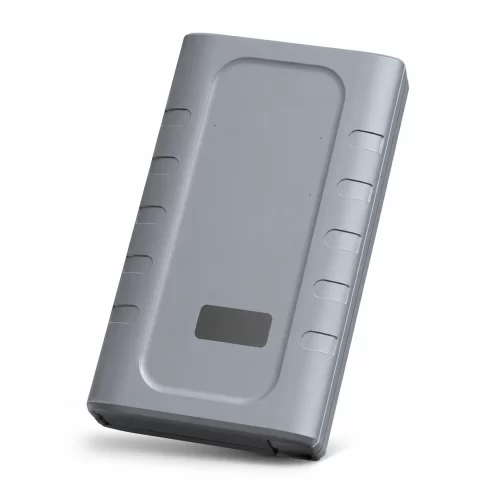
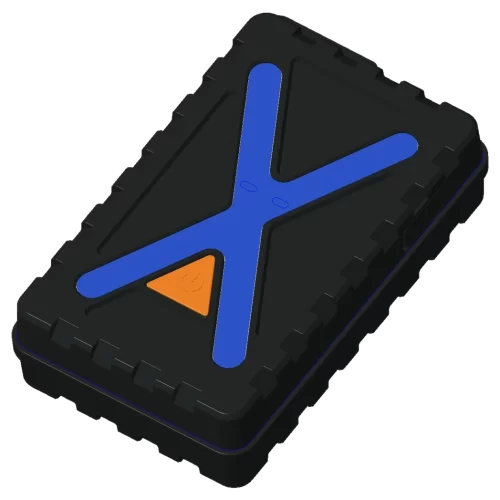
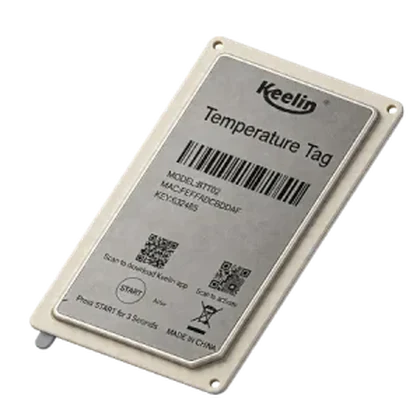
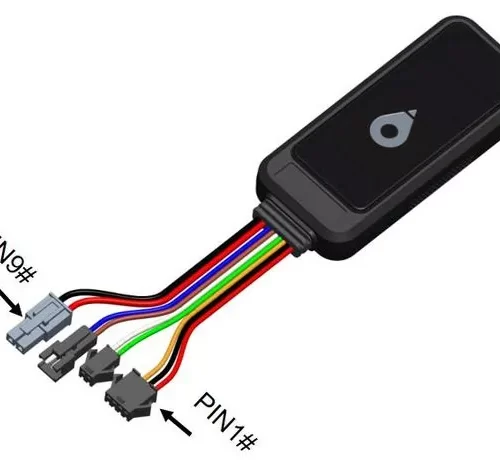
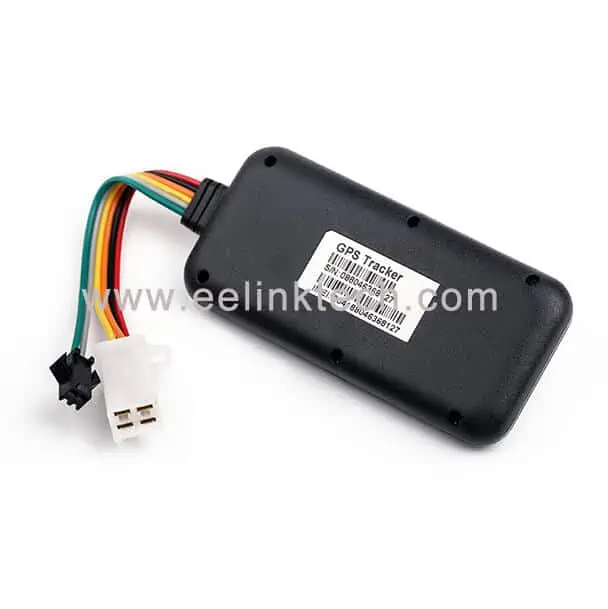
For context on where this screen runs day to day: Eelink builds cold-chain recording hardware such as the GPT45-M multi-sensor tracker for OEM and platform programmes, and every inbound cold-chain RFQ meets the gates described here. The buyer-side companion pieces — seven questions before sourcing and the case that compliance is becoming an evidence problem — cover the same ground from the other side of the table.
Run the Screen Backwards Before You Send the RFQ
Every gate above converts into a self-check a buyer can run in an afternoon. Each item asks yes or no, and each names an artifact you can attach. Complete attachments do not guarantee a quote — they guarantee your RFQ is evaluable in one pass instead of several rounds.
Measurand drawing. Can you attach a sketch naming which temperature is the record — enclosure air, return air or product core — and where the sensor or probe sits?
Market matrix. Does a country-by-SKU table name the certification deliverable each market triggers?
Operating profile. Are temperature dwell, reporting cadence, coverage gaps and trip-plus-storage durations written down?
Battery assumptions. Is the duty cycle behind any battery-life expectation stated, so a quoted number can be checked against it?
Accuracy budget. Are the target uncertainty and the calibration evidence your auditors will demand — EN 12830-aligned or otherwise — named?
Cycle-time arithmetic. Does your forecast survive the per-unit calibration and test time your own spec implies?
Enclosure constraints. Do antenna clearance, potting and the probe feed-through stay open to change until radiated tests on the real installation pass?
Integration owner. Is one named person accountable for the platform API and data contract?
Change discipline. Is it written down who signs an engineering change, and within what turnaround?
Score yourself the way the screen would. Every box ticked: your RFQ is ready to send. Prices come back sharper, because the factory prices less uncertainty. Artifacts missing but no contradictions: budget a feasibility phase before tooling. Contradictions present: redesign the requirement before sending it — the RFQ round you save is your own.