
GPT45-M
Cold Chain Cargo Tracker · Shipment Evidence · LTE-M / NB-IoT / 2G
Most trackers tell you something went wrong. GPT45-M records enough to tell you where, when and in whose custody: temperature, humidity, light, shock, pressure and position on one synchronised time base — a single account of the load that survives carrier handover. Built for cold chain lanes, and available as a white-label ODM platform.
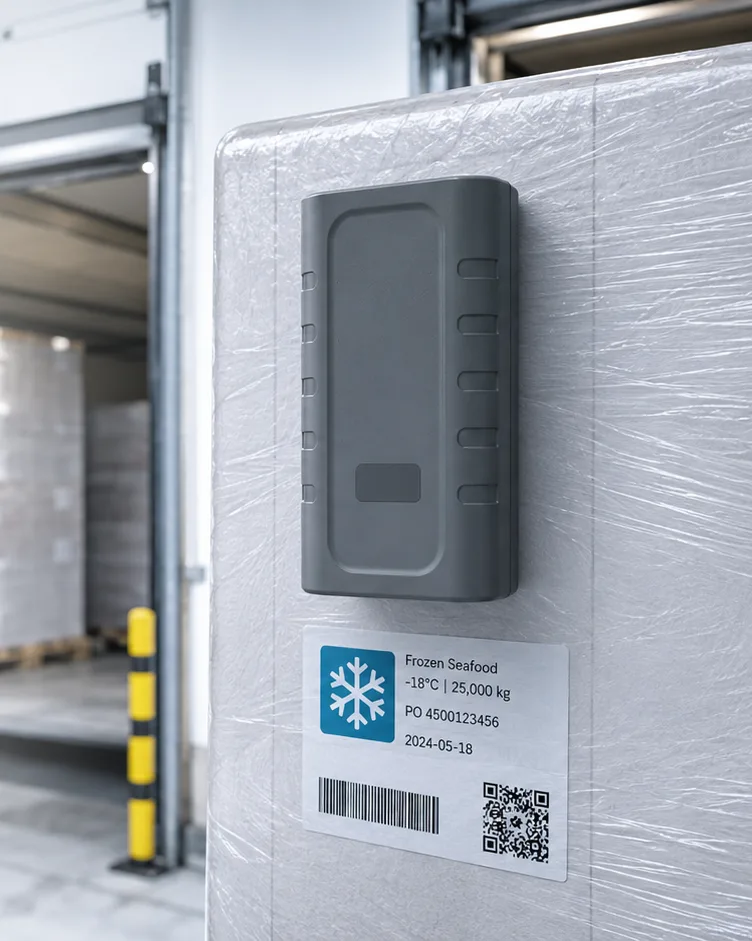
One sensor proves something went wrong. Seven prove where, when and whose.
Click through an illustrative lane below. Each stage shows what every channel recorded at that moment — and what the combination lets you conclude.
Illustrative lane used to explain signal correlation. Values are not measured product or shipment data.
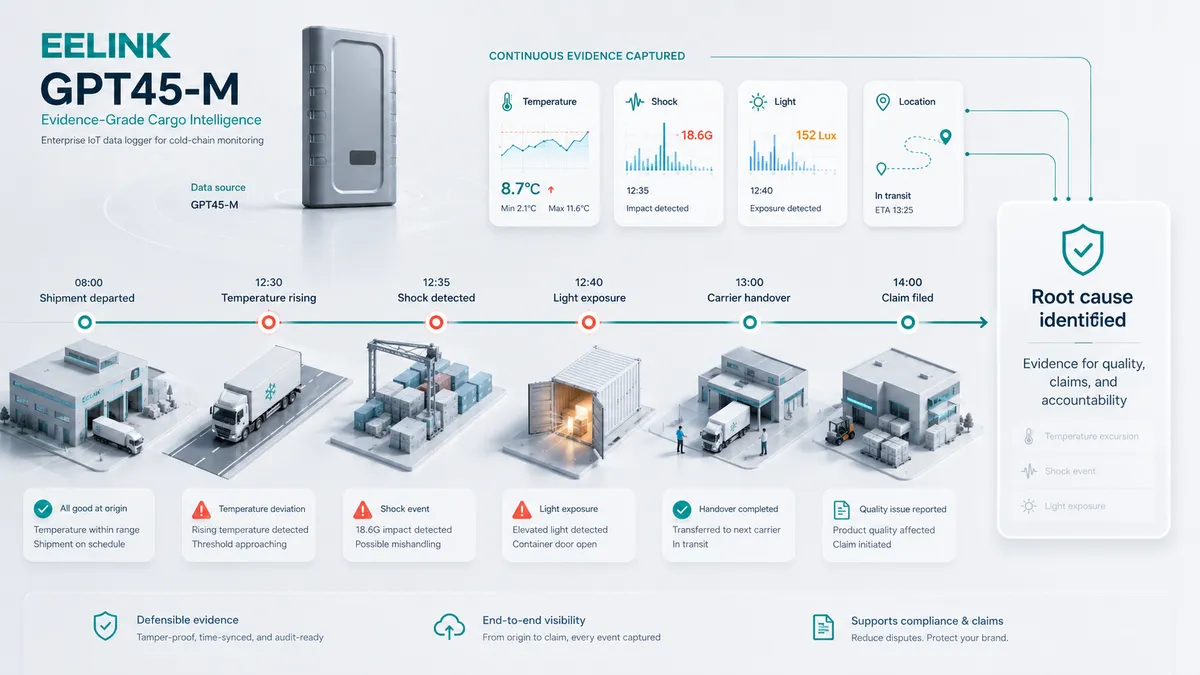
The same logic as a shareable timeline: every event captured, root cause identified, evidence ready for quality reviews and claims. Illustrative scenario, not measured data.
GPT45-M specifications
Figures marked CONFIRMED PER PROJECT are locked during project definition and released with validation evidence — we publish measured values, not datasheet estimates.
| Mechanical, environmental & power | |
|---|---|
| Dimensions | 95 × 55.5 × 22.7 mm |
| Weight | 106 g |
| Ingress protection | IP65 |
| Operating range | −20 °C to +75 °C · 20–90 % RH |
| Battery | 2,550 mAh rechargeable Li-ion, 3.8 V nominal |
| Charging | USB Type-C, 5 V |
| Charge time / cycle life | CONFIRMED PER PROJECT |
| SIM | Nano-SIM (4FF) |
| Controls & indicators | Power button · red LED (cellular) · blue LED (GNSS) |
| Memory | 4 MB flash · 400 KB SRAM |
| Offline buffering | Records logged to flash when out of coverage and forwarded automatically on reconnection |
| Cellular connectivity | |
|---|---|
| Radio access | LTE Cat M1 · LTE Cat NB2 · EGPRS (2G) |
| LPWA module | Quectel BG95-M3, 3GPP Release 14 |
| LTE-M bands | B1 / B2 / B3 / B4 / B5 / B8 / B12 / B13 / B18 / B19 / B20 / B25 / B26 / B27 / B28 / B66 / B85 |
| NB-IoT bands | B1 / B2 / B3 / B4 / B5 / B8 / B12 / B13 / B18 / B19 / B20 / B25 / B28 / B66 / B71 / B85 |
| EGPRS bands | 850 / 900 / 1800 / 1900 MHz |
| Shipping configuration | Module band capability shown; the shipping band list and roaming profile are locked per project and destination market |
| Reporting protocol | EELINK Device Protocol V2.3 over TCP / UDP · SMS and USB command channels |
| Module approvals | GCF · CE · FCC · IC · KC · JATE / TELEC · RCM plus major-operator approvals, held at module level (Quectel BG95-M3). End-device certification is confirmed per project. |
| Positioning | |
|---|---|
| GNSS constellations | GPS · GLONASS · Galileo · BeiDou · QZSS (L1, 1575 MHz) |
| Receiver architecture | Dedicated GNSS receiver, separate from the cellular modem, so positioning and reporting run concurrently |
| GNSS sensitivity | −165 dBm tracking · −145 dBm acquisition |
| Time to first fix | Hot 5 s · warm 10 s · cold 40 s, typical open sky |
| Assisted positioning | Wi-Fi access-point scan · cell-ID fallback for indoor and stacked-container conditions |
| Antennas | LTE bracket antenna · GNSS ceramic patch · on-board 2.4 GHz |
| Position accuracy | CONFIRMED PER PROJECT — published with validation evidence per configuration |
| Sensing, alarms & interfaces | |
|---|---|
| On-board sensing | Temperature · humidity · ambient light · three-axis accelerometer · barometric pressure |
| External sensor | PT1000 platinum RTD probe (optional) |
| Alarms | Temperature & humidity thresholds · light exposure · shock / drop / vibration · geofence · low battery |
| Sensor accuracy & calibration | CONFIRMED PER PROJECT |
| Wired interfaces | USB Type-C configuration, charging, firmware · UART AT commands, transparent mode |
| Short range | Bluetooth LE · 2.4 GHz Wi-Fi (scan-assisted positioning) |
| Firmware update | Cellular OTA across a deployed fleet · wired via USB |
Sensor accuracy, calibration method, battery runtime, charging performance, certifications, operator compatibility and market readiness are confirmed per project during engineering validation. Published figures follow the current engineering baseline and the markers described at the top of this section.
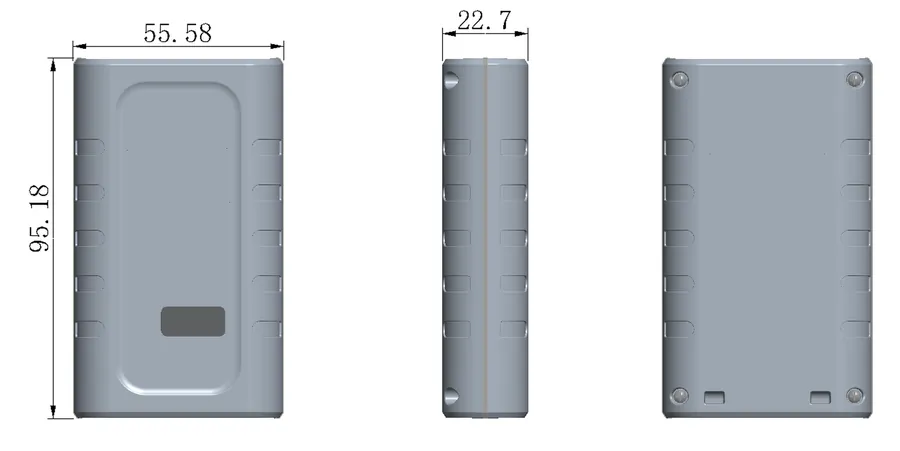
Front · side · rear elevations, dimensions in millimetres
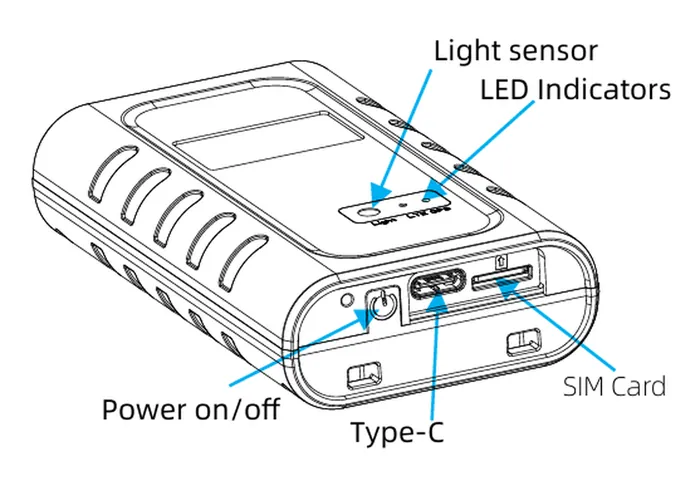
All external interfaces on one edge, behind a single sealing line
Cold chain compliance is turning into an evidence problem
EU GDP guidelines expect temperature records from calibrated, traceable instruments. The FSMA 204 era in the United States pushes food supply chains toward traceable, shareable records at each critical tracking event. Neither regulation names a device — both define the record you must be able to produce. That is the right way to buy a tracker: not "does it have sensors", but "can it produce a record your auditor, your insurer and your trading partner will accept".
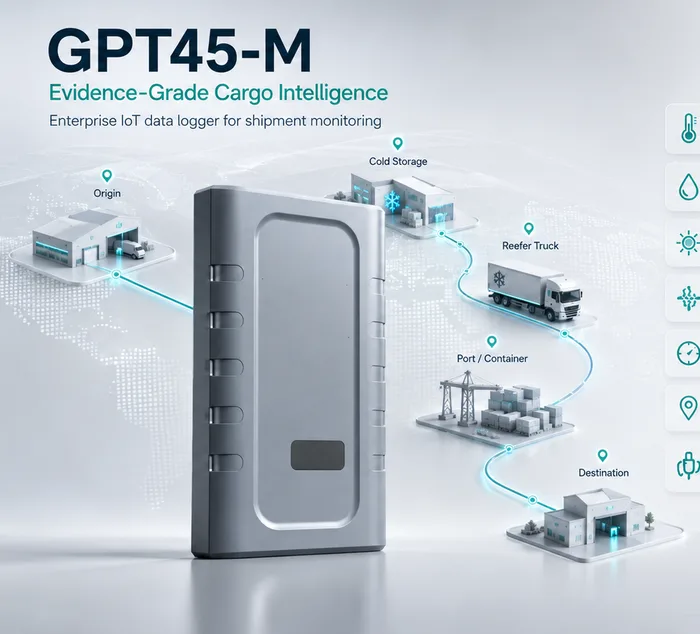
One device travels with the load, origin to destination.
Every reading carries the same timestamp, device identity, configuration and firmware version — what, when, where and how, in one structure that can be interpreted the same way twice.
Delivered over TCP / UDP into your existing server contract. No Eelink portal or cloud account in the data path.
EU GDP-style documentation
Continuous, time-stamped temperature and humidity logging designed to slot into GDP-style quality documentation. Sensor calibration and traceability evidence is scoped and confirmed per project — before the pilot, not after the audit.
FSMA 204-era traceability
FSMA 204 is technology-neutral: it defines traceability records, not hardware. GPT45-M contributes the condition-and-location layer of those records — attributable to a place, a time and a custody stage. Compliance itself remains a process your quality team owns; we supply the evidence it runs on.
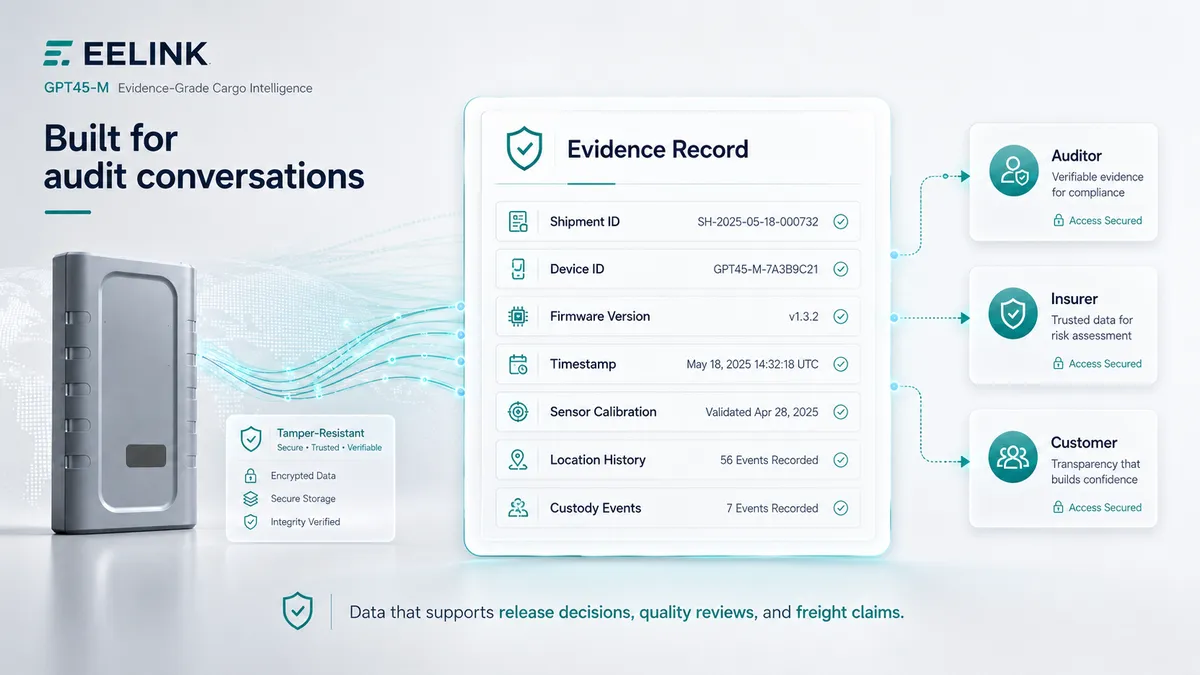
Who the record is for: your auditor, your insurer, your customer — the three conversations where "trust me" is not an answer.
Seven channels, one time base
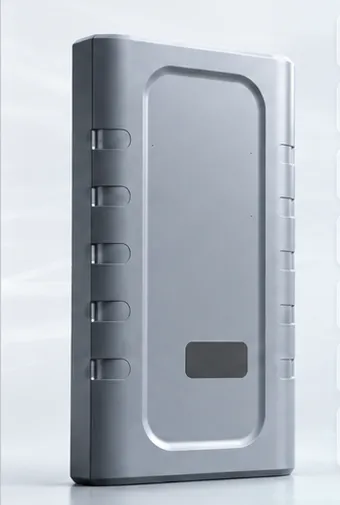
Every channel is timestamped against the same clock, so events from different sensors can be compared to each other rather than reconciled afterwards. That is the difference between a tracker that says something went wrong and one that can defend what happened:
Generic single-sensor tracker
Partial visibility. Incomplete answers.

GPT45-M
Evidence-grade visibility. Trusted answers.
Temperature
Continuous logging with configurable interval and high/low threshold alarms. The core compliance record for chilled and frozen cargo.
Humidity
Continuous relative-humidity logging with threshold alarms, for pharmaceuticals, produce, electronics and paper goods.
Ambient light
Logs, alarms and wakes the device on light exposure — the practical signal that a sealed carton or container door was opened.
Three-axis motion
Shock, drop and vibration events captured with magnitude, plus motion-triggered wake ahead of the next scheduled report.
Barometric pressure
Pressure and derived altitude across the journey — an indicator of air-freight legs and of sealed-container integrity.
External PT1000 probe
Optional platinum RTD outside the enclosure, for product-core or return-air temperature and for conditions colder than the logger's own rating.
Position
GNSS across five constellations, with Wi-Fi scan and cell-ID assist so a location is still available indoors and in stacked containers.
One record
All seven channels carry the same timestamp, device identity, configuration and firmware version — so the reading can be interpreted the same way twice.
Three deployment patterns
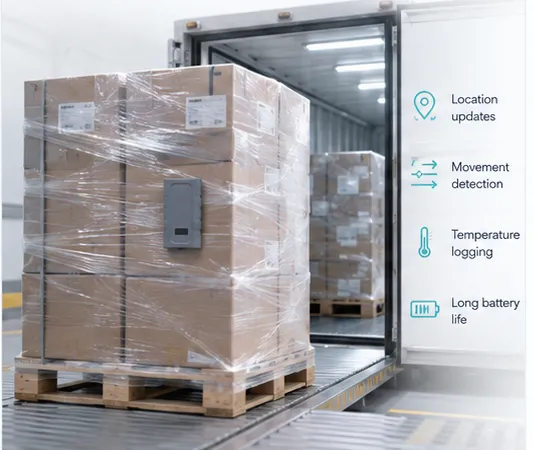
- Travels with the pallet or carton for the whole lane
- Temperature and humidity logged continuously with alarms
- Light and shock events time-stamped as handling evidence
- One record that survives carrier handover
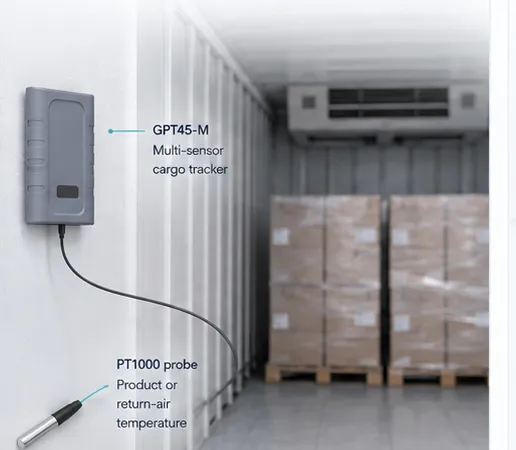
- Placed inside the container or reefer body
- PT1000 probe reaches product or return-air temperature
- Barometric channel indicates seal integrity and air legs
- Extended-standby profiles for ocean and rail
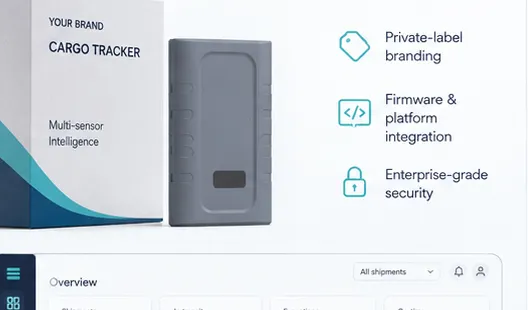
- Your brand, your platform, your customer relationship
- Custom firmware, protocol and payload structure
- Private-label enclosure marking and packaging
- Hardware without building a hardware team
Deliberately out of scope: general fleet telematics, personal and pet tracking, and fixed cold-store instrumentation. A focused device does fewer things — and produces better evidence about them.

Five constellations on a dedicated receiver — best accuracy on the road, rail and sea legs.

Access-point scanning keeps a position in warehouse aisles, docks and yards where GNSS dies.

Serving-cell backup whenever the device has network but no fix — stacked containers included.
One design, three networks
Built on the Quectel BG95-M3 tri-mode LPWA module (3GPP Release 14), so the same hardware finds whichever network a lane actually offers.
| Radio | When to use it |
|---|---|
| LTE Cat M1 | Default for cargo in motion — full LTE mobility including connected-mode handover. |
| LTE Cat NB2 | Deeply stowed or stationary assets. Idle-mode reselection only; not intended for reporting at highway speed. |
| EGPRS (2G) | Latin America, Africa and 2G-retaining European markets. Not applicable where 2G is retired. |
Shipping band list is confirmed per project and destination market.
Hybrid location engine
Cargo does not stay outdoors. Three methods layered so a position is still available in a warehouse aisle or a stacked container.
| Method | Detail |
|---|---|
| GNSS | GPS · GLONASS · Galileo · BeiDou · QZSS on a dedicated receiver, separate from the cellular modem |
| Wi-Fi scan | Access-point scanning for indoor and dense-urban positioning |
| Cell-ID | Serving-cell fallback whenever the device has network but no fix |
| Antennas | LTE bracket · GNSS ceramic patch · on-board 2.4 GHz Wi-Fi/BLE |
Runtime is an outcome of the reporting policy
Battery life on an LPWA tracker is not a fixed property of the cell. It is what the wake logic, sensing interval, fix time, network conditions and reporting interval add up to — and all five are exposed to you.
Reporting profiles
| Profile | Logging / reports |
|---|---|
| Long-haul ocean or rail | 30 min · 2 per day |
| Standard road freight | 15 min · 4 per day |
| Actively monitored lane | 10 min · 12 per day |
| High-resolution / pharma | 5 min · 24 per day |
RUNTIME PENDING — released per profile after bench validation of the production configuration. We do not publish modelled battery life as a specification.
Operating in the cold: an honest note
The device is rated −20 °C to +75 °C. Rechargeable lithium-ion loses a substantial share of usable capacity below 0 °C, and commodity cells are generally not rated for discharge below −20 °C — a property of the chemistry, not of this design. For deep-frozen and dry-ice lanes, place the logger in a thermally moderated position and measure the product itself with the external PT1000 probe. An extended low-temperature build is on the development roadmap.
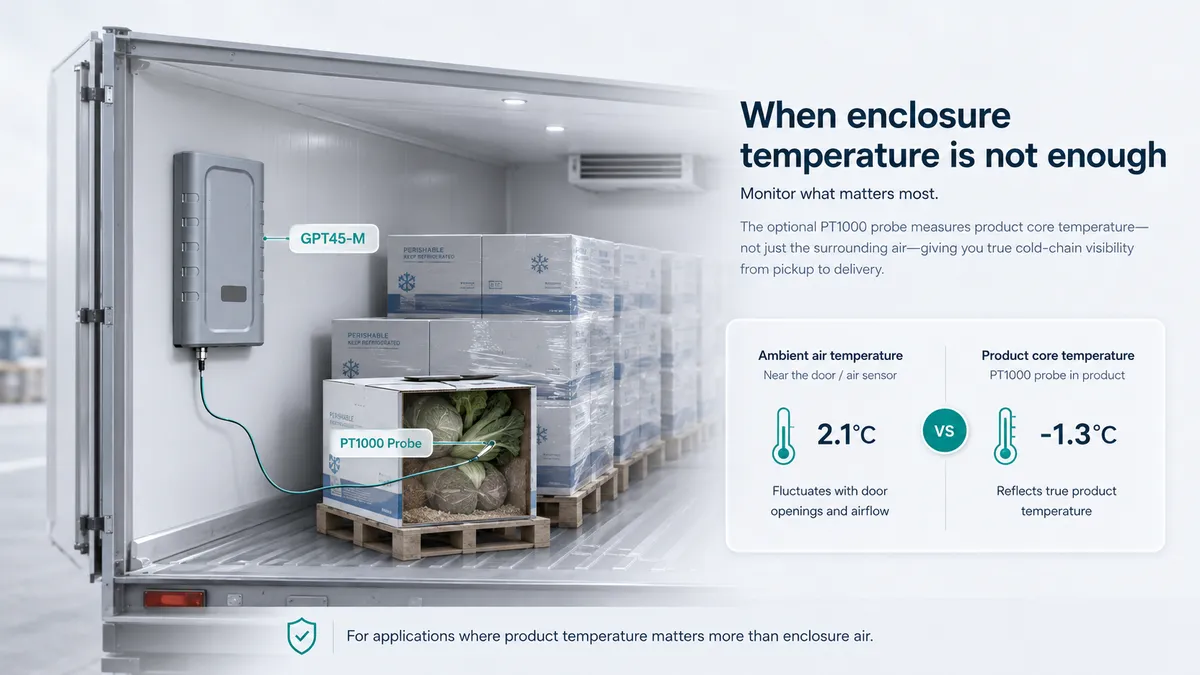
Why the probe matters: air temperature fluctuates with every door opening — the product's core is what your quality system actually rules on. Values illustrative.
Two decades of ODM engineering. Two countries of manufacturing.
Eelink has designed and built cellular tracking hardware in Shenzhen since 2004 — and multi-sensor cold-chain hardware since 2019, from BLE temperature loggers to cellular gateways, long before "shipment evidence" became a category. An ODM programme here is not a factory quotation: it is engineering, certification, supply chain and quality management delivered as one accountable service, by a team that has carried cold-chain products from first schematic to volume production many times over.
ENGINEERING OWNED IN-HOUSE
TRACKER DESIGN
CHINA & VIETNAM
EACH ENDS IN A DOCUMENT
 SHENZHENDesign & NPI centre
Hardware, firmware, RF and mechanical engineering. EVT / DVT validation, protocol stack and certification management — one accountable team from schematic to release.
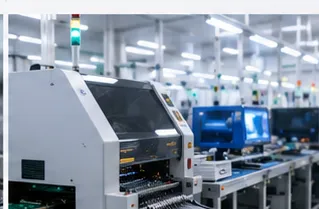 CHINAProduction base
Volume SMT and assembly next to the world's densest component ecosystem, minutes from the NPI team when a build needs an engineer at the line.
 VIETNAMProduction base
A second qualified production origin running the same Eelink test specifications — capacity headroom and supply continuity for global programmes, with origin flexibility where customers require it.
CE · FCC / ISED · UKCA · PTCRB / GCF and operator approvals planned into the programme from gate one — with the holder of every certificate named, so your compliance file is audit-ready on day one.
Clear-to-build material planning reconciled against the demand plan every week, franchised-channel component sourcing, BOM change control and end-of-life monitoring before it bites your forecast.
First-pass yield tracked per factory and per order, batch-level defect reporting with root-cause closure — the quality numbers arrive with the shipment, not after you chase them.
EELINK Device Protocol V2.3, custom payload structures, AT command set and OTA update across a deployed fleet. The stack is ours — which means it can be changed for you.
Multi-sensor in-transit hardware in production since 2019: temperature, humidity, light and shock sensing, BLE loggers, probes and cellular gateways. GPT45-M is the latest of a family, not a first attempt.
The brand, the platform, the data and the customer relationship stay with you — nothing in the data path requires an Eelink account, and nothing on the enclosure needs to say Eelink.
Chances are you have already used Eelink hardware without knowing it — inside shipment-visibility platforms serving North America and Europe, carrying our customers' own brands. We consider that anonymity part of the service: in an ODM partnership the spotlight belongs to your brand. Once a programme conversation begins, manufacturing credentials are shared openly and in detail — per site, per certificate, per line.
It disappears behind your platform
Nothing in the data path requires an Eelink-branded application, portal or cloud account. Server address, port, reporting cadence, alarm thresholds and payload structure are all configurable, and the device can transmit into an existing server contract unchanged.
| USB Type-C | Parameter configuration and wired firmware update |
| UART | AT command interface plus transparent-transmission mode |
| Cellular OTA | Remote firmware update across a deployed fleet |
| SMS | Out-of-band command channel, including wake during sleep |
Five gates, five documents
Each gate closes a different class of risk, and each leaves you holding a document rather than a reassurance.
| 01 Define | Lane, evidence required, receiving workflow → Evaluation brief |
| 02 Configure | Bands, sensors, reporting profile, payload, branding → Approved configuration |
| 03 Validate | RF, power, sensor and mechanical through EVT/DVT → Test record |
| 04 Qualify | Operator, roaming, certification path, pilot → Market readiness matrix |
| 05 Scale | Firmware and BOM change control, quality plan → Release package |
LTE-M · NB-IoT · 2G
global coverage, one hardware
TCP / UDP over the EELINK Device Protocol V2.3 — SMS and USB as command channels
Your endpoint, your port, your payload structure, your domain. No Eelink cloud between the device and you.
No forced cloud layer: data flows directly to your platform. You own the experience and the data.
Documents worth an engineer's time
Everything here is written to be forwarded — to your quality team, your platform engineers or your procurement file — without a sales call attached.
Datasheet (EN)
Full specification tables, band lists, sensing channels and interfaces — preliminary values flagged per project.
DOWNLOAD GPT45-M DATASHEETQuick start guide
SIM installation, charging, power-on, LED states and first report — from box to first fix in one page.
DOWNLOAD QUICK START GUIDEPT1000 probe application note
When to measure the product instead of the air: probe placement, deep-frozen lanes and calibration traceability.
DOWNLOAD PT1000 APP NOTEEvaluation brief template
The five inputs that start a pilot — lane, markets, reporting profile, integration target, validation evidence. Fill it in, send it back.
DOWNLOAD EVALUATION BRIEFUser manual, certification documents and per-profile runtime reports are added here as they are released through the programme gates.
GPT45-M questions
What is the Eelink GPT45-M?
GPT45-M is a cold chain cargo tracker that records shipment evidence rather than location alone: temperature, humidity, ambient light, three-axis shock, barometric pressure, optional external PT1000 probe temperature and position, all on one synchronised time base. It reports over LTE-M, NB-IoT or 2G into the customer's own platform, and is available as a white-label ODM design.
How long does the GPT45-M battery last?
Runtime depends on the reporting profile, not on the cell alone. A 30-minute logging profile with two daily uploads draws far less than a 5-minute pharma profile with 24 uploads. Eelink releases validated runtime per approved profile after bench testing rather than publishing a single modelled figure.
Can the GPT45-M be used below −20 °C?
The enclosure is rated to −20 °C. Rechargeable lithium-ion loses substantial usable capacity below 0 °C and commodity cells are not rated for discharge below −20 °C. For deep-frozen and dry-ice lanes, place the device in a thermally moderated position and measure the product with the external PT1000 probe. An extended low-temperature build is on the roadmap.
Should I choose LTE-M or NB-IoT for moving cargo?
LTE-M for anything in motion. It inherits full LTE mobility including handover while connected, so a report sent while crossing a cell boundary at speed still completes. NB-IoT supports idle-mode reselection only and suits stationary or deeply stowed assets such as containers sitting in a yard or port.
Does GPT45-M work with my existing tracking platform?
Yes. Server endpoint, port, reporting cadence, alarm thresholds and payload structure are configurable, and under an ODM programme the firmware can transmit into an existing server contract unchanged. There is no Eelink portal or cloud account in the data path.
How does GPT45-M compare with the Eelink GPT29 and GPT50?
GPT29 is a solar-assisted multi-sensor tracker for longer-duration supply-chain visibility; GPT50 is a high-capacity pallet tracker with an 8-year power budget. GPT45-M sits between them as a pocket-format, rechargeable, multi-trip device sized to travel inside the load rather than be mounted on it.
Can Eelink supply GPT45-M as a white-label product?
Yes. Eelink is an ODM: the brand, platform, customer relationship and data stay with you, while hardware design, firmware, certification management and the manufacturing programme sit with Eelink in Shenzhen. Production runs across China and Vietnam under one set of Eelink test specifications, so supply continuity never depends on a single site.
Does the GPT45-M make my cold chain FSMA 204 or EU GDP compliant?
No device makes you compliant, and you should distrust any datasheet that claims otherwise. Both frameworks are technology-neutral: they define the records you must produce, not the hardware you must buy. GPT45-M contributes the condition-and-location layer of those records — time-synchronised, attributable readings that slot into GDP-style documentation and FSMA 204-era traceability. Compliance itself remains a process your quality team owns.
Can GPT45-M work alongside BLE temperature loggers like the Eelink BTT02?
Yes, and that is the usual architecture for pharma and food lanes: GPT45-M rides at shipment level as the cellular evidence recorder, while ultra-thin BTT02 BLE loggers sit inside individual cartons for product-level temperature history. The two levels answer different audit questions — what happened to the shipment, and what happened to this specific carton.
Does the GPT45-M include on-device AI?
No, and that is deliberate. The GPT45-M records evidence-grade telemetry — seven channels on one synchronised time base — while analytics, anomaly detection, risk scoring and AI workflows run on your own platform, where they belong. This split keeps the hardware layer auditable and your data pipeline fully under your control.
What should we validate in a pilot before scaling up?
Four things: network coverage and roaming on your actual lanes, the reporting profile against your runtime target, payload mapping into your platform, and sensor readings against your own acceptance criteria. The Evaluation Brief template in the Resources section structures exactly this checklist, and Eelink engineers review the configuration with you before scale-up.
One device rarely covers a whole cold chain
GPT45-M records the shipment. Around it, the same platform family covers the carton, the pallet and the asset — each level answering a different audit question.
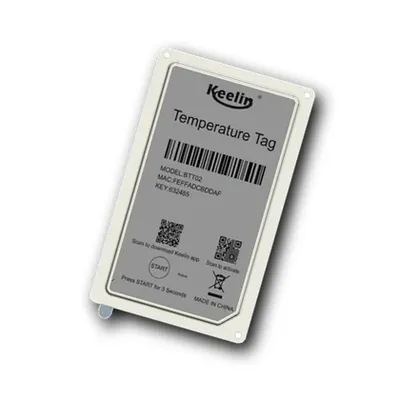 BTT02
BTT02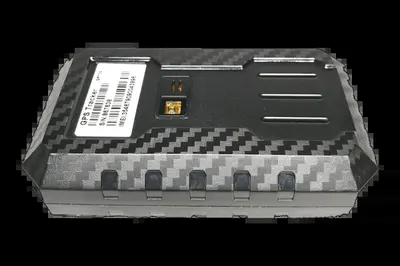 GPT29
GPT29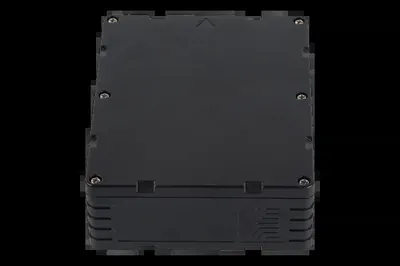 GPT50
GPT50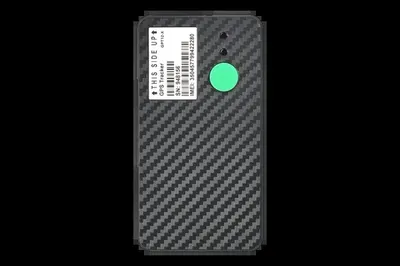 GPT12-X Ultra
Define the evaluation brief
Bring your lane, route markets, reporting profile, integration target and the validation evidence your quality team needs. We will scope the rest.
Talk to Eelink engineering