Why Long-Battery-Life Trackers Are Not Just About ‘Using a Bigger Battery‘
Multi-year tracker life is a systems problem, not a battery-shopping problem. Radio behavior, GNSS policy, motion logic, battery chemistry, antenna efficiency, and field conditions all matter.
“Just make the battery bigger.”
It sounds reasonable. On paper, battery life looks like a math problem: if a tracker runs out too soon, give it more capacity and the problem goes away.
In real deployments, that is one of the fastest ways to misunderstand long-life tracking.
A bigger battery can help. But it is usually the last lever, not the first one. Multi-year battery life is the outcome of an entire system behaving efficiently: the modem sleeps correctly, the tracker wakes only when it should, GNSS gets in and out quickly, motion sensing prevents useless uplinks, and the battery chemistry matches the real current profile of the device.
When any of those pieces are wrong, a larger cell may only hide the problem for a while. It does not solve it.
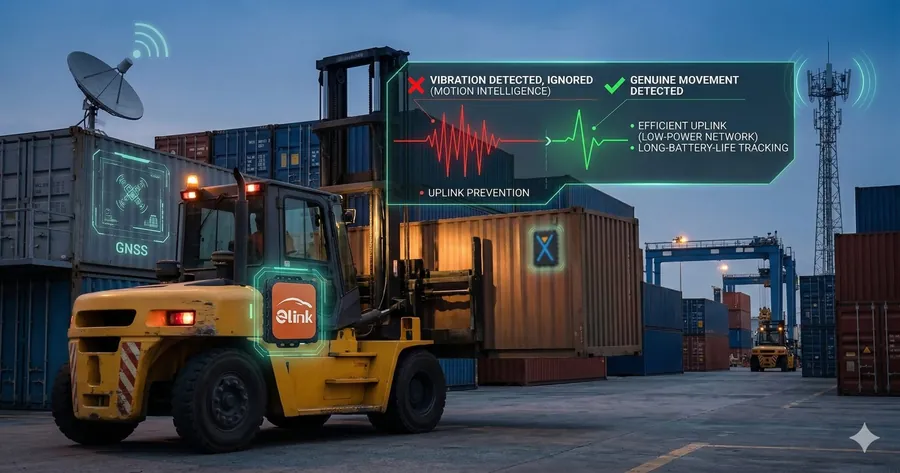
Motion intelligence helps a tracker ignore irrelevant vibration and report only meaningful movement.
A bigger battery masks inefficiency. A systems-engineering approach — optimizing RF strategy, GNSS policy, motion intelligence, battery chemistry, and firmware — eliminates it.
Battery Life Is Mostly Won During Awake Time
Buyers often focus on battery capacity because it is easy to compare. A 5,000 mAh battery sounds better than a 2,000 mAh battery.
The trouble is that tracker life is rarely limited by sleep alone. The real energy cost sits in the moments when the device is awake and doing work.
That work includes:
- Searching for GNSS satellites
- Attaching to the network
- Retrying transmissions in weak coverage
- Processing sensor events
- Sending data more often than necessary
- Waking up for movement that does not matter
This is why two trackers with similar battery capacities can produce very different field results. The better product is usually the one with the better state machine, not the bigger battery.
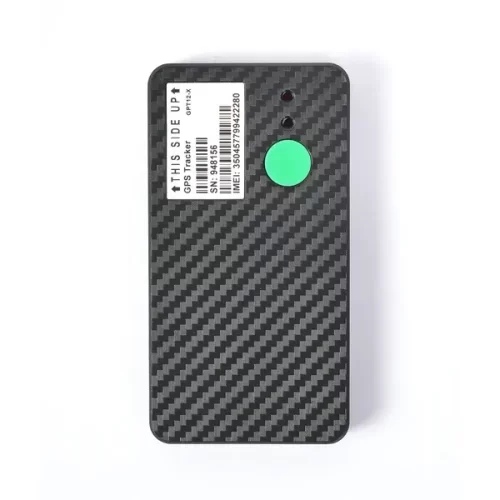
A compact tracker with disciplined wake logic — like the GPT12-X Ultra — can outperform a physically larger unit that burns energy on every unnecessary session.
The Modem Can Waste More Energy Than the Battery Can Save
Cellular behavior is one of the biggest reasons “bigger battery” thinking fails.
A modem does not consume energy only when it sends a packet. It also consumes energy when it searches, attaches, retries, camps poorly, or wakes more often than the use case justifies. Weak signal conditions make this worse. So do deep-indoor placements, metal mounting surfaces, and global roaming scenarios that create longer or less predictable network sessions.
In other words, the same tracker can look efficient in the lab and expensive in the field if the RF environment is bad.
That is why low-power tracking starts with radio strategy:
- Use the right connectivity tier for the job — LTE-M for mobile assets, NB-IoT for static or deep-indoor deployments
- Minimize avoidable sessions
- Keep payloads compact
- Design for real mounting environments, not free-space fantasies
- Optimize antenna performance and link margin before adding battery volume
If the modem behavior is not disciplined, a larger battery is just carrying bad architecture for longer. Products like the GPT48-X address this by matching RF design to the enclosure and mounting constraints of their target asset class.
GNSS Can Quietly Dominate the Power Budget
Many buyers think of GNSS as a binary feature: either the tracker has location or it does not.
In reality, GNSS has a policy cost.
The power budget changes dramatically depending on:
- Whether the tracker is doing cold starts or warm starts
- How often a fix is requested
- How good the sky view is
- How quickly the firmware gives up when conditions are poor
- Whether the product falls back intelligently when a full fix is not worth the energy
This matters because location acquisition can be one of the most expensive actions a tracker performs. A device that asks for location too often, or keeps hunting too long in poor conditions, can erase the apparent advantage of a larger battery very quickly.
Good long-life products do not simply “have GNSS.” They manage GNSS. They decide when a full fix is worth paying for, when a motion event justifies it, and when the operational value of another location point is too low for the energy cost.
Motion Intelligence Is One of the Most Underrated Battery Features
Many trackers fail on battery life not because they lack capacity, but because they wake too often.
That is usually a motion-logic problem.
If a device wakes for every vibration, small shock, forklift bump, or meaningless shift in orientation, the modem and GNSS end up doing work that no customer actually values. The battery gets blamed, but the real culprit is poor event filtering.
A well-chosen motion sensor changes that. It lets the product remain asleep most of the time, detect meaningful movement at very low power, and trigger more expensive actions only when the asset state has genuinely changed.
This is how serious low-power trackers are built: not as “always-active” devices, but as event-driven systems. The GPT29 and GPT12-X Ultra both use this approach — their accelerometer-driven wake logic ensures the modem and GNSS only engage when the asset state has meaningfully changed.
In practical terms, the motion sensor protects the battery by reducing the number of cellular and GNSS sessions that never should have happened in the first place.
Battery Chemistry Matters as Much as Battery Size
Capacity alone is not enough.
The battery also has to match the load profile of the tracker.
Long-life asset trackers often use primary lithium chemistries (such as Li-SOCl₂) because they are well suited to low average current draw and long shelf life. But chemistry still matters. Pulse behavior matters. Temperature matters. Self-discharge matters. Shipping rules matter. The physical size and weight of the cell matter too, because they affect enclosure design, attachment method, and field handling.
This is one reason engineers do not blindly maximize battery size. A larger battery changes:
- Product thickness and weight
- Mounting options
- Enclosure cost
- Logistics and shipping behavior (lithium shipping regulations)
- Industrial design
- Replacement economics
- Certification planning (FCC, CE, UN38.3)
If the device becomes harder to install, heavier to ship, or too large for the asset, the “battery upgrade” may create a commercial problem while trying to solve a runtime problem.
Bigger Batteries Do Not Fix Bad Reporting Logic
Another common mistake is assuming that long life is just battery capacity divided by daily usage.
But daily usage is not fixed. It is created by firmware policy.
Reporting cadence, retry logic, sensor thresholds, tamper rules, GNSS timeout policy, wake windows, and sleep depth all change daily energy consumption. A tracker configured to report once a day behaves like a different product from the same tracker configured to report every 15 minutes.
That is why battery claims should always be attached to a reporting profile.
If a vendor talks about long battery life without explaining:
- Reporting interval
- Expected motion profile
- Network assumptions
- Temperature conditions
- Event triggers
- GNSS usage pattern
then the number is marketing, not engineering.
What Buyers Should Really Ask Instead
If you want a long-life tracker, ask better questions than “How big is the battery?”
Ask:
- What is the reporting profile behind the battery-life claim?
- What happens in weak coverage or metal-heavy environments?
- How is GNSS duty-cycled?
- What motion logic prevents unnecessary wake-ups?
- What battery chemistry is being used, and why?
- How many truck rolls or battery replacements does the design aim to avoid?
- How does the enclosure size change as capacity increases?
Those questions reveal whether the product is truly optimized or merely oversized.
The EELINK View: Long Life Is Designed, Not Purchased
At EELINK, the practical lesson is straightforward: long-life tracking is a systems-engineering job.
The tracker has to combine the right low-power network behavior, the right GNSS strategy, the right motion-trigger model, the right battery chemistry, and the right enclosure trade-offs for the asset class. That is why a compact multi-year tracker like the GPT12-X Ultra can outperform a much larger device when the firmware, RF, and power architecture are built with discipline.
In other words, the best long-life trackers are not the ones that start with the battery compartment.
They are the ones that start with the wake budget.
The Bottom Line
A bigger battery can extend runtime, but it cannot rescue a tracker that wakes too often, searches too long, transmits inefficiently, or reacts to the wrong events.
Multi-year battery life comes from architecture:
- Modem behavior
- GNSS policy
- Motion filtering
- Battery chemistry
- Antenna efficiency
- Field-specific configuration
Get those right, and battery size becomes a scaling tool.
Get them wrong, and the battery becomes a costly bandage.
The difference is what separates a “large battery tracker” from a genuinely low-maintenance product.
Looking for a tracker where the battery life claim holds up in the field?
Explore EELINK’s multi-year asset tracking portfolio — including the GPT12-X Ultra, GPT48-X, and GPT29 — or contact our team to discuss your deployment requirements.
FAQ
Does a bigger battery improve tracker life at all?
Yes, but only after the rest of the design is under control. Added capacity helps most when wake logic, GNSS policy, network behavior, and motion filtering are already optimized.
Why does weak signal reduce battery life so much?
Because the modem may spend longer searching, attaching, retransmitting, or staying awake in poor RF conditions. Battery life depends on session efficiency, not only nominal sleep current.
Why do two trackers with similar battery sizes perform differently?
Because battery life depends on the full load profile: firmware behavior, sensor wake logic, GNSS search time, antenna efficiency, and network conditions can all outweigh capacity differences.
What is the best way to compare tracker vendors on battery life?
Compare battery-life claims against the same reporting cadence, motion profile, network conditions, and location policy. Ask for the assumptions behind the number. A credible vendor will specify the reporting interval, expected temperature range, and GNSS duty cycle behind every claim.
What connectivity technology is best for long-battery-life tracking?
LTE-M and NB-IoT are the leading low-power wide-area (LPWA) technologies for multi-year asset trackers. LTE-M suits mobile assets with moderate data needs, while NB-IoT is optimized for static or deep-indoor deployments with very low data rates. Both support Power Saving Mode (PSM) and extended Discontinuous Reception (eDRX), which are critical for minimizing modem wake time.
How does EELINK approach long battery life in its tracker designs?
EELINK treats battery life as a systems-engineering outcome. Products like the GPT12-X Ultra combine disciplined modem wake logic, intelligent GNSS duty-cycling, accelerometer-based motion filtering, and matched battery chemistry to deliver multi-year field life in a compact enclosure — rather than relying on oversized batteries.