Reefer Temperature Probe Placement: Air, Product, or Both?
This article covers temperature probe placement inside integral refrigerated containers. Refrigerated trailers use different air-delivery designs. The measurement principles transfer, but the specific placement plan does not. Eelink manufactures cold chain tracking hardware, including devices that accept an external probe. The guidance applies to monitoring hardware generally, not only to Eelink products. Every placement decision still needs validation against the specific equipment, load plan, and quality protocol.
A reefer container can hold the same setpoint across an entire voyage while the receiver later records out-of-spec product temperature. Both records can be accurate at once, because they describe different locations and different thermal responses.
Reefer temperature probe placement decides which of those locations your evidence describes. This article walks through what the container’s own record measures, why product temperature lags air temperature, how warm and cold zones form inside a loaded box, and how teams decide the number of probes.
What Does a Reefer Container’s Temperature Record Actually Measure?
Air, not cargo. Integral reefer units typically monitor delivery and return air, and many recording systems retain both channels. Neither reading is the product temperature. Guidance from the West of England P&I Club states the point plainly: container recording systems do not usually record the temperature of the cargo, only air temperature.
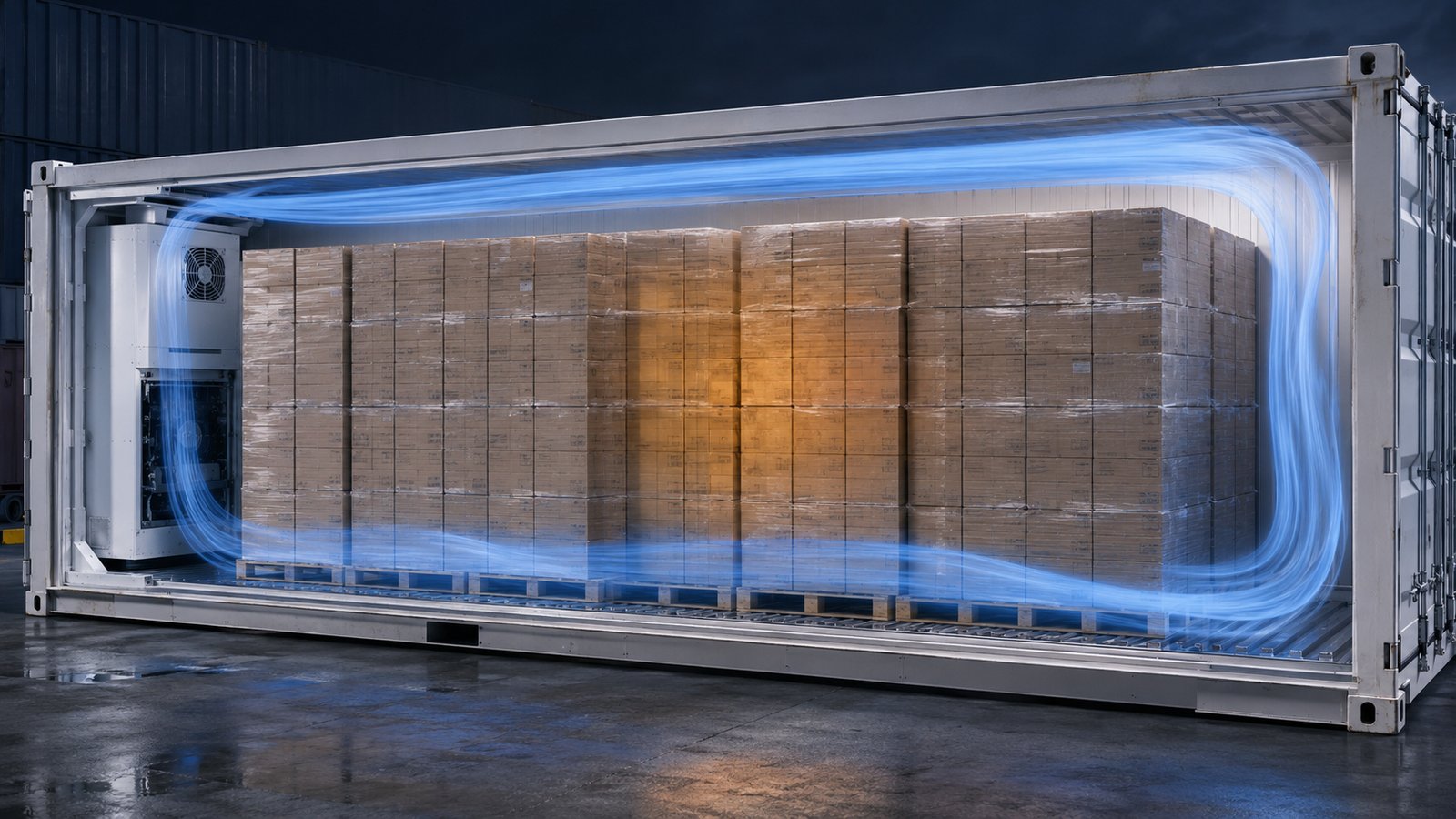
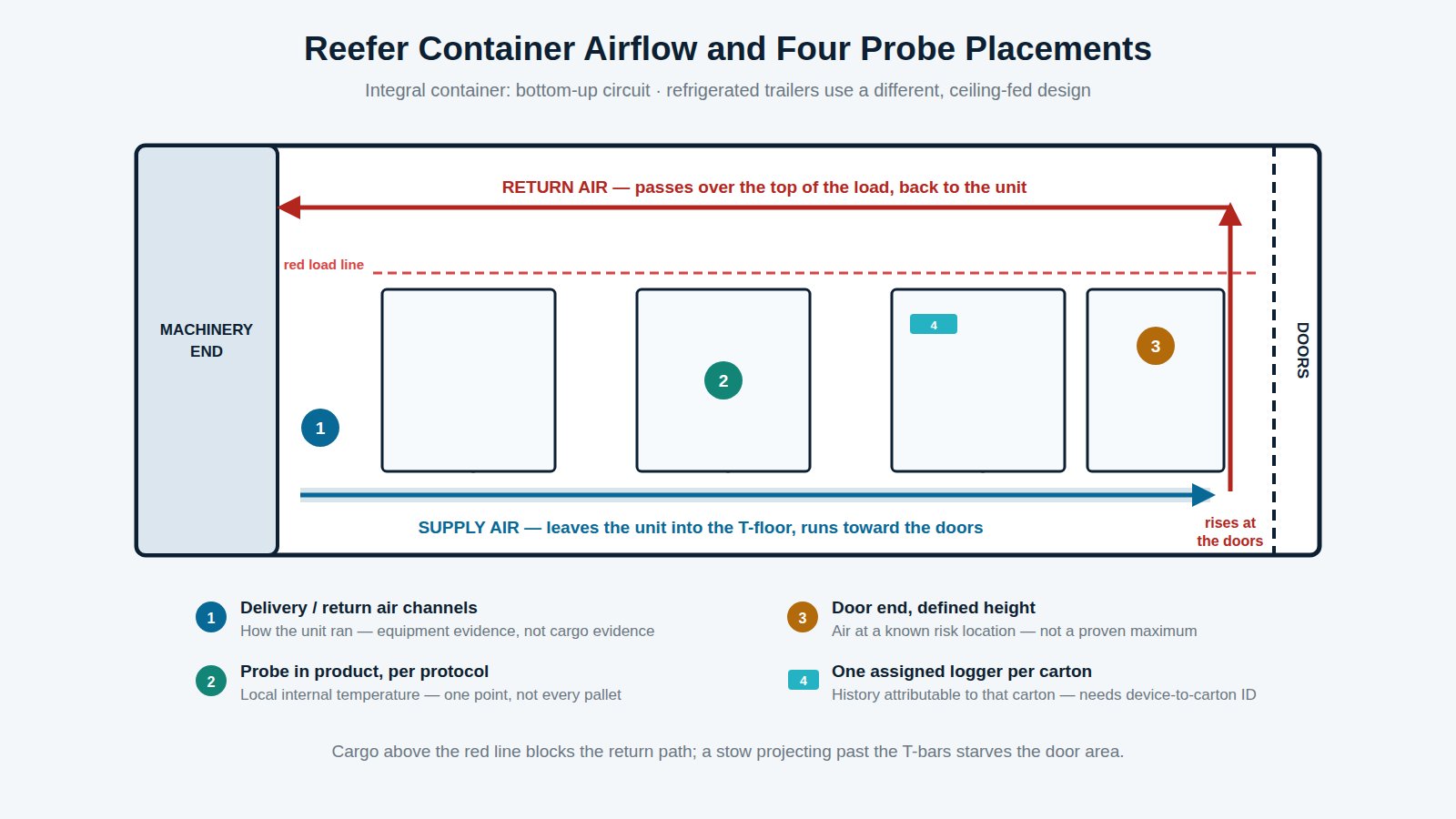
The airflow circuit explains why. In an integral reefer container, the unit blows chilled air from the bottom of the machinery end into the T-floor. That air travels along the floor toward the doors, rises at the door end, passes over the top of the cargo, and returns to the unit at the top of the machinery end.
The reefer handling guideline published by ONE describes the same circuit: cold air enters the T rail from the bottom of the unit, travels toward the door side, then rises and returns across the top of the load. Refrigerated trailers commonly work the other way round, delivering air through a ceiling chute. That difference is one reason placement advice does not transfer between the two.
Delivery air and return air answer different questions
Delivery air describes what the unit produced. Return air describes what came back after passing the load. The difference between them reflects the net heat exchanged inside the cargo space, which includes cargo heat, enclosure heat ingress, infiltration, and fan heat.
Which channel the controller acts on varies by equipment and operating mode. Some configurations control on delivery air for chilled cargo and on return air for frozen cargo. The West of England P&I Club loss prevention bulletin recommends recording both temperatures at every check, and it notes that the return air sensor sits close to the refrigeration machinery.
A setpoint, meanwhile, is a command rather than evidence. Measured delivery and return traces say something useful about how the unit ran. They still cannot establish product-core temperature or rule out a localized airflow problem.
Why Does Product Temperature Lag Air Temperature?
Thermal mass. Air sensors generally respond faster than product-core sensors, so a brief air excursion may barely move the core of a dense pallet. The reverse also happens: a slowly warming pocket of blocked cargo can develop while a sensor in a free air channel reads normal.
Response time depends on the product, the packaging, the airflow around the sensor, and the probe’s own construction. Surface product responds far faster than a pallet core. Two failure patterns follow from that spread, and they pull in opposite directions.
The door-opening artifact
Someone opens the doors at a cross-dock. Ambient air enters. An air sensor near the doors climbs quickly, then recovers once the doors close and the unit catches up.
A high-thermal-mass product core moves very little during a short event like that. The air record, however, now shows an excursion. Teams then spend hours explaining an alarm that may never have threatened the cargo.
The blocked-flow blind spot
The reverse case does more damage. Suppose airflow through part of the stow is obstructed. Air in the free channels still circulates near setpoint, so a sensor sitting in one of those channels reads normal.
The obstructed cartons meanwhile warm gradually. A sensor placed inside or next to that zone would likely catch it, but one in an unaffected channel may not. The first clear evidence then arrives when the receiver measures product or core temperature at delivery.
Where Do Warm and Cold Zones Form Inside a Loaded Container?
Zones follow airflow and stow rather than a fixed map. The door end draws attention because it sits at the end of the supply run and takes heat ingress whenever the doors open. Actual warm and cold spots depend on equipment, stow pattern, cargo, and season, so lane mapping validates them.
That qualification matters. Treating the door end as automatically the hottest point produces confident conclusions from thin evidence. Treating it as a sensible risk location, then validating, produces defensible ones.
Why the door area gets special attention
Container loading rules single out that end. West of England guidance instructs that the stow should cover the entire floor area but must not project beyond the floor T-bars, specifically to allow cooling of the door area and to keep return airflow effective.
The door end also faces the outside world during every handling event. Those two factors together explain why monitoring plans so often put a sensor there.
Stow decides whether any placement works
A probe cannot rescue a badly stowed container. The published handling rules differ by cargo type, and applying the wrong one undermines the whole circuit:
Many chilled, respiring cargoes need air to move through the load. That calls for ventilated packaging and a stow that lets air permeate upward, while still covering the floor and avoiding gaps that short-circuit the supply air.
Frozen cargo wants a solid block stow. Here the aim is circulating cold air around the edges of the cargo rather than through it.
Never load above the red line. Cargo above that mark blocks the return path across the top of the load.
Cover the floor, respect the T-bars. The stow should cover the whole floor area without projecting past the T-bars at the door end.
Where Should a Monitoring Probe Actually Go?
Placement follows the question being asked. A door-end sensor at a defined height documents conditions at a known risk location. A probe in product documents local internal temperature. Delivery and return air describe the equipment. Disputes usually turn on the first two.
The table below maps each reefer temperature probe placement to what it helps assess, and — just as important — to the limit that placement accepts.
| Objective | Placement | What it helps assess | Limit |
|---|---|---|---|
| Risk-location air | Door end of the load at a defined, protected height | Air temperature at a known risk location | Not proof of the maximum across the whole load |
| Product condition | Probe installed into product or an approved simulant, per protocol | Local internal temperature at the sensing element | One point does not represent every pallet |
| Machine performance | Delivery air and return air channels | How the unit ran during the voyage | Equipment evidence, not cargo evidence |
| Unit-level history | One assigned logger per carton or product unit | Temperature history attributable to that carton | Requires validated device-to-carton identification |
Two details often decide whether the product measurement is usable at all. Probes intended for product contact must satisfy hygiene and food-contact requirements, and sealed pharmaceutical goods frequently prohibit penetration entirely. A mid-pallet probe also has to go in during loading, since nobody can reach that position afterwards.
Reefer temperature probe placement has to survive handling
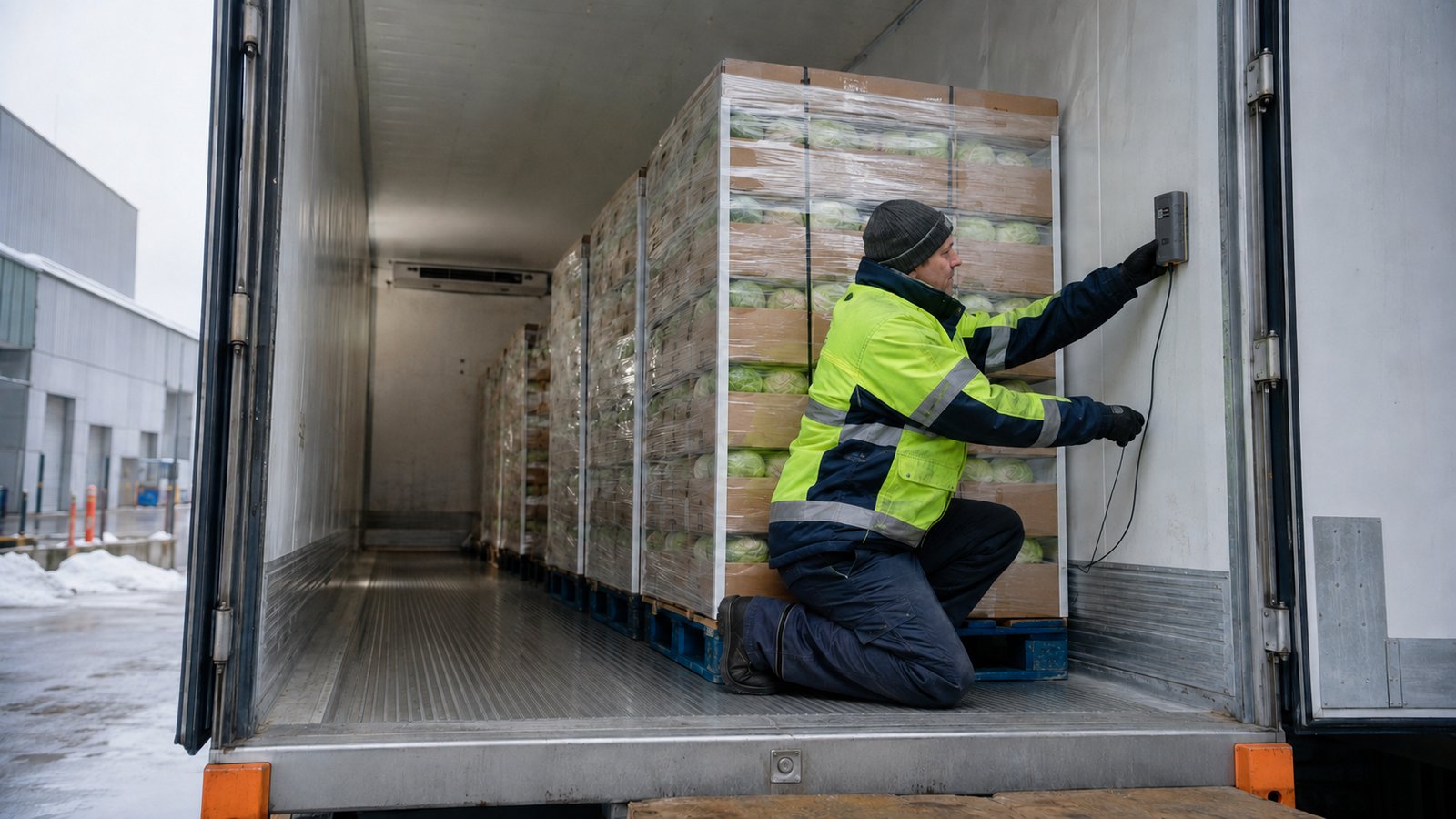
Placement also has to survive the yard. AIG’s reefer transport risk recommendations warn to position recorders where forklift prongs cannot damage them. A damaged probe can cause loss or corruption of that measurement channel, which is exactly the channel a dispute will ask about.
A single-point temperature record does not by itself prove the whole cargo stayed in range. It documents what happened at one point in space. Placement is the decision that turns a number into usable evidence.
How Many Probes Does a Lane Need?
One probe answers one question, so the count follows the risk assessment. Regulated treatment protocols illustrate the principle: APHIS phytosanitary cold treatment requires at least three temperature sensors in the treatment enclosure, and vessel holds require at least four per hold.
That requirement is treatment-specific and should not be read as a default for ordinary commercial lanes. It does illustrate something useful, though. When a protocol has to withstand scrutiny, it specifies multiple defined measurement locations rather than one.
The cold treatment rule published in the Federal Register also requires that recording devices resist manipulation and identify the date, time, sensor number, and temperature during calibration and treatment. Sensor number matters here. Multi-probe records only work when each reading identifies where it came from.
Deciding the number for a commercial lane
Some monitoring plans pair one air sensor with one product or simulant sensor. Others run more. The right count comes from risk assessment, temperature mapping, customer requirements, and any regulation that applies to the cargo — not from a rule of thumb.
Lanes with repeated claim history usually justify the extra sensors. Each additional validated and identifiable location can reduce spatial uncertainty once a dispute starts.
How Does Eelink Handle Probe Placement in Hardware Design?
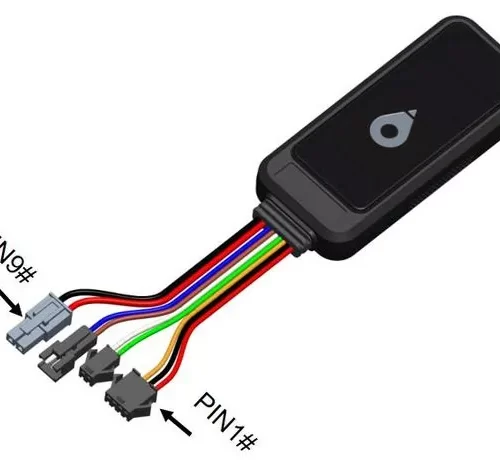
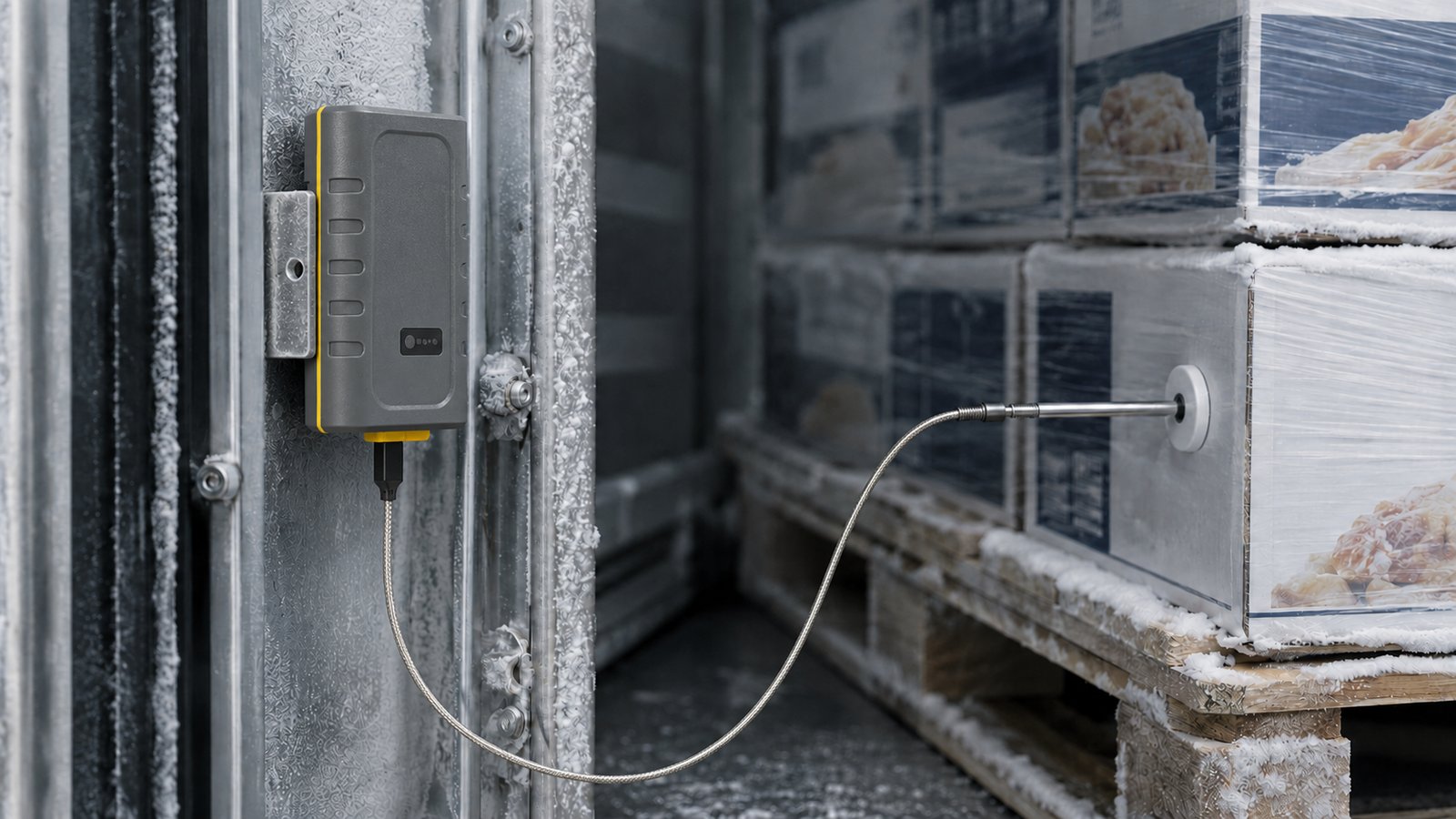
Eelink separates the electronics from the measurement point where the installation allows it. The device body mounts in a less severe thermal position while an optional external probe reaches the product. On frozen lanes that separation can matter, because in some designs low temperature constrains battery output while the RTD element stays within its rated range.
Below zero, available capacity and pulse-current capability decline for many common battery chemistries. A device buried inside frozen product therefore faces two demands at once: survive the cold and still transmit. Mounting the body in a milder position can improve that budget. It does not remove the need to validate the complete device at the expected temperature, reporting interval, and mission duration.
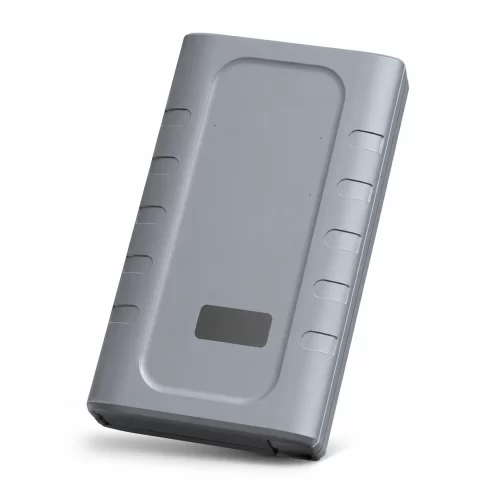
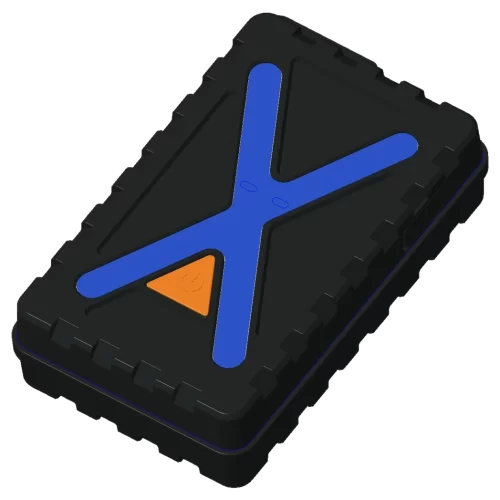
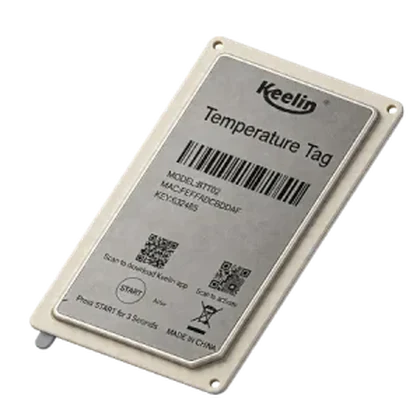
The GPT45-M cold chain cargo tracker supports that pattern. Its published channels — temperature, humidity, ambient light, three-axis accelerometer, barometric pressure, and position — are recorded on one timebase according to the product page, and an optional external PT1000 probe extends measurement to the product. For carton-level history, the BTT02 BLE temperature logger rides inside packaging in a 2.4 mm housing.
A note on specifications belongs here. PT1000 identifies the sensing element — a platinum resistance sensor with a nominal 1,000 ohms at 0 °C. On its own it says nothing about system accuracy, calibration uncertainty, response time, ingress protection, or suitability for product penetration. Those get confirmed per project against the approved specification rather than assumed from a sensor type.
The manufacturing side supports that work directly. The 101,000 m² campus in Yibin, China runs five SMT lines and 28 assembly lines, with current output of approximately 300,000 devices per month.
Frequently Asked Questions
Does the container’s own temperature record prove the cargo stayed in range?
No. Container recording systems typically capture delivery and return air, which describes how the unit ran rather than the cargo. Confirm which channels the specific unit and data export actually retain. Loss prevention guidance states directly that these systems do not usually record cargo temperature. A clean air trace also cannot show whether an obstructed section of the stow warmed up.
Should a temperature probe go in the air or in the product?
It depends on what the record must support. Air placement at the door end captures a known risk location and reacts quickly to handling events. Product placement captures local internal temperature, which many quality protocols reference. Lanes that see disputes often justify both, since each covers the other’s limit.
Which way does air move inside a reefer container?
Chilled air leaves the bottom of the machinery end into the T-floor, travels along the floor toward the doors, rises at the door end, then passes over the top of the cargo and returns to the unit. Loading above the red line blocks that return path. Refrigerated trailers commonly use a different, ceiling-fed circuit.
How deep should a probe go into the product?
Deep enough to reach the intended measurement point rather than the surface, since surface temperature tracks the air. Depth, product type, packaging, hygiene requirements, and probe construction all affect the result. The quality protocol should define the insertion method, and teams should validate it before a lane goes live.
Can one device cover both air and product temperature?
Yes, if the device independently records an onboard temperature channel and an external-probe channel. The body then measures conditions where it is mounted while the probe measures at its sensing element. That arrangement can also keep the electronics out of the most severe thermal position, which helps on frozen lanes where battery output declines.
Key Takeaways
Container records describe air, not cargo. Delivery and return air document how the unit ran during the voyage.
Airflow runs bottom-up in an integral reefer container: T-floor toward the doors, up at the door end, back across the top of the load. Trailers differ.
Thermal mass separates air readings from product readings. Short air events barely move a dense core, and a blocked zone can warm without showing in a free air channel.
The door end is a sensible risk location rather than a guaranteed hot spot. Stow rules and lane mapping decide whether any placement produces useful data.
Sensor count follows risk assessment and mapping. Regulated cold treatment protocols specify multiple defined locations, which shows what a defensible record looks like.