‘An Excursion Is Any Reading Outside Range’ – Auditing the Definition Before Buying the Recorder
“An excursion is any reading outside the range.”
You meet that sentence in SOPs. In RFQ replies. In recorder datasheets. Nobody questions it, because it sounds like a definition.
It is not one. It is three separate decisions wearing one sentence, and they do not all get answered by the same person or the same data. Audit it before it reaches a purchase specification. The recorder you buy on the strength of it may not produce the evidence any of those three decisions needs.

The claim is answering three questions at once
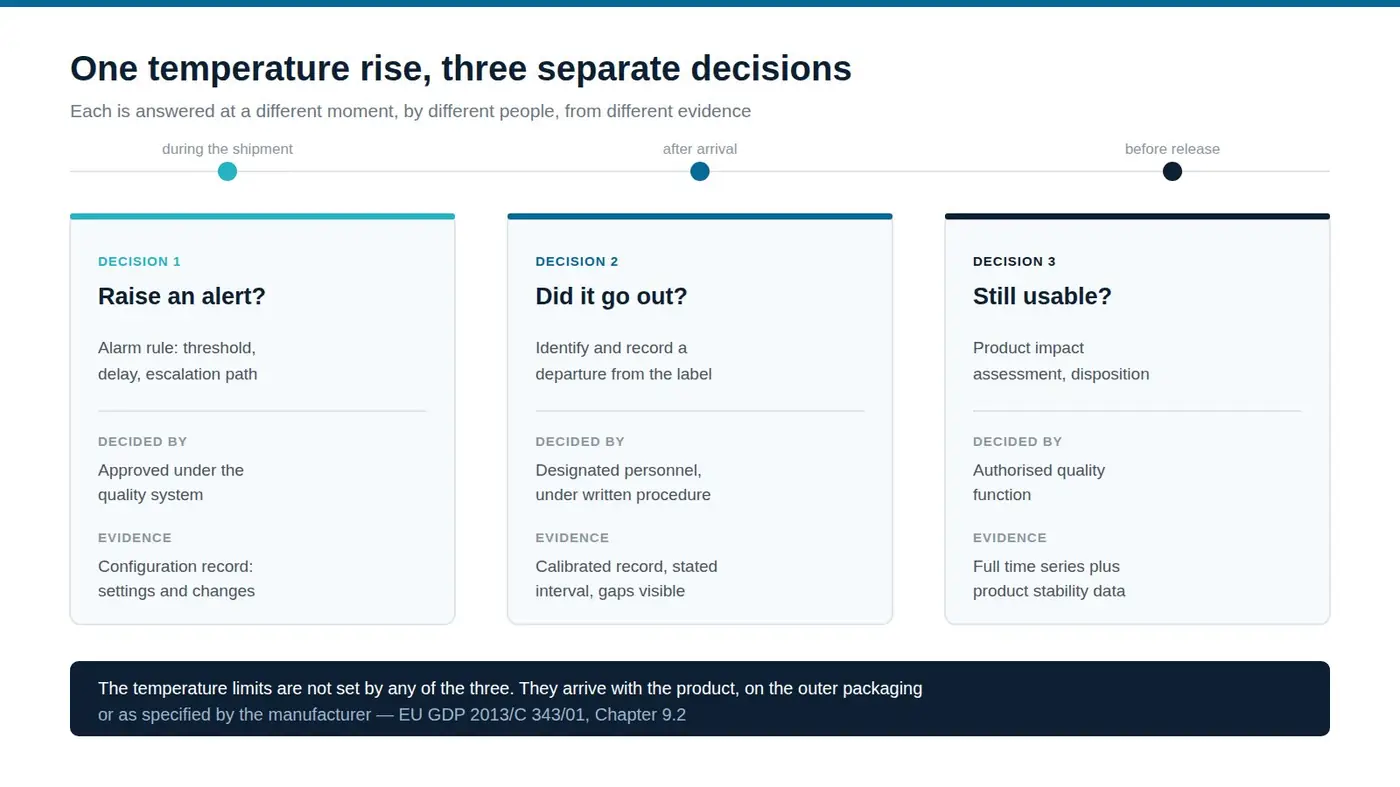
Walk a temperature rise through an operation. You will find three distinct moments where somebody has to decide something. They happen at different times. Each wants a different kind of evidence. The responsibility model below is a recommendation, not an allocation the guidelines prescribe — in a real quality system the roles can overlap, and who approves each decision is yours to write down.
| The question being asked | What is actually being decided | Who typically decides | Evidence it needs |
|---|---|---|---|
| When does the system raise an operational alert? | The alarm rule — threshold, delay before it fires, who gets escalated to | Approved under the quality system, configured by authorised personnel | A configuration record: what the thresholds were set to, and when they changed |
| Did the temperature go outside the specified conditions? | Identification and recording of a deviation | Designated personnel at the distributor or carrier, under the written procedure | A calibrated, traceable record with a known sampling interval and no unexplained gaps |
| Can the goods still be used? | Product impact assessment and disposition | An authorised quality function, with manufacturer or marketing authorisation holder input where required | The full time series — not a summary — plus the product’s own stability evidence |
Collapse those three into one sentence and you get a familiar failure. A folder of logs nobody can use. An alarm count that will not convert into a disposition decision. The data underneath was only ever built to make a buzzer sound.
The range is not yours to define
Here is the part that trips up careful teams.
The EU GDP guidelines never define the word excursion in their glossary. It is tempting to conclude that each company may therefore set its own. That conclusion does not hold. Chapter 9.2 of the Guidelines of 5 November 2013 on Good Distribution Practice of medicinal products for human use (2013/C 343/01) requires that the storage conditions for medicinal products are maintained during transportation within the defined limits described by the manufacturers or on the outer packaging. The limits arrive with the product. Nobody downstream gets to widen them.
The same subchapter requires that a deviation such as a temperature excursion be reported to the distributor and to the recipient, and that a procedure exists for investigating and handling temperature excursions. Chapter 3.3 adds that appropriate alarm systems should be in place to provide alerts when there are excursions from pre-defined storage conditions, with alarm levels appropriately set and regularly tested.
Read those two together and the boundary is clear. What you write is the procedure — how you monitor, when you alert, how you investigate, who decides. What you do not write is the temperature range.
One thing the alert configuration never decides: whether a transport deviation gets reported. Chapter 9.2 puts that duty on the operation, towards the distributor and the recipient, however the alarm was tuned.
An alarm is a configuration, not a finding
Alarm rules exist so a human learns about a problem in time to act. That purpose has nothing to do with whether a deviation occurred. Treat the two as one thing and a team ends up drowning in alerts, or missing the real ones.
A configurable delay is an engineering feature, not permission to ignore an out-of-limit reading. Open a reefer door at a transfer hub and the probe nearest the door may read high for a while, whether or not the cargo ever warmed. Alert on every one of those and people stop reading alerts. Suppress them all and the one that mattered goes unseen. This is a tuning problem, and it is solved in configuration rather than in the definition of a deviation. Whatever the delay, the device should keep recording through it.
What the hardware has to support is narrower than most specifications assume. Alert thresholds that can be approved per consignment, not fixed once for the whole fleet — with one caveat worth stating plainly, because a lane can carry products with different requirements: the configuration follows the product’s conditions, it never redefines them. A configurable delay before an alert is raised. Escalation that survives one phone being on silent. And the one people forget: a record of what the settings were at the time. Keep that configuration history for the same retention period as the data, or a reviewer cannot reconstruct which rules were in force during the shipment.
An alarm that fired flags a possible deviation. It does not settle what happened — that comes from the measurements underneath it. And an alarm that did not fire is not evidence that conditions stayed within limits.
Identifying a deviation is a data-quality question
Did the temperature actually go outside the labelled conditions? That is answered from the record, not from the alert history. So the record has to carry the weight.
Two of the properties come from the guidelines. Chapter 3.3 asks for calibration at defined intervals, set by a risk and reliability assessment, traceable to a national or international measurement standard. Chapter 9.2 adds that temperature monitoring equipment used during transport should be maintained and calibrated at regular intervals, at least once a year.
The rest are specification choices the guidelines leave open, and they decide whether the record is usable. Traceable calibration says the instrument was checked against a standard. It does not say the instrument suits the job.
So specify the measurement itself. Range, accuracy, resolution and response time for the conditions you actually ship in, and a calibration that covers the part of the range that matters — a probe calibrated at room temperature tells you little about its behaviour at −20 °C. Carry the measurement uncertainty into how you read a borderline value, because a reading sitting half a degree outside a limit is a different conversation once uncertainty is on the table.
Then specify the record. A sampling interval that is stated and justified for the job; coarse sampling can miss a short event entirely, and even when it catches one the duration stays uncertain. Gaps that stay visible as gaps, not silently interpolated away. And a stated timestamp accuracy with a synchronisation tolerance between channels, so that a temperature rise and a door opening can be ordered against each other rather than merely landing near each other.
None of those is exotic. Verify them during procurement rather than inferring them from price. A temperature that was never sampled cannot be recovered afterwards as measured evidence.
Whether the goods can be used is somebody else’s decision
Recorder output alone cannot establish that a product is still acceptable. Fitness for use after a thermal event is assessed against the product’s own stability evidence, by an authorised quality function under written procedures, with manufacturer or marketing authorisation holder input where that is required. Operations staff should be careful about appearing to make that call.
Mean kinetic temperature belongs to this third decision. ICH Q1A(R2), adopted at Step 4 in February 2003, defines it as a single derived temperature that, if maintained over a defined period, affords the same thermal challenge to a drug substance or product as would be experienced over a range of both higher and lower temperatures for an equivalent period. That is a glossary definition of an equivalent thermal challenge. It is not a disposition rule, and Q1A(R2) does not make it one. Whether MKT tells you anything useful depends on the product and how it degrades. What it never does is erase a recorded departure from the labelled conditions — averaging a short spike into a comfortable longer-period figure is a misuse of the method, not a finding.
For a procurement specification the consequence is dull and clear. Require that the original sampled time series, its timestamps and its metadata survive to the assessment and can be exported. Minimum, maximum and average may not be enough to characterise exposure, and the assessor — not the recorder — decides whether what survived supports a decision.
The corrected statement
The guidelines do not supply a definition, so this is an operational formulation rather than a regulatory one. Written this way, the three decisions stay separate:
A temperature excursion is a departure from the storage conditions specified by the manufacturer or on the outer packaging. Whether one occurred is established from the monitoring record — but the record is the evidence, not the event. Missing data or an overdue calibration does not mean nothing happened; it means you cannot show what did, and that is itself something to investigate. The alarm rule determines when people are notified. The product impact assessment, made by an authorised quality function against the product’s stability evidence, determines what the excursion means for the goods.
What you can safely say in a claim file
Three sentences that hold up, and two that do not.
You can say the shipment was monitored with calibrated equipment, and give the calibration date and traceability. You can say that every valid recorded sample, at a named monitoring location, stayed within the conditions specified on the outer packaging, or departed from them — and give the sampling interval, any missing data, and where the sensor sat. You can say the deviation was reported and investigated under your written procedure, and point to the record.
You cannot say a shipment was compliant because no alarm fired. The alarm is a notification rule, not a measurement verdict. You cannot extend an in-range statement to periods you did not measure, to the product’s own temperature, or to compliance. And you cannot say the product was unaffected until an authorised quality assessment says so.
One boundary worth admitting. None of this settles the harder argument about probe placement. A reading near the door and a reading in the pallet core can both be true and still disagree. That is a separate problem, and no definition fixes it.
Eelink manufactures tracking and sensing hardware. No recorder and no temperature record establishes GDP compliance for a device or a shipment. Compliance depends on the whole operation — quality system, qualified or validated systems where applicable, procedures and records. The manufacturer or marketing authorisation holder supplies the product-specific conditions and evidence; regulatory oversight rests with the competent authorities.