ATP 2026 Is Now in Force: What Changed for Temperature Recorders in European Perishable Transport?
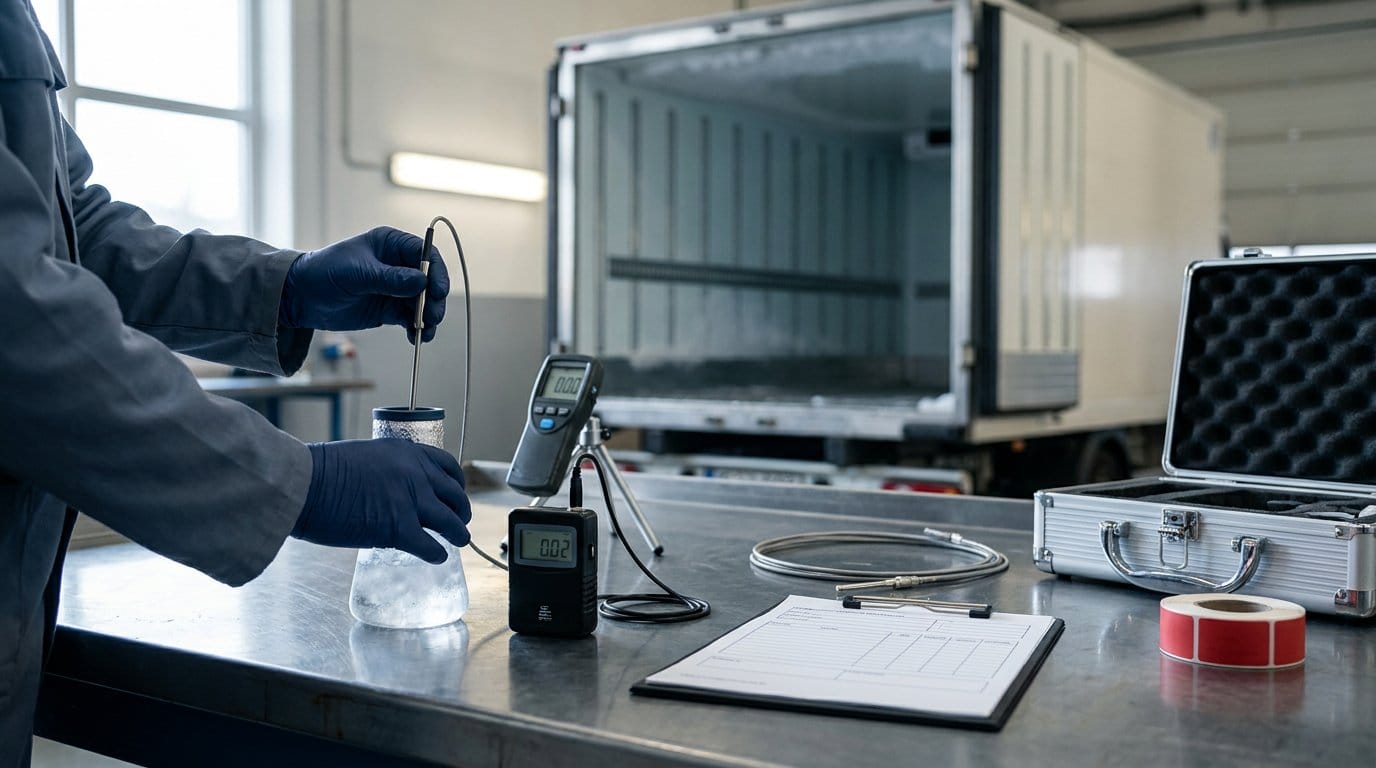
“The transport equipment shall be fitted with an instrument capable of measuring and recording air temperatures and storing the data obtained … to monitor the air temperatures to which quick-frozen foodstuffs intended for human consumption are subjected.” — ATP, Annex 2, Appendix 1, paragraph 1
That paragraph is the anchor. The amended Appendix 1 sets out four further requirements around it. A named recorder standard. A named verification standard with a minimum number of measurement points. A rule about who may inspect and what calibrates their equipment. A retention duty on the operator. It also carries transitional measures, and those are where most readings of the amendment go wrong.
This article reads the amended Appendix paragraph by paragraph — what each provision says, what evidence it implies, and whom the text names. It separates ATP requirements from buyer controls and ends with ten audit questions. The ATP Handbook 2025 (ECE/TRANS/377) reproduces the Agreement with the amendments in force from 25 August 2026. Eelink manufactures tracking and sensing hardware; no device on its own establishes ATP conformity, and this article names no device as compliant. Your national competent authority decides how the Agreement applies where you operate.
Appendix 1 is narrower than ATP
The instrument provision in Appendix 1 concerns the air temperatures to which quick-frozen foodstuffs intended for human consumption are subjected. Annex 2, paragraph 1 puts it plainly: the equipment used for the transport of quick-frozen foodstuffs “shall be fitted with the device referred to in appendix 1 to this annex”. Frozen foodstuffs generally, and the chilled foodstuffs in Annex 3, sit within ATP. That sentence does not bring them under Appendix 1.
Above that sits Article 3, which sets ATP’s own reach.
Article 3 conditions
Article 3(1) covers carriage “whether for hire or reward or for own account”. The modes are rail, road, or a combination of the two. The loading and unloading points lie in two different States, and the unloading point lies in the territory of a Contracting Party. Article 3(2) extends this to sea crossings of less than 150 km, provided the goods travel in the equipment used for the land journey without transloading, and the crossing precedes, follows or falls between qualifying land journeys. Article 3(3) lets Contracting Parties decline to apply Article 4 to foodstuffs not intended for human consumption.
A Handbook comment reads Article 3(1) as referring to commercial carriage. It excludes non-commercial movements such as rescue services, defence forces and carriage for private use. The Foreword marks comments as not legally binding.
ATP is not the EU quick-frozen regulation
Inside the EU, Commission Regulation (EC) No 37/2005 runs in parallel. Article 2(2) requires measuring instruments to “comply with EN 12830, EN 13485 and EN 13486 standards” — naming no editions. Article 2(3) puts a one-year retention duty on the food operator and requires the recording to carry a date. Article 3 allows specified derogations, mainly for retail display cabinets and small cold stores in retail outlets. A movement can fall under ATP, under the Regulation, under both, or under neither.
ATP is not EU GDP and not the FDA traceability rule
EU Good Distribution Practice governs medicinal products. The FDA Food Traceability Rule governs traceability records for listed foods entering US commerce. Content that bundles all three as “cold chain compliance” misreads each of them. ATP regulates transport equipment and carriage conditions for perishable foodstuffs, and says nothing about medicines or lot codes.
Scope is a legal determination made per movement, per commodity and per route, and no recorder feature makes it. ATP names no scope document, so a written scope note is a buyer control rather than an obligation — but a useful one. It records the commodity, the loading and unloading States, and the regime relied on. Getting it wrong in either direction is expensive: an unnecessary programme, or an uncovered lane.
Four requirements, three of them delayed
Appendix 1 requires transport equipment carrying quick-frozen foodstuffs to carry an instrument that measures, records and stores air temperatures. By 25 August 2027 at the latest, three more measures apply: the operator keeps dated recordings per transport operation for at least a year; the device complies with EN 12830:2018; the instrument is verified at two or more points to EN 13486:2023. Recorders already in service that comply with EN 12830:1999 may continue to be used.
Each element names a different actor and implies a different document. The paragraph numbering below follows the Appendix.
Paragraph 1 — the instrument itself, and it applies now
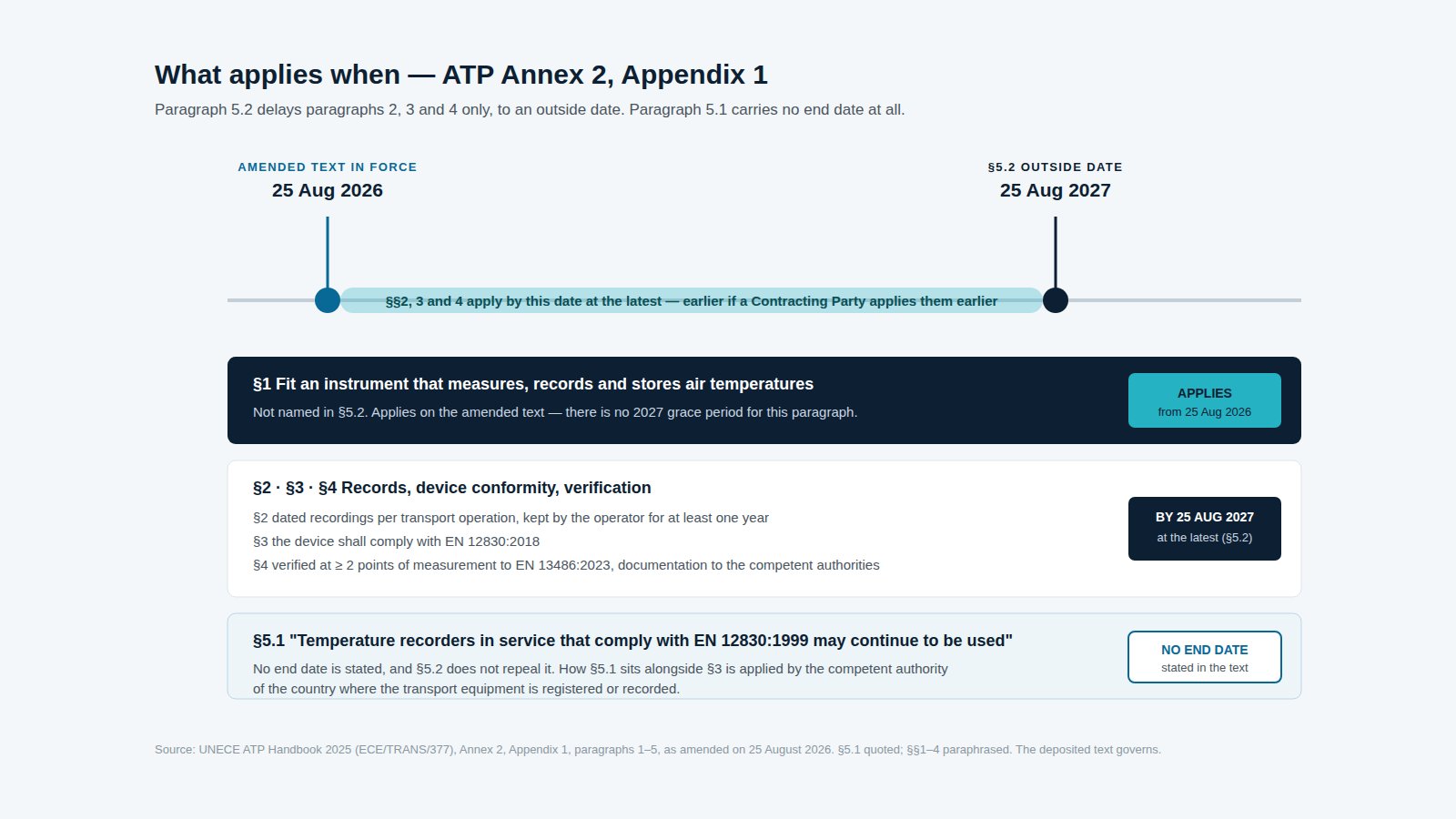
Paragraph 1 requires an instrument capable of measuring air temperatures, recording them, and storing the data obtained. Note what paragraph 5.2 delays and what it does not. It names paragraphs 2, 3 and 4. Paragraph 1 is not on that list. The duty to fit the instrument therefore stands on the amended text as it applies.
Paragraph 2 — the operator keeps the recordings for at least a year
“Temperature recordings obtained in this manner for each transport operation shall be dated and stored by the operator for at least one year or longer, according to the nature of the food.” Two details in that sentence are easy to overlook. The duty names the operator, not the equipment owner and not the recorder supplier. And it attaches per transport operation.
In practice, paragraph 2 does not prescribe a storage architecture. It does not say records must sit in separate files or separate databases. What it requires is narrower: the recordings for each transport operation are identifiable, dated, retained for at least a year and retrievable. A continuous telemetry stream satisfies that if a given operation can be pulled out of it, dated, and produced.
Paragraph 3 — the device complies with EN 12830:2018
“The device shall comply with EN 12830:2018.” The paragraph names an edition and no equivalent. It does not name a duty-holder, a conformity-assessment route or a document. EN 12830:2018 covers temperature recorders for the transport, storage and distribution of temperature-sensitive goods. It sets out tests, performance and suitability. The BSI catalogue entry states that the standard specifies technical and functional characteristics between −80 °C and +85 °C. It separately lists protection of data against manipulation, data accessibility and readability, and software verification. The same entry records the 2018 edition as superseding EN 12830:1999.
Because paragraph 3 names no document, a supplier statement naming EN 12830:2018 for the model and configuration supplied is procurement evidence, not an ATP-required certificate. It remains the practical way a buyer substantiates the claim. Ask which edition, model, sensor or probe variant and firmware the statement covers.
Paragraph 4 — two points of measurement, and who may check them
“The instrument shall be verified with at least two points of measurement in accordance with EN 13486:2023 and the documentation of the verification shall be made available to the ATP competent authorities.” A single ice-point check, or a single comparison against the reefer controller display, does not meet a requirement for two or more points.
The same paragraph constrains who performs the check. Inspections are carried out “either by accredited bodies or by bodies approved by the competent authority, of the country in which the transport equipment is registered or recorded”. The phrase “or recorded” matters — trailers, swap bodies and leased pools are often recorded rather than registered.
Two further sentences attach to the approval route specifically. To grant approval, the competent authority ensures that the inspection body’s staff “is duly trained in accordance with the procedures laid down by the competent authority”. Then: “the approved bodies shall use measuring equipment which has been calibrated in a laboratory accredited in accordance with standard EN 17025:2017”. Both sentences name approved bodies. Neither reaches the recorder manufacturer, the connectivity provider or the logistics company.
Paragraph 5 — the transitional measures, read carefully
Two short provisions govern the changeover, and they do different work.
“5.1 Temperature recorders in service that comply with EN 12830:1999 may continue to be used.” That is an open permission for instruments already in service. Paragraph 5.1 sets no end date, and paragraph 5.2 does not repeal it.
“5.2 The measures referred to in paragraphs 2, 3 and 4 shall apply no later than 12 months after 25 August 2026.” That is an outside date — 25 August 2027 — by which those three measures apply. It is a latest date rather than a switch-on date, and a Contracting Party may apply them earlier.
Read together, the two provisions leave a question the text does not resolve on its face. Paragraph 3 names EN 12830:2018 for the device, while paragraph 5.1 lets in-service EN 12830:1999 recorders continue. How that interaction works falls to the competent authority of the country where the equipment is registered or recorded. Ask that authority before budgeting a replacement programme. Record the answer with the date it was given.
Two assessments that are often confused
Paragraph 3 and paragraph 4 sit next to each other and behave differently. Paragraph 3 is about the device against a named standard edition. Paragraph 4 is about a specific instrument in service — a body the competent authority accepts checks it at two or more points, and the documentation reaches the authorities.
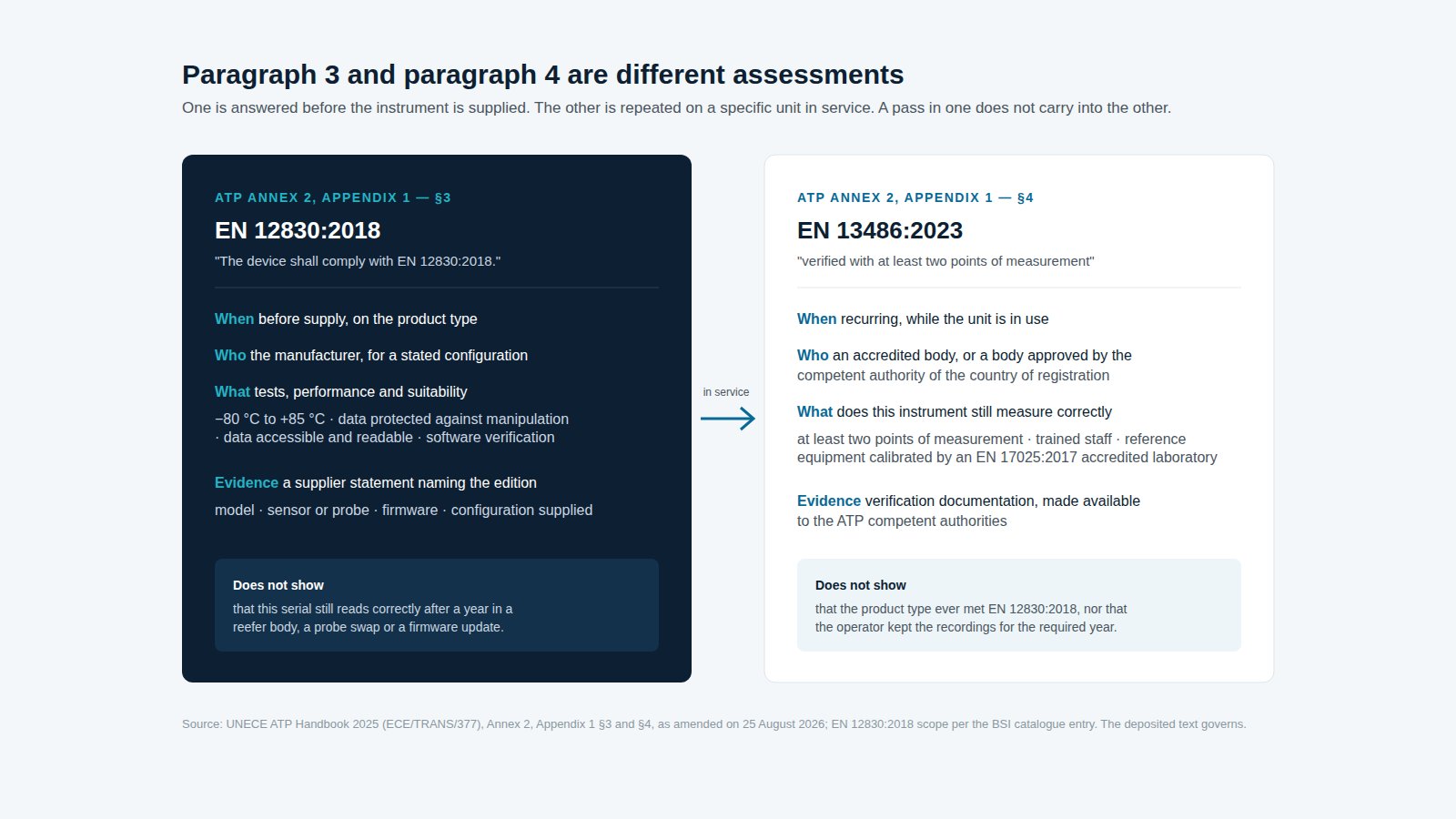
A fleet can hold a supplier statement naming EN 12830:2018 and still have no verification record for a single instrument. Another can hold clean verification records for instruments with nothing behind the edition claim. Neither file answers both paragraphs.
The requirement crosswalk
The table maps each paragraph to what it means operationally, the evidence it implies, and whom the text names. The labels are deliberately conservative. “Expressly required” means the ATP text states it. “Claim substantiation” means it backs an assertion the text does not require in that form. “Buyer control” means a practice the Agreement does not prescribe.
| Paragraph | Operational meaning | Evidence | Whom the text names |
|---|---|---|---|
| Scope (Art. 3; Annex 2 §1) | Decide per movement whether Appendix 1 reaches it: quick-frozen foodstuffs for human consumption, hire or reward or own account, road or rail, two States, unloading in a Contracting Party. | Buyer control: a written scope note recording the commodity, the loading and unloading States and the regime relied on. | Nobody. The Agreement names no scope document, and the instrument cannot decide scope. |
| §1 Instrument fitted | The transport equipment carries an instrument that measures, records and stores air temperatures. Not delayed by §5.2. | Expressly required: the instrument, fitted and working. | The requirement attaches to the transport equipment. |
| §2 Records retained | Recordings for each transport operation are dated and kept at least a year, longer where the food warrants it. No storage architecture is prescribed. | Expressly required: dated recordings per transport operation, identifiable and retrievable for the retention period. | The operator. |
| §3 Device conformity | The device complies with EN 12830:2018. A connectivity feature, a CE mark or an “ATP-compliant” badge is not the standard. | Claim substantiation: a supplier statement naming EN 12830:2018 for the model and configuration supplied, with a test report where offered. The paragraph names no document. | Nobody. The duty is stated of the device. |
| §4 Verification | Verification at two or more points of measurement to EN 13486:2023, by an accredited body or by a body approved by the competent authority of the country where the equipment is registered or recorded. | Expressly required: verification documentation, made available to the ATP competent authorities. | The inspection body; the ATP competent authorities as recipients. |
| §4 Inspection equipment | Approved bodies use measuring equipment calibrated in a laboratory accredited to EN 17025:2017. Their staff are trained to the competent authority’s procedures as a condition of approval. | Expressly required of approved bodies: calibration by an accredited laboratory. Buyer control: check the laboratory’s accredited scope covers that calibration. | Approved bodies. Not the recorder maker, not the platform. |
| §5 Transitional measures | §5.1: in-service EN 12830:1999 recorders may continue to be used, with no end date stated. §5.2: §§2, 3 and 4 apply by 25 August 2027 at the latest. | Buyer control: an asset register recording model, serial, claimed edition and in-service date, plus the competent authority’s answer on how §5.1 and §3 interact. | Nobody is named. Application rests with Contracting Parties. |
Cellular bearer, cloud dashboards, alerts, geofencing and remote sampling can all be legitimate contractual, food-safety or operational requirements. None of them is an ATP requirement and none evidences EN 12830:2018 conformity. Keep them in the specification where the operation needs them, but label each one by source: ATP, EU or national law, contract, or internal standard. EN 13485 covers indicating thermometers and belongs to the Regulation 37/2005 list, not to the ATP recorder paragraphs.
What the Handbook comments add
The ATP Handbook places comments next to the provisions they explain. Its Foreword states that comments “are not legally binding for Contracting Parties”. They still matter for interpretation, harmonization and application, because they reflect the opinion of the Working Party on the Transport of Perishable Foodstuffs. The comments on Annex 2, Appendix 1 are where the practical numbers sit. Treat them as design inputs, not as duties.
Accuracy and logging interval
The comments put the measuring accuracy for air temperature in transport equipment at ±1 °C or better. They also set recording intervals by journey duration: at least once every 5 minutes for journeys up to 24 hours, at least once every 15 minutes for journeys between 24 hours and 7 days, and at least once every 60 minutes beyond 7 days.
Those three intervals size the hardware. A 5-minute cadence over a 24-hour journey is 288 samples; a 60-minute cadence over a 30-day movement is 720. The interval drives memory depth, upload budget and battery current. A “logging interval configurable” line on a datasheet tells you nothing until you specify the journey durations you actually run and check a candidate instrument against them.
Shutdown detection and physical protection
A further comment says the instrument should let a reader determine whether it, or its measuring, recording and storage components, shut down during carriage. Another asks for adequate protection against damage from moving parts or from cargo during loading, unloading and shifting, adding that no means of protection should affect the accuracy of the air temperature measurement inside the transport equipment. Detecting its own downtime is a firmware behaviour rather than a sensor property. Name it explicitly in a specification.
Principles for the inspection body
The comments also set out six principles for inspection bodies: impartiality, competence, consistency, confidentiality, independence and accountability. A fleet choosing between an accredited body and an approved one can use those six words as the interview.
Where files come apart
Two different kinds of gap show up in a recorder file, and they carry different consequences.
Deficiencies against Appendix 1
No instrument, or no storage. Equipment carrying quick-frozen foodstuffs without an instrument that measures, records and stores, against paragraph 1.
Records that cannot be produced per operation. A stream that will not date and retrieve for a single transport operation. Or retention that rolls off before a year, against paragraph 2.
One-point checks. A single ice-point or a single comparison with the reefer controller recorded as verification, against a requirement for two or more points.
An inspection body outside paragraph 4. A verification from a body holding neither accreditation nor approval from the competent authority of the country of registration or record.
Documentation that never reaches the authority. Verification documents that exist somewhere but have never been produced for a named serial.
Buyer-control gaps
Unscoped movements. Nothing on file explaining why Appendix 1 does, or does not, reach a given lane.
Conformity by badge. A datasheet claiming “ATP” or “EN 12830” without an edition, a model and a configuration.
No asset register. No list of which instruments claim which edition and when they entered service, and no note of what the competent authority said about paragraph 5.1.
Unchecked accreditation scope. A calibration certificate from an accredited laboratory whose scope does not cover that calibration.
Connectivity closes neither list. Each gap closes with a document, a decision or a procedure that a named person holds.
Ten audit questions
The operator, carrier or fleet holding the file should be able to answer these. Questions marked “(buyer control)” ask for something the Agreement does not name but good practice supplies.
Does Appendix 1 reach this movement? Check the commodity, hire or reward or own account, road or rail, two States, and unloading in a Contracting Party.
Does every unit carrying those goods have an instrument that measures, records and stores? Paragraph 1 does not wait for 2027.
Can you produce the recordings for one transport operation, dated and attributed to it? Does the system holding them retain for at least a year?
Which EN 12830 edition does each instrument claim? Does the supplier statement name the model and configuration supplied rather than a product family? (buyer control)
When did each instrument last go through verification, and does the record show two or more points of measurement against EN 13486:2023?
Did an accredited body perform that verification, or a body approved by the competent authority of the country of registration or record?
For an approved body, which laboratory calibrated its measuring equipment? Is that laboratory accredited to EN 17025:2017, and does its scope cover the calibration performed?
If an ATP competent authority asked for the verification documentation today, who produces it and against which serial? Has anyone actually tried that retrieval?
For instruments still in service under paragraph 5.1, what has the competent authority said about how 5.1 sits alongside paragraph 3? On what date was that given? (buyer control)
Does the specification separate ATP requirements from EU or national law and from contract terms? Does it record the Handbook comment values as design inputs? (buyer control)