Seed Is Not on the Food Traceability List. Six Seed Records Are Still Required.
Disclosure: regulatory text below is quoted from 21 CFR 1.1330 as published on eCFR, and outbreak figures from FDA pages carrying a ‘content current as of 15 September 2026’ date, both checked on 23 September 2026. The investigation is open and its numbers will change. This is not legal advice on who is a covered entity, and nothing here attributes the contamination to any party, process or transport condition — FDA has published no such finding.
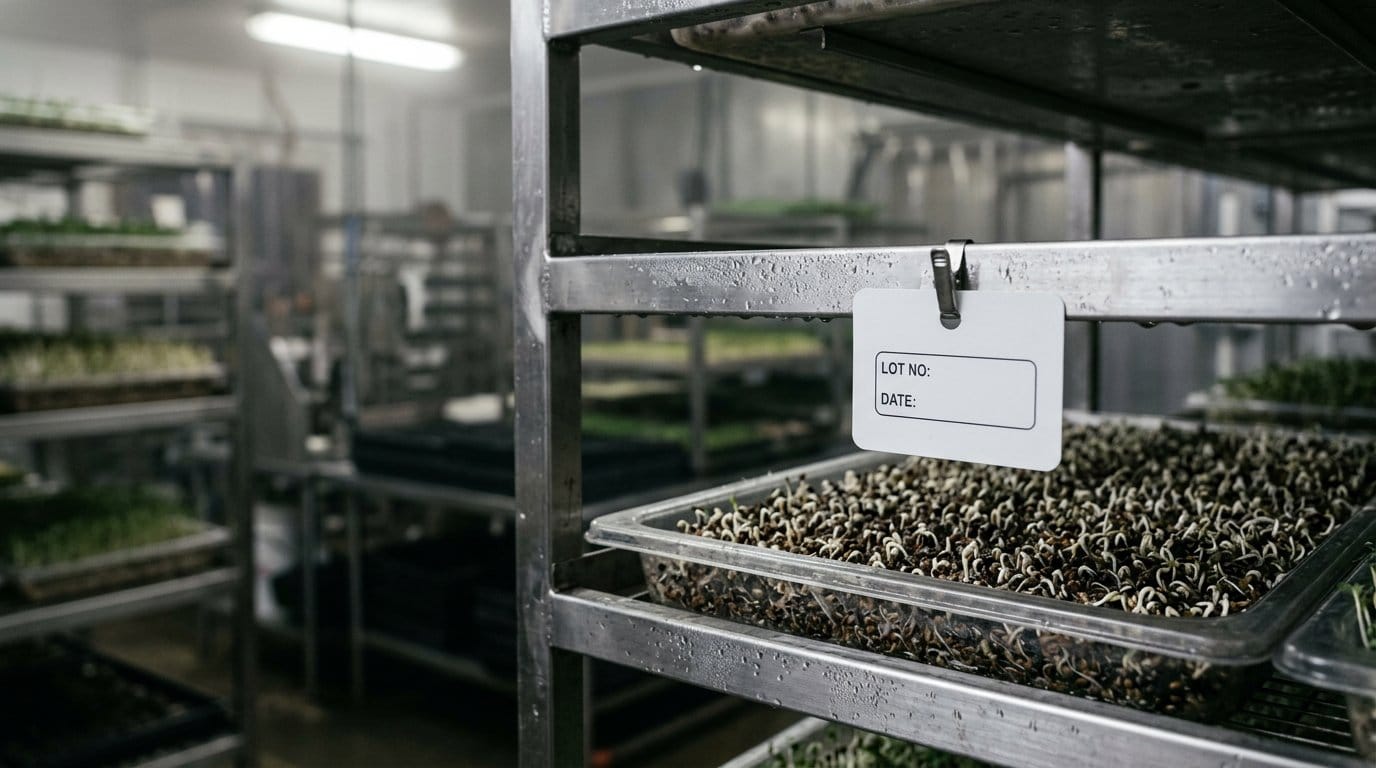
A sprouter packing its first lot of the day owes FDA six pieces of information about seed it did not grow, from companies it may never have spoken to.
One. ‘The location description for the grower of seeds for sprouting and the date of seed harvesting, if either is available.’
Two. ‘The location description for the seed conditioner or processor, the associated seed lot code, and the date of conditioning or processing.’
Three. ‘The location description for the seed packinghouse (including any repackers), the date of packing (and of repacking, if applicable), and any associated seed lot code assigned by the seed packinghouse.’
Four. ‘The location description for the seed supplier, any seed lot code assigned by the seed supplier (including the master lot and sub-lot codes), and any new seed lot code assigned by the sprouter.’
Five. ‘A description of the seeds, including the seed type or taxonomic name, growing specifications, type of packaging, and (if applicable) antimicrobial treatment.’
Six. ‘The date of receipt of the seeds by the sprouter.’
That is 21 CFR 1.1330(b), and it is the part of the Food Traceability Rule that gets missed, because everyone reads the list first.
Where those six come from
The Food Traceability List is a list of foods. It carries ‘Sprouts (fresh)’ and describes the entry as covering all varieties of fresh sprouts ‘irrespective of seed source.’ Seed for sprouting has no row of its own, and no footnote adds one.
It is easy to read that as a boundary — the rule starts at the sprouts, and everything upstream is somebody else’s problem. That reading is wrong, and 1.1330(b) is why. Section 1.1330(a) sets out the ordinary initial-packing records for a raw agricultural commodity on the list: commodity, receipt, farm, harvester, harvest date, cooling, packing. Paragraph (b) then adds, for sprouts specifically, the six elements above, ‘except for sprouts grown from soil or substrate and harvested without roots.’
Seed for sprouting is not a Food Traceability List food, yet a sprouter’s initial-packing records must carry six seed-side elements — including the seed supplier’s master lot and sub-lot codes and any new code the sprouter assigns. Rather than adding seed to the list, the rule places the seed-record duty on covered initial packers of sprouts.
That is a deliberate piece of design, and worth naming plainly because it generalises: which foods are listed and how far the required records reach are two different questions. Reading only the first one leaves you with a chain that stops exactly where the interesting part starts.
The case that shows why the paragraph exists
On 15 September 2026, FDA updated an open sprouts investigation. The page records 55 illnesses, 4 hospitalisations and no deaths across 15 states, most recent onset 8 August. Forty-six people were infected with E. coli, seven with Salmonella, two with both. Of 34 people interviewed, 26 reported eating alfalfa sprouts.
Traceback from restaurants and grocery stores ‘identified alfalfa sprouts distributed by Everything Sprouts, LLC as a source of illness in this outbreak.’ Note a source. The page then says FDA ‘has identified at least one additional sprout grower who received and used the same lot of alfalfa sprout seeds under investigation in this outbreak from a common seed supplier,’ and that the seed supplier ‘agreed to initiate a recall of the alfalfa seed lot linked to this outbreak.’
The recalled seed lot had gone to growers and wholesale distributors in 16 US states and Puerto Rico, and to four international destinations: Canada, Mexico, Tahiti and Venezuela. Everything Sprouts’ own finished sprouts had reached two states.
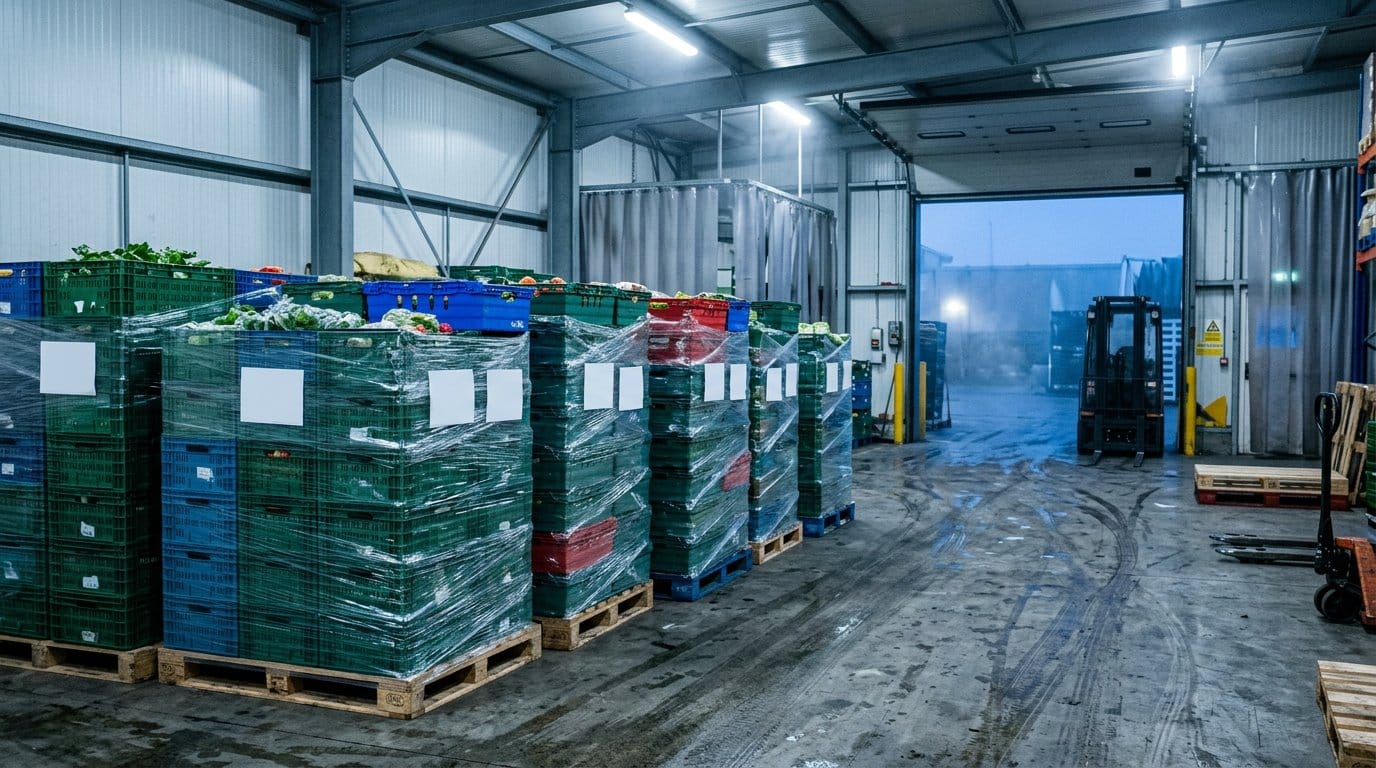
Two boundaries on what this case shows. FDA has published no cause and no point of contamination; the traceback reached a shared seed lot, which is not the same as a finding that the seed was contaminated. And temperature does not appear anywhere on the page. The published account gives no basis for attributing this outbreak to a cold chain failure, or for claiming that temperature monitoring would have changed its course — worth saying before anyone stretches the case into an argument for monitoring.
Who assigns each key, and who can see it
The six elements are not six fields in one system. They describe five roles, which may or may not be five separate companies, and not all six are assigned identifiers. They reach the sprouter by whatever means the seed trade happens to use — a certificate of analysis, a bag tag, an email attachment.
Seed growerHarvest location and dateAssigned upstream, often unavailable — the rule says ‘if either is available’
Conditioner or processorIts own seed lot code, plus the date of conditioningPassed down on documentation, not on the product
Seed packinghouse or repackerAnother seed lot code, plus packing and repacking datesMay replace the conditioner’s code entirely
Seed supplierA master lot code and a sub-lot codeThe sub-lot is what the sprouter actually receives
SprouterA new seed lot code, then the finished traceability lot codeThe finished code is the only one that travels downstream
The rule requires the sprouter to hold all of it and to connect it to the traceability lot code it assigns. FDA’s own definition of that code is narrower than most people assume: ‘Traceability lot code (TLC) means a descriptor, often alphanumeric, used to uniquely identify a traceability lot within the records of the firm that assigned the traceability lot code.’ Within the records of the firm that assigned it. Two firms can issue the same string and mean different things.
What the sprouter’s customers inherit
Here is the consequence, and it is the part worth taking to a supplier meeting. What a downstream customer receives is itself defined, and it is more than a bare code: under 1.1340 a shipper must provide seven elements with each traceability lot — the code, the product description, the quantity, the ship-from and ship-to locations, the ship date, and the one that matters here, ‘the location description for the traceability lot code source, or the traceability lot code source reference.’ That element tells you who assigned the code. It does not tell you anything behind it. The master lot, the sub-lot, the conditioner’s code: none of that is required to travel with the product.
Downstream you are handed the address of the lot code, not its history. The seed records exist and are required, and nothing obliges them to travel with the product.
That is workable in normal trading and awkward in an investigation, because the question an investigator asks a downstream party — which incoming lot became this outgoing lot — is answerable locally, while the question that actually resolves the event sits two or three parties upstream. The September case moved in that direction: from points of sale to a distributor, then to a seed lot shared with an additional grower.
So the useful supplier question is not ‘is my commodity on the list.’ It is: who in this chain holds the upstream key, what is their commitment on producing it, and how long does it take. If the answer involves someone opening a filing cabinet, that is the finding.
Where shipment and sensor records attach
Narrowly, and it is worth being narrow about it. Telemetry cannot identify a biological source; that comes from epidemiology, traceback and laboratory work. What a shipment record can do is sit alongside the lot graph and answer the physical questions — when it left, where it went, how long it sat, when it was handed over, where the data has gaps.
For that to work, the lot identity has to be namespaced. A device bound to a bare traceability lot code can end up joined to two different firms’ lots that happen to share a string, which is the collision the traceability lot code source element exists to prevent. Record the issuing firm alongside the code, treat a shipment as carrying several lots rather than one, and keep the binding history rather than the current state, because devices get reassigned between shipments.
The rest is record hygiene rather than a hardware feature list: whatever a device writes has to still be readable the same way a year later, which is a question about versioned schemas and retained context rather than about sensors. We went through what makes device data defensible separately, and the same binding problem turns up on any multi-sensor cold chain cargo tracker whose records are meant to outlive the shipment.
On the compliance date, be precise
The FDA rule page says the original compliance date was 20 January 2026, that ‘The FDA proposed to extend the compliance date for the rule by 30 months to July 20, 2028,’ that Congress ‘directed FDA not to enforce the Food Traceability Rule prior to that same date,’ and that ‘FDA intends to comply with this Congressional directive.’ A proposal plus a non-enforcement directive. A Federal Register check on 22 September 2026 found only the proposed rule of 7 August 2025 and no final rule extending the date. FDA describes its own position as not enforcing rather than withdrawing, so the recordkeeping requirements are not repealed — we covered what that date does and does not change in more detail.
Frequently Asked Questions
Are seeds for sprouting on the FDA Food Traceability List?
No. The list includes “Sprouts (fresh)” and covers them “irrespective of seed source,” but there is no entry for seeds for sprouting. That does not mean seed falls outside the rule’s records: 21 CFR 1.1330(b) requires a sprouter’s initial-packing records to include six seed-side elements, including the seed supplier’s master lot and sub-lot codes.
What seed records must a sprouter keep?
Six, under 1.1330(b): the seed grower’s location and harvest date if available; the conditioner or processor with its seed lot code and date; the seed packinghouse or repacker with its date and lot code; the seed supplier with master and sub-lot codes plus any new code the sprouter assigns; a description of the seeds including type, growing specifications, packaging and any antimicrobial treatment; and the date the sprouter received them.
Do sprouts grown in soil have the same requirement?
The paragraph applies to sprouts other than those grown from soil or substrate and harvested without roots. That exception is written into 1.1330(b) itself, and whether a given operation falls inside it is a question for the operation’s own regulatory counsel rather than one to settle from a description.
Can a distributor see the seed lot behind the product it bought?
Not from the shipment records alone. Under 1.1340 a shipper provides the traceability lot code and the traceability lot code source, which identifies who assigned that code, but not the seed-side elements behind it. Getting to the seed provenance is a request to the supplier, which is why the response commitment belongs in the supply agreement rather than in an emergency.
Did temperature or cold chain cause the 2026 sprouts outbreak?
FDA has published no cause and no point of contamination, and its outbreak page does not mention temperature or cold chain. The investigation remains open. The traceback reached a shared seed lot, which is a statement about where the evidence converged, not about how contamination occurred.
Key Takeaways
Listed food and required record are different questions. Seed for sprouting is not on the Food Traceability List, and six seed-side elements are still required at initial packing under 1.1330(b).
The upstream key sits with the regulated party. FDA put the seed provenance burden on the sprouter rather than on the seed trade, including the supplier’s master and sub-lot codes.
Shipment records carry the code and its source, not the seed behind it. Section 1.1340 gives a downstream customer seven elements including who assigned the lot code. The seed-side records are a request to the supplier, not a lookup.
A TLC is a local key. FDA defines it as unique ‘within the records of the firm that assigned’ it, so any system joining on it needs the issuing firm recorded alongside.
The published account does not support a cold chain reading. Temperature appears nowhere in it. Telemetry adds physical context to an investigation and cannot identify a biological source.
FDA has not named the additional grower, and has published no illness linked to it. What put that operation inside the investigation was not a complaint, a sample or a temperature record. It was a seed lot it had in common with somebody else — the thing element four exists to make findable.