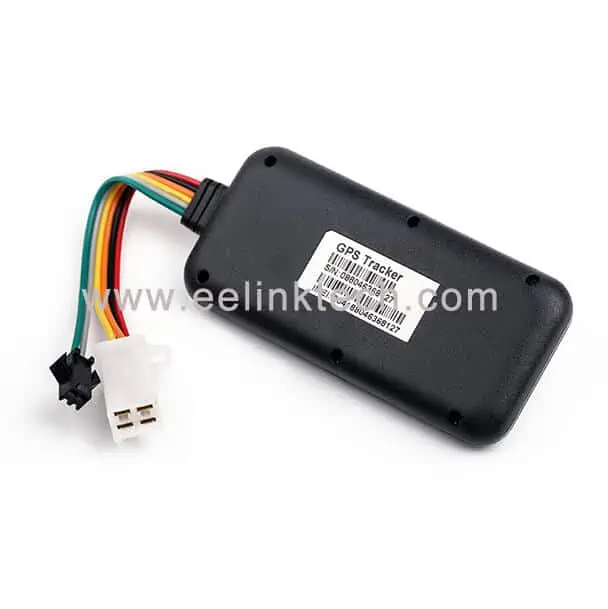
Global Coverage Has to Survive the Factory
Nudge a tracker’s antenna feed away from the board edge. Fit an enclosure whose wall is a little thicker. Route the battery cable down the other side. The module part number on the bill of materials does not change. What the antenna actually radiates does.
That gap is where a lot of “global coverage” lives. A platform brand sourcing its own cold-chain hardware gets a module datasheet, a band list and a world map. None of those three is the measurement an operator’s acceptance process turns on.
None of them survives a transfer to a production line on its own.
The carrier measures the tracker you ship, not the module you bought
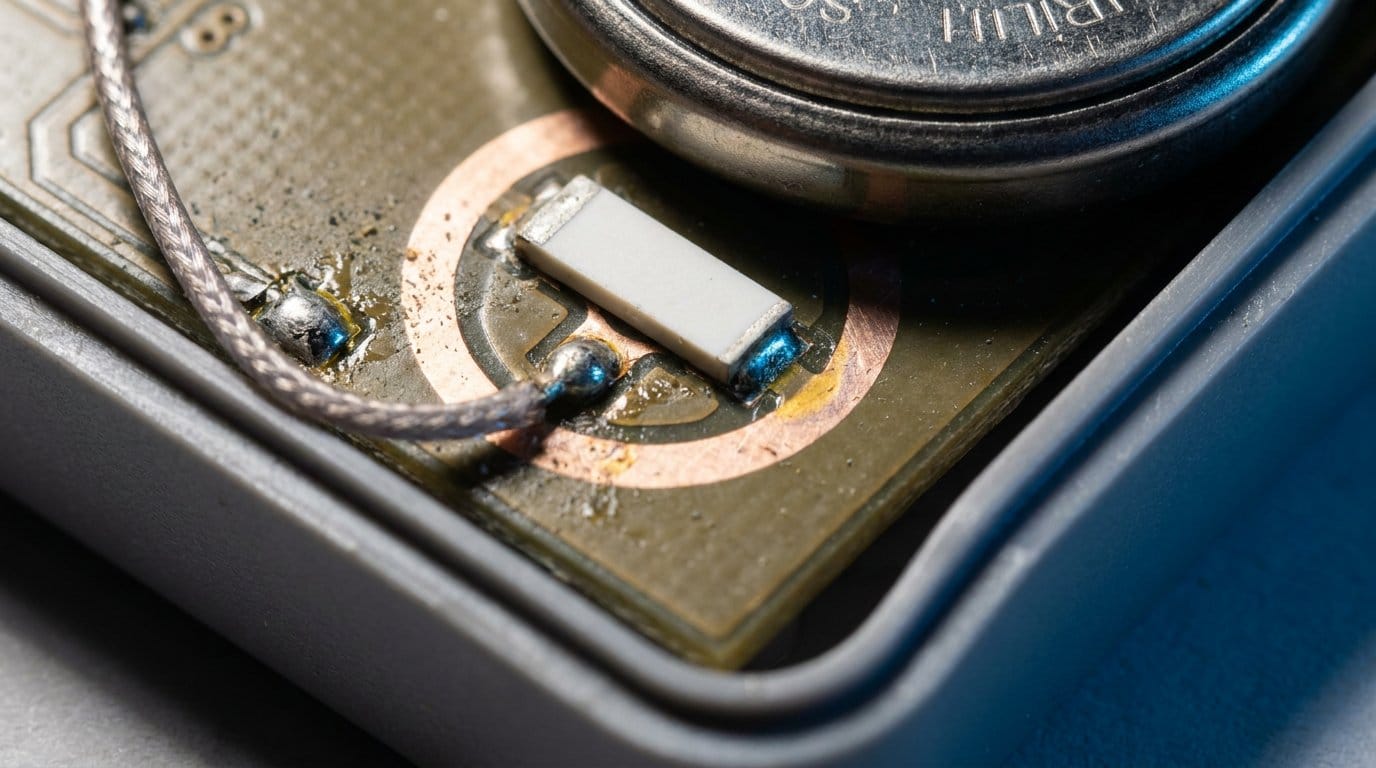
TRP and TIS describe the radiated power and sensitivity of a finished tracker: antenna, enclosure, battery and cable routing included. AT&T’s published requirements apply at device level. They state that a device must meet them for every band its module or chipset supports. No module datasheet can answer that.
Total radiated power and total isotropic sensitivity are system measurements. They are taken over a sphere around the assembled product. The plastic, the metal, the cell and the harness are all part of the answer. The requirement quoted above comes from version 2.1 of AT&T’s Device Architecture IoT Radiated Performance Requirements, dated 23 July 2025. Other operators set their own thresholds, so read it as an example of where the line sits.
Three gates, and they are not the same gate
Certification follows the same logic. PTCRB runs an IoT Network Certified route, described as “a streamlined certification process for cellular-enabled IoT devices utilizing PTCRB certified wireless modules”. Streamlined is doing real work in that sentence, and so is device. The module’s certificate shortens the path. It does not end it. Operators do publish approved-module lists, which is why the shortcut feels safe; what they accept onto the network is still a finished product.
Market access is a third, separate gate. In the United States, the FCC’s equipment authorization rules require RF devices subject to authorization to comply with the technical requirements before importation or marketing. That obligation is owed to a regulator, not to an operator. Clearing it says nothing about whether a carrier will accept the device. Other markets have their own route, and the obligation lands on the finished product in each of them.
A band list is the least informative document in the sourcing package. In the RFQ packs that reach us, it is usually the first one.
The antenna geometry has to survive the factory transfer
Here is the part that gets skipped. A design passes its radiated measurements on a defined set of units, in a chamber, with one lot of enclosures and one antenna revision. Those units may be hand-built or production-intent; either way they are a sample, chosen and assembled with care. Volume production then has to reproduce the result on every unit after them. On a second line. Eventually at a second site, with different fixtures, different operators and a different mould cavity. Design qualification answered whether the product can perform. Production answers whether it still does. In our experience, accepting the first as proof of the second is where a coverage promise quietly stops being true.
We have yet to see a purchase order that distinguishes the two.
Which variables need design control, and which need a work instruction
Antenna position, keep-out clearance, matching values, enclosure material and wall thickness are held by the design. They move only through a controlled revision, and a change triggers an impact assessment that often ends in re-qualification. Cable routing, screw torque, gasket seating, shield-can soldering and cell position are specified by the design but held by the process, through work instructions, fixtures and inspection. They drift quietly if nobody watches. Both sets move radiated performance. One set gets scrutinised at design freeze; the other is only ever as good as the last line audit.
What a production screen can and cannot see
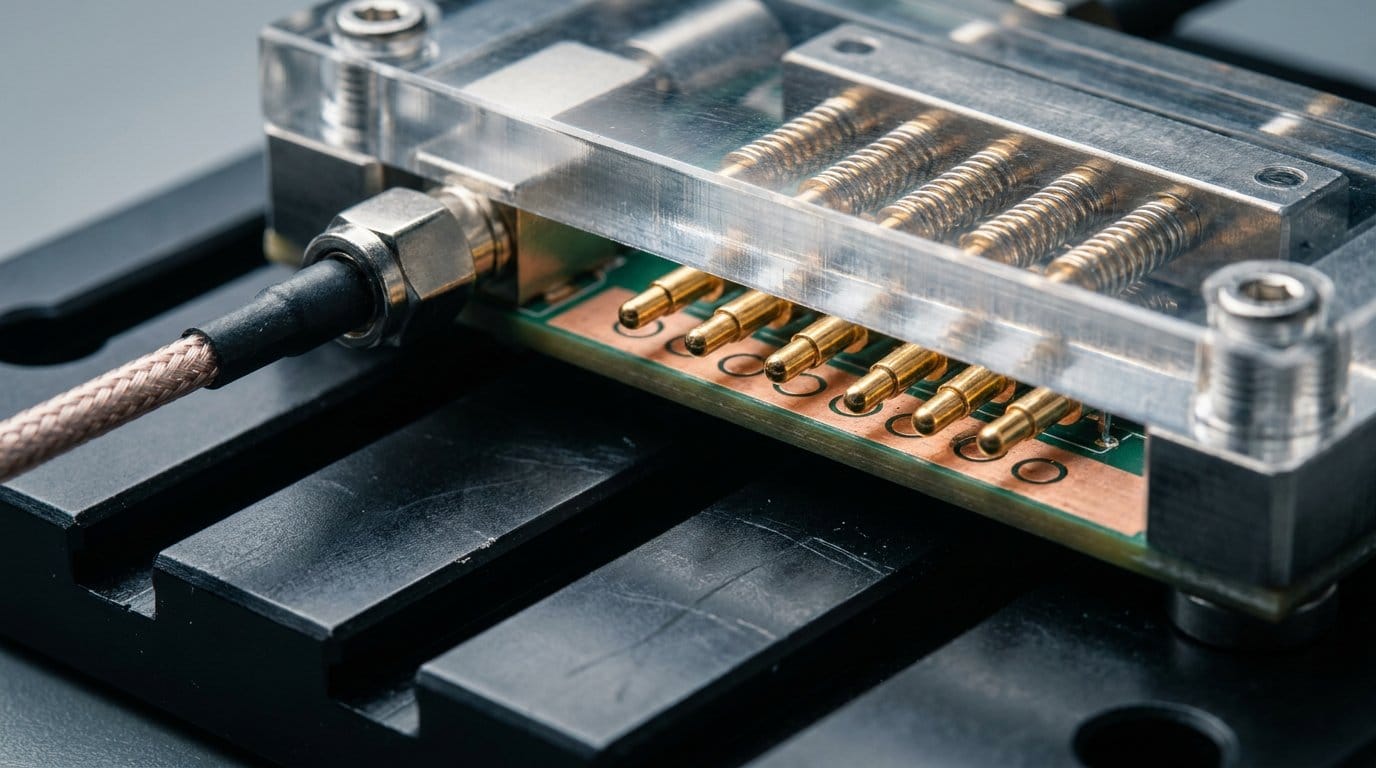
Component brief — what a production RF screen covers. Production screens come in several shapes: a conducted test on an open board through pogo pins, a conducted test on a sealed RF port, a coupler test on the closed product, or a sampled radiated retest. Each sees a different part of the signal path. A conducted test taken ahead of the antenna will find a mistuned front end, a bad solder joint on the RF chain or a wrong band configuration. It will not see an antenna detuned by the enclosure, the cell or a rerouted cable, because those sit outside the path it measures.
That is the gap to ask about. If a screen is being used as a stand-in for the finished device’s radiated behaviour, someone has to have shown that the two track each other — and even then, correlation on normal units cannot make a test sensitive to a fault that bypasses its measurement path. Whichever screen a line runs, closing the loop needs radiated measurement on representative finished units.
Moving a released design to a second site
For a second site the questions are mechanical rather than philosophical. Is the released configuration identical, down to the antenna revision and the adhesive? Are material substitutions controlled by the same change process, or by whichever local supplier is quickest? Have the test fixtures at the two sites been correlated against each other? Has anyone measured representative finished units from each site and compared them? A shared process sequence and a shared quality system do not, on their own, establish that two sites produce the same radiated result. Nothing here should be read as a claim that they have been shown to. Ask for the records instead of the claim.
A launched network is the start of a lane, not the end of one
The GSMA’s Mobile IoT commercial launches page was last updated in November 2025. It lists 129 LTE-M networks and 140 NB-IoT networks, 269 in total. Those are network launches. They are not countries, and they are certainly not lanes. A launch says a technology went live somewhere in an operator’s footprint.
A lane is a sequence of radio environments. The inside of a steel reefer. A stacked yard at a port. A queue at a land border. A warehouse aisle with racking to the ceiling. The GSMA’s own launch list is a useful census of where the technologies exist. It was never meant to say whether one tracker, in one installation position, reports reliably on one route.
A figure like 269 is easy to circulate in a sourcing review. The question worth asking is what the person circulating it believes it proves.
A supported band does not entitle the device to attach
The GSMA’s IR.73, Steering of Roaming Implementation Guidelines, version 5.0 of 4 May 2020, describes how a home operator steers a roaming device. It can use signalling based methods, or the preferred-PLMN list written onto the SIM. In the signalling method, a registration rejection is what pushes the device to attempt another network.
So band support is one input to network selection, and not the deciding one. The subscription carries a policy the hardware vendor usually cannot see or audit on its own, and which can change after the devices have shipped. Some of it is obtainable from the connectivity provider, and some of it only shows up as observed attach behaviour on the route. If a lane matters commercially, the evidence you need is subscription-specific. Which visited operators is that profile permitted on? What does the steering configuration do at the borders on that route? What happens when the first choice rejects the registration?
We do not know what preferred-PLMN list a given home operator will write for a given crossing. Neither does the factory. That is a boundary worth stating out loud rather than papering over.
A reading that arrives is not yet a reading you can defend
Connectivity work has a habit of ending at the moment the packet lands. For cold chain that is only part of the job. A value that uploads on schedule can still be wrong. It can also be one whose provenance nobody can reconstruct later. We went into that in an earlier note on what makes device data defensible.
The same physical assembly governs both outcomes, through different mechanisms. The enclosure and the internal layout set the antenna’s electrical environment. They also set the sensor’s thermal environment. Self-heating from nearby components. The thermal mass between the sensor and the air it is meant to represent. Whether the vent path is open, or blocked by a cable someone rerouted on the line. Delivery and accuracy are separate achievements, and neither one implies the other.
Production has its own obligations on that side. Keep the link between each sensor, its calibration record and the unit it was fitted into, through rework, retest and substitution. A component calibration certificate is not the same thing as a verified assembled logger; the built device needs its own temperature check under the conditions it will actually see. Handling of gaps and retransmission is a separate discipline, covered in an earlier piece on buffering, resends and audit trails.
ODM, CM/EMS and OEM are commercial labels, not engineering boundaries
Every question above resolves to the same one: who owns the released configuration, and who may change it. An ODM arrangement tends to start with the design baseline on the manufacturer’s side; a contract-manufacturing arrangement tends to start with it on the brand’s. That is as far as the labels go. Design ownership, change approval, test execution, certification maintenance and who pays for a re-test can each be allocated separately, and in practice they often are. Neither acronym tells you who approves a material substitution at two in the morning. Write that into the agreement instead of inferring it from the initials.
For what it is worth on our side. Eelink’s Shenzhen operation is an R&D centre with no factory attached. The owned manufacturing site in Yibin, Sichuan runs five SMT lines and 28 assembly lines; its campus covers 101,000 m². The owned manufacturing site in Haiphong, Vietnam runs the same process sequence and quality system: SMT, assembly, RF test, final inspection, shipping. Both sites can take the same ODM and CM programmes, which is a statement about capability and redundancy rather than about measured radiated results on any given SKU. Current production output: approximately 300,000 devices per month across Eelink’s manufacturing operations in China and Vietnam. Management systems are certified to ISO 9001, ISO 14001 and IATF 16949. Product-level market-access credentials — FCC authorization, CE marking, PTCRB certification — vary by SKU and configuration. Which is exactly the point.
What the reference unit on the bench can and cannot settle
Keep a reference unit. Build it from the released configuration, characterise it properly at the start, record its build data, store it in controlled conditions and verify it periodically. Built to the drawing is not the same as known good. When a batch behaves oddly on a lane, a characterised reference turns an argument into a measurement.
It settles less than people hope. A reference unit tells you what one known device does. Whether the units in the container were built the same way is answered by production records, fixture correlation and measurements on representative finished units.
A reference tracker can anchor the comparison. It cannot prove that the next batch behaves the same.
This article describes engineering and sourcing practice at category level. It certifies no product and makes no compliance claim for any device. Certification status, radiated performance and network acceptance are specific to a SKU, a hardware configuration and a target market. Each must be confirmed against the applicable certificates and operator requirements. Figures quoted from external sources carry the source and the applicable publication or update date.