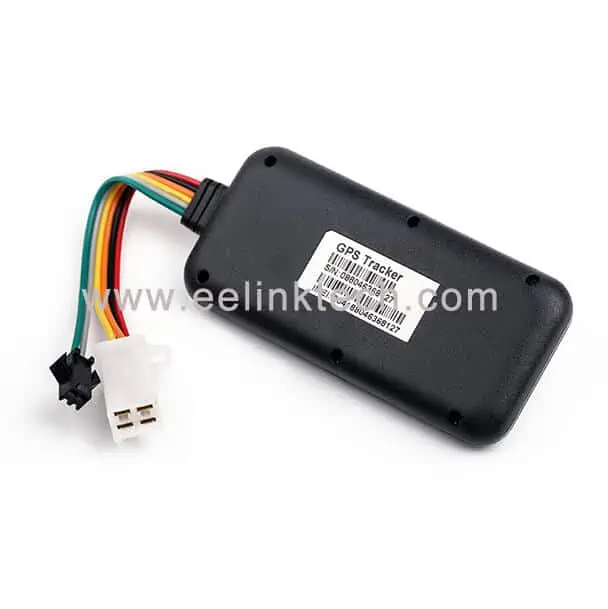
Tracking Pallets for Years: How EELink’s GPT50 Is Transforming Logistics
Introduction
In the world of logistics, the humble pallet carries the weight of global commerce. Millions of pallets circulate through supply chains, transporting everything from raw materials to retail goods. Yet keeping track of these pallets and their valuable contents remains a persistent challenge. Assets get lost, shipments are delayed, and sensitive cargo can spoil due to unseen temperature excursions. Traditional GPS tracking devices offer some visibility but often fall short – many need frequent charging or battery swaps, struggle with coverage on long routes, and lack the sensors to monitor conditions in transit.
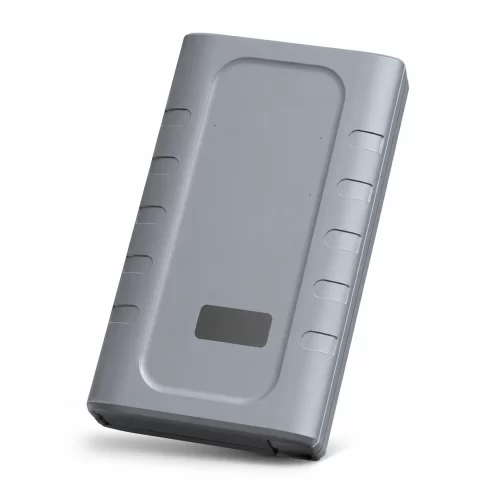
EELink’s GPT50 pallet GPS tracker is a game-changer for this problem. The GPT50 is a compact, ultra-long-life tracking device designed specifically to monitor pallets, containers, and other assets over multi-year journeys. With its massive battery and intelligent power management, the GPT50 can run for up to 8 years while transmitting location data once a day, and up to 10 years on the lightest duty cycles. The cell is non-rechargeable — it is never charged in the field, which is what removes the retrieval trip from the deployment. It combines precise global positioning, cellular IoT connectivity, and built-in sensors, all within a rugged, concealable form factor.
In this article, we explore how GPT50’s advanced features are transforming logistics by providing reliable, low-maintenance tracking for high-value assets across the world.
Ultra-Long Battery Life for Low Maintenance
One of the most revolutionary aspects of the GPT50 is its ultra-long battery life. The device is powered by a 24,000 mAh lithium-manganese dioxide (Li-MnO₂) primary cell — non-rechargeable and sealed in at assembly, engineered for efficiency and longevity. Unlike typical trackers that might only last a few weeks or months before needing attention, the GPT50 can operate for up to 8 years in standby mode with once-daily location updates, and up to 10 years on the lightest duty cycles.
This tremendous battery life is achieved through a combination of battery capacity and smart design:
High-capacity battery chemistry: The lithium-manganese battery in GPT50 has minimal self-discharge, meaning it holds its charge over long periods. Even if a pallet is stored or idle for months, the device won’t drain itself.
Intelligent power management: GPT50’s onboard microcontroller actively conserves energy. It turns off GNSS and cellular modules when not needed and puts the device to sleep between reports. A built-in motion sensor keeps the tracker dormant when the asset is stationary and wakes it only when movement or events occur.
Configurable reporting modes: By default, GPT50 wakes up on a set schedule (for example, once every 24 hours) to send a location update and then returns to deep sleep. This “Long Standby Mode” maximizes battery longevity. For special situations, it can switch to “Emergency Mode” – broadcasting in real time when an asset is in distress or needs live tracking – and then revert to conserve power.
For logistics operators, this ultra-long battery means minimal maintenance. Once a GPT50 is installed on a pallet or container, it can function for years without human intervention. There’s no routine battery charging or replacement to worry about each month. In large-scale operations with thousands of assets, eliminating the labor and downtime associated with battery upkeep translates into huge cost savings and smoother operations. Asset managers can effectively “deploy and forget,” trusting that their trackers will keep reporting reliably.
Global Connectivity via LTE Cat.1
Long battery life alone wouldn’t matter if the device couldn’t report from wherever your assets go. GPT50 addresses this with a 4G LTE Cat.1 radio covering both FDD and TDD bands, with EGPRS/GSM fallback, allowing it to operate on cellular networks worldwide. Cat.1 runs on ordinary LTE infrastructure rather than on an LPWA overlay, so coverage does not depend on whether a given operator has rolled out LTE-M or NB-IoT along that route — which matters on lanes crossing several countries. The trade-off is power, and that is handled on the device side: the radio stays off except during scheduled reports.
In practical terms, GPT50-equipped pallets can travel across continents — through remote warehouses, shipping yards, or inside metal containers — and still regularly transmit their location and sensor data. The multi-band LTE support covers a range of frequencies to ensure compatibility in different regions. If a shipment route passes through areas with older network infrastructure, the tracker’s 2G fallback keeps it connected even in 4G dead zones. This global connectivity means real-time visibility for your assets in transit, whether they’re on a cross-town truck or an intercontinental voyage.
The GPT50 also includes assisted GPS features to maintain visibility under challenging conditions. It can use cell tower data and even nearby Wi-Fi signals to approximate location when GNSS satellite signals are weak (such as inside a warehouse or deep in a ship’s hold). The result is continuous tracking coverage, indoors and out, across the entire supply chain.
Precision Tracking and Multi-Sensor Monitoring
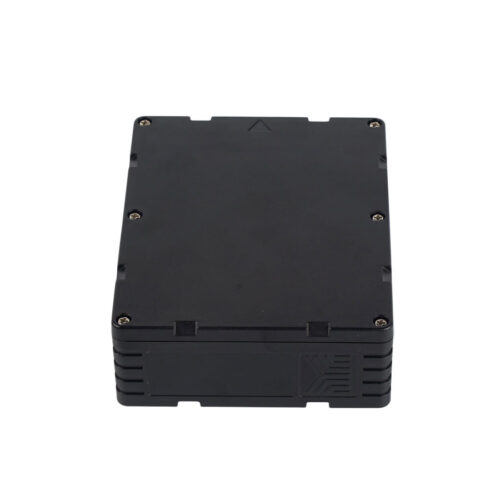
GPT50 Pallet GPS Tracker embedded in a warehouse pallet to ensure visibility and prevent asset loss.
At its core, the GPT50 is a highly capable GPS tracker. It leverages multi-constellation GNSS – including GPS, GLONASS, BeiDou, and Galileo – to achieve accurate positioning anywhere on the globe. By tapping into multiple satellite networks, the device can get a position lock faster and more reliably, even in urban areas or under light cover. Typical accuracy ranges around 5–15 meters, ensuring that pallet locations are pinpointed to the right facility or even section of a yard.
Beyond location, GPT50 is packed with sensors to monitor the condition and security of assets:
Temperature sensor: Critical for cold chain logistics, the built-in temperature sensor logs ambient conditions around the pallet. If the temperature goes above or below preset thresholds, the GPT50 triggers an instant alert. This helps logistics managers react to refrigeration failures or temperature excursions in real time, protecting sensitive goods like food and pharmaceuticals.
Motion and vibration sensor: A 3-axis accelerometer detects movement, vibration, and even orientation (tilt). This serves a dual purpose: it conserves battery by waking the device only when motion is detected, and it acts as a security feature by sensing unexpected movement or shock. For instance, if a stationary pallet gets lifted or dropped, the sensor can flag potential mishandling or unauthorized moving of inventory.
Light sensor (tamper detection): The GPT50 includes a light sensor under its casing that stays in darkness when the unit is properly mounted. If someone removes the tracker or opens a sealed container it’s attached to, light hits the sensor and the device will immediately send a tamper alert. This feature protects against theft or tampering by alerting stakeholders the moment a pallet or container might have been breached.
All these sensor readings (temperature, motion, light) are sent through the GPT50’s cellular connection along with location data. On the backend, the device reports over the EELINK protocol (TCP/UDP) directly into the customer’s own platform — there is no mandatory vendor platform — and those data streams can feed existing dashboards and alert systems. For example, if a pallet experiences a temperature spike above safe limits, the system can notify the fleet manager to check the refrigeration unit or re-route the shipment. If a loaded container is opened in an unscheduled location, security teams can be alerted to a possible theft in progress. Proactive alerts and rich sensor data turn each GPT50-equipped pallet into a smart, reporting asset that not only tells you where it is, but also how it’s being handled.
Rugged Design and Stealth Installation
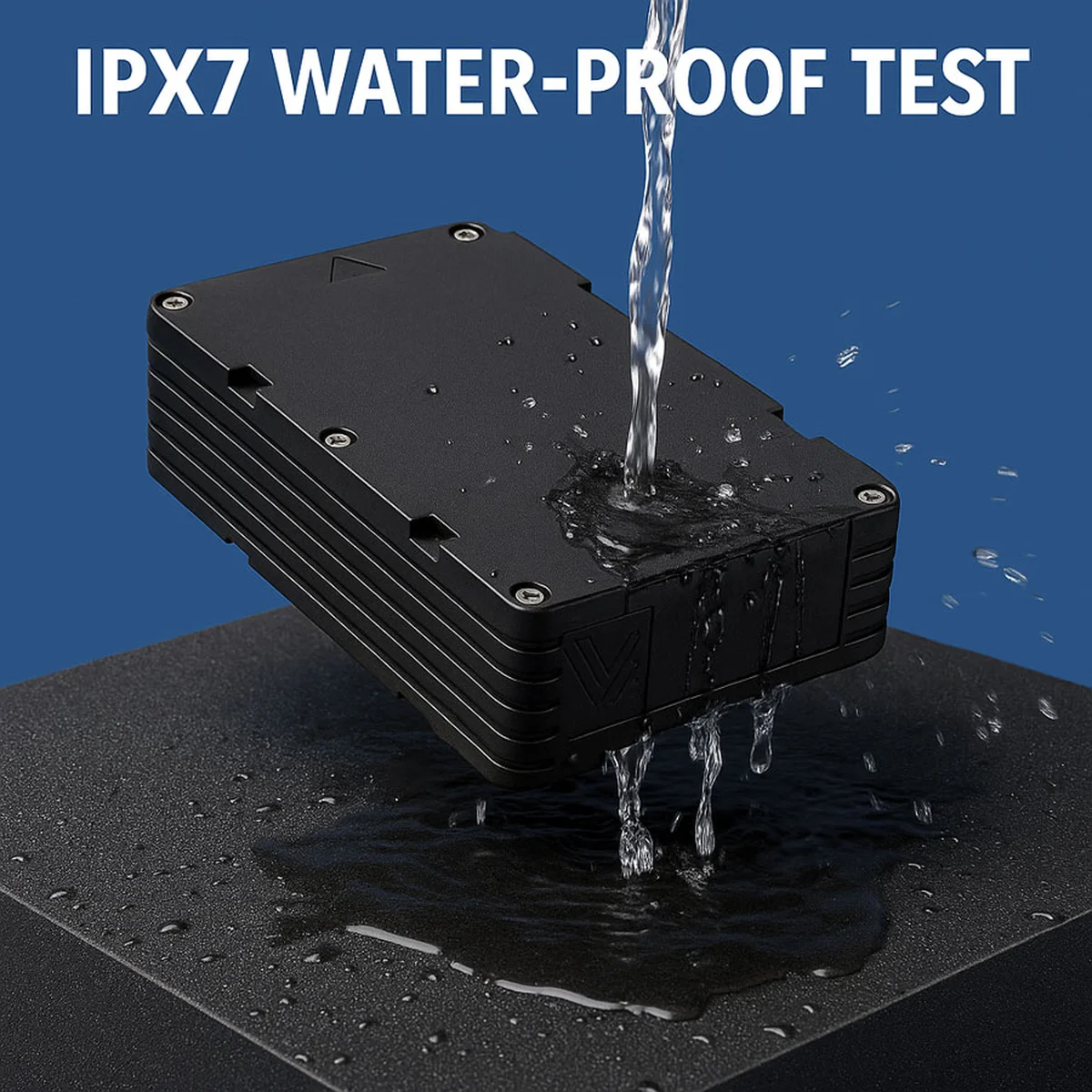
Logistics environments can be harsh – equipment is exposed to weather, shock, and rough handling. The GPT50 is built to survive these conditions over years. Its enclosure is rated IP67 waterproof and dustproof, so it can handle rainstorms, dust clouds, and even brief submersion without issue. The device operates in temperatures from -20°C up to +65°C, ensuring functionality in frozen storage or sweltering summer transports. From tropical humidity to desert dust, GPT50’s industrial-grade design keeps it functioning in the field.
Another aspect of the design is the recess-mount form factor tailored for pallets. The unit is slim and flat, able to sit flush in the underside cavity of standard EUR/EPAL pallets without protruding. It affixes with four small screws, making it effectively a part of the pallet. This clever mounting approach protects the device from impacts during forklift handling and keeps it out of sight to casual observers. The tracker can’t be easily knocked off and is hard for thieves to spot or remove quickly.
Installation of the GPT50 is straightforward – the unit has a simple one-button activation and can be configured over the air. Once attached and activated, it requires no further manual attention for years. This stealthy, durable installation is crucial for large pallet fleets and containers – the device works in the background reliably, without changing how pallets are handled in daily operations.
Transforming Logistics at Scale
By combining long-lasting power, global connectivity, and smart sensing, GPT50 enables a new scale of asset visibility. Companies can deploy hundreds or thousands of these trackers across their pallet pool or cargo fleet without adding maintenance burden. The impact on logistics is significant:
Reducing lost assets: Every year, a sizable percentage of pallets and containers go missing or unaccounted. For example, in pallet rental pools an estimated 8–9% of pallets are lost annually, representing millions of units. With GPT50 trackers attached, each pallet continuously reports its whereabouts. If a pallet strays from its expected route or ends up misplaced in a warehouse, the system can pinpoint its last known location. This helps recover assets that would otherwise be written off as lost and holds supply chain partners accountable for transfers.
Protecting cargo integrity: The real-time sensor alerts prevent small issues from becoming costly problems. A single pallet of vaccines exposed to heat can ruin thousands of doses; catching a refrigeration outage instantly can save that shipment. In fact, industry studies show about 20% of temperature-sensitive products are damaged during transport due to broken cold chains. By using GPT50 to monitor conditions throughout transit, logistics providers can intervene early – adjusting temperatures, expediting delivery, or rerouting shipments – to dramatically reduce spoilage and compliance issues.
Optimizing utilization and workflow: Continuous tracking data allows for better optimization of asset usage. Pallets sitting idle in one location can be reallocated when their position is known. Cycle times can be measured and bottlenecks identified – for instance, if certain distribution centers consistently take too long to unload pallets, that issue can be flagged and addressed. Essentially, GPT50 turns passive assets into IoT data points, enabling data-driven logistics decisions that improve efficiency.
Deterrence of theft and tampering: Knowing that high-value shipments are being tracked and will raise an alarm if disturbed has a deterrent effect. And in cases where theft is attempted, the live tracking mode can be triggered to assist in fast recovery. The emergency remote wake-up feature allows switching to live tracking on-demand via SMS or platform command whenever a quick response is needed.
Real-World Application Scenarios
The versatility of the GPT50 means it can enhance operations in many sectors:
Pallet pool management: Pooling companies or manufacturers with large pallet inventories can fit GPT50 units to their pallets for end-to-end traceability. This virtually eliminates the “black hole” of pallet exchanges – each pallet’s journey is logged, so losses and turn times can be monitored. Over years, the reduction in pallet loss rates and improved cycle management can save significant costs.
Cold chain logistics: For food, pharmaceuticals, and chemicals that require strict temperature control, GPT50 provides confidence that conditions are maintained across the journey. For example, a pharmaceutical distributor can attach GPT50 trackers to vaccine pallet shipments. As they move from the production facility, to an airport tarmac, to a refrigerated truck, the devices report any temperature deviations or delays immediately. This ensures cold chain compliance at every step, helping meet regulatory traceability requirements and preventing costly spoilage or patient safety risks.
Long-haul and cross-border shipments: Whether it’s intermodal containers on multi-month ocean voyages or rail cars crossing continents, GPT50 offers a truly “deploy-and-forget” tracking solution. Logistics coordinators can monitor the progress of shipments in near-real-time and receive alerts if a container deviates from its planned route or is opened unexpectedly. The device’s ability to endure tough conditions means the same tracker can accompany an asset by sea, land, and air without ever needing replacement along the way.
Future Outlook: Bridging to an Ambient IoT Future
Technologies like the GPT50 are laying the groundwork for smarter supply chains today and are a bridge to the future of ambient IoT. In the coming years, we anticipate a world of battery-free tags and AI-driven logistics optimization. So-called Ambient IoT devices – tiny sensors that harvest energy from radio waves or the environment – may one day be attached to every package or product. They promise ultra-low cost and maintenance-free tracking per item.
However, ambient IoT is still an emerging technology and not yet able to cover all use cases, especially for longer-range tracking and more complex data needs. This is where solutions like GPT50 remain crucial. An ultra-long-life tracker with substantial battery power can complement ambient IoT by tracking assets over large distances and providing richer data (like GNSS location and continuous environmental monitoring) that passive tags cannot yet deliver.
Moreover, the data collected by GPT50 and similar devices can feed into AI-powered platforms. With constant streams of location and sensor information, AI algorithms can optimize routes, predict maintenance needs, and refine inventory forecasts. Essentially, GPT50 brings critical visibility and data today that enables the AI-driven, automated logistics systems of tomorrow.
Conclusion
The GPT50 pallet GPS tracker demonstrates a significant leap in asset tracking capabilities. By eliminating the frequent battery swaps and connectivity gaps that plagued older trackers, it allows companies to instrument their supply chain at scale, with confidence that once a tracker is deployed, it will perform reliably for years.
From ensuring pallets don’t disappear into a supply chain void, to safeguarding perishable cargo, to streamlining global operations, GPT50 is transforming how logistics teams manage their assets. In an industry where knowing the location and condition of goods in real time is increasingly not just a luxury but a necessity, innovations like EELink’s GPT50 offer a practical and powerful solution. Smarter logistics starts with smarter assets, and equipping pallets and containers with multi-year trackers is a big step toward a more transparent, efficient, and secure supply chain.
Specifications follow the current GPT50 datasheet (Rev. A, September 2026). See the GPT50 product page for the figures that apply today.