Supply Chain Visibility: A 5-Level Framework for Choosing the Right Tracking Solution
Supply chain visibility isn’t a single capability — it’s a spectrum. This framework breaks it into five levels so you can assess where your operation stands and what tracking technology you actually need.
Why “Visibility” Means Different Things to Different Teams
When logistics teams evaluate tracking solutions, the conversation often starts with a simple question: Can we see where our shipments are?
But that question hides a much bigger one: How much can we actually see — and how much are we missing?
Supply chain visibility isn’t a single capability. It’s a spectrum. Some organizations only receive milestone notifications from carriers. Others monitor real-time GPS positions, environmental conditions, and predictive ETAs simultaneously. The level of visibility you need depends on what you’re shipping, where it’s going, and what’s at stake if something goes wrong.
This framework breaks visibility into five distinct levels — from basic shipment confirmation to fully predictive logistics intelligence. Use it to assess where your operation stands today and determine what level of tracking technology you actually need.
Level 1: Shipment Confirmation Only
At this level, your only confirmation that a shipment is in transit comes from carrier-generated documents: bills of lading, shipping receipts, or manual confirmation emails. There is no electronic tracking of any kind.
This approach still exists in regional freight networks, subcontracted last-mile delivery, and cross-border shipments involving multiple handoffs. The risk is straightforward — you have no way to detect delays, diversions, or losses until the destination reports a problem.
Level 2: Milestone-Based Tracking
Most organizations operate at this level. Carriers or logistics partners provide checkpoint updates — picked up, in transit, arrived at hub, out for delivery, delivered — typically via EDI, carrier portals, or TMS integrations.
The data is structured and reliable, but it’s retrospective. You learn that a shipment arrived at a distribution center yesterday, not that it’s currently stuck there. Dwell times between milestones are invisible. There’s no mechanism to detect route deviations, unauthorized stops, or environmental incidents between checkpoints.
Level 3: Real-Time GPS Tracking
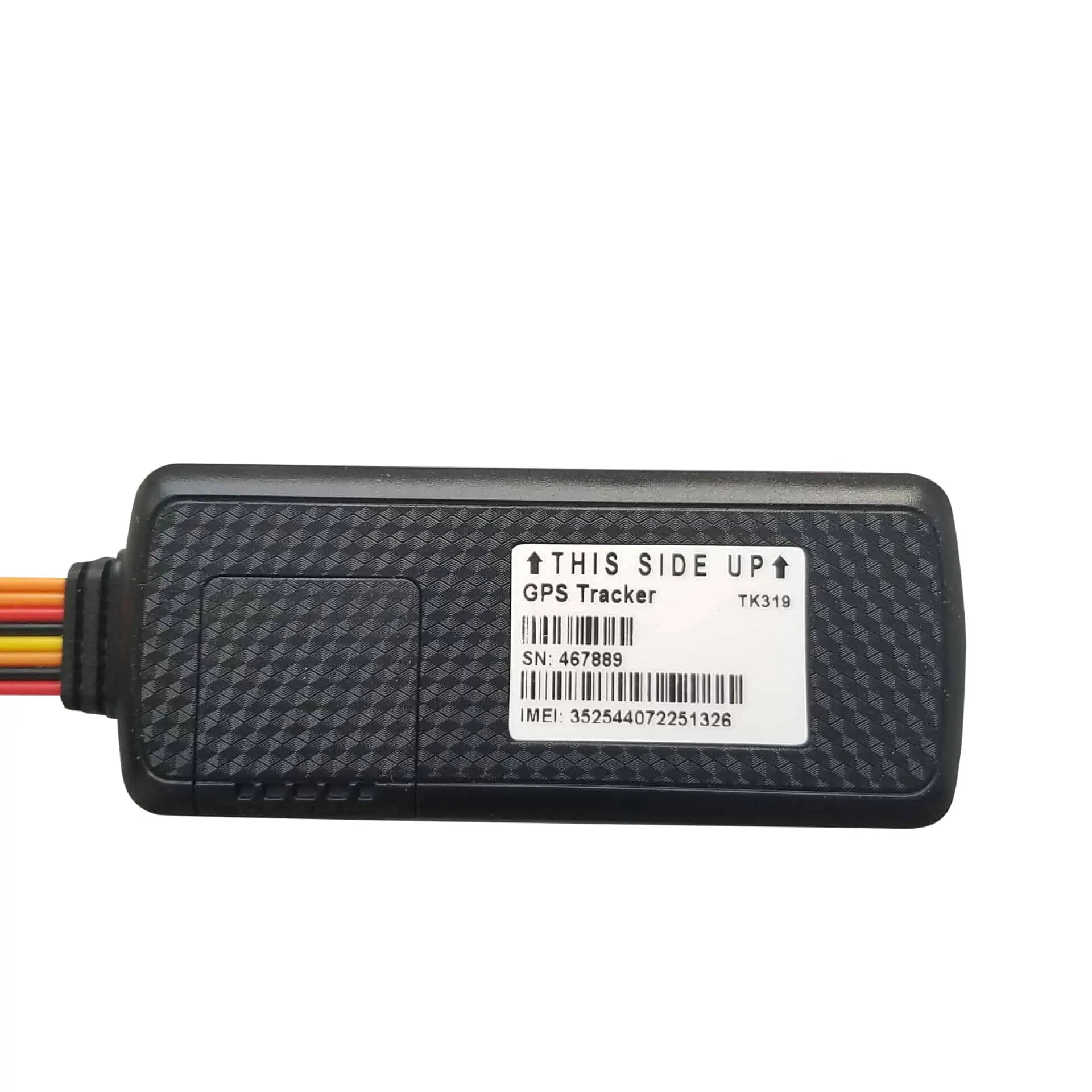
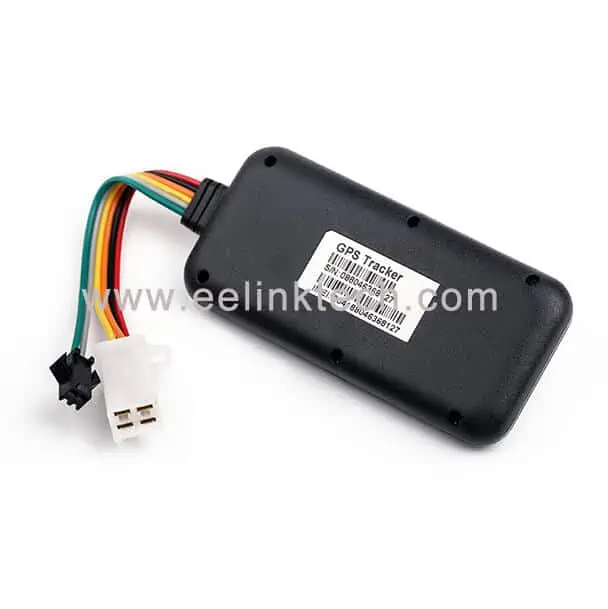
Level 3 introduces dedicated tracking hardware — GPS/GNSS devices with cellular (LTE-M, NB-IoT, or Cat-1) connectivity installed directly on the asset. Position reports are transmitted at configurable intervals, giving operations teams a live view of every tracked shipment.
This enables capabilities that milestone tracking cannot provide:
- Live ETA calculation based on actual position and speed, not carrier estimates
- Geofence alerts when assets enter or leave designated zones
- Route deviation detection for identifying unauthorized stops or detours
- Dwell time monitoring at ports, warehouses, and intermediate facilities
The choice of tracking device at this level matters significantly. Key selection criteria include battery life (especially for unpowered assets like containers and trailers), network coverage across operating regions, form factor for installation constraints, and total cost of ownership including connectivity fees.
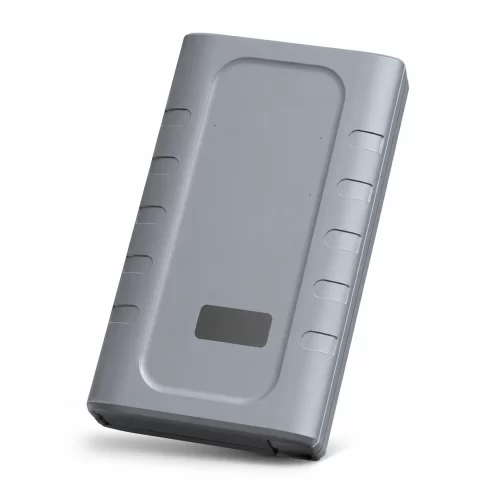
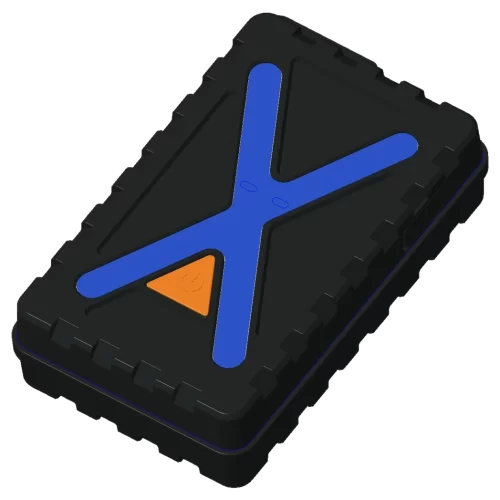
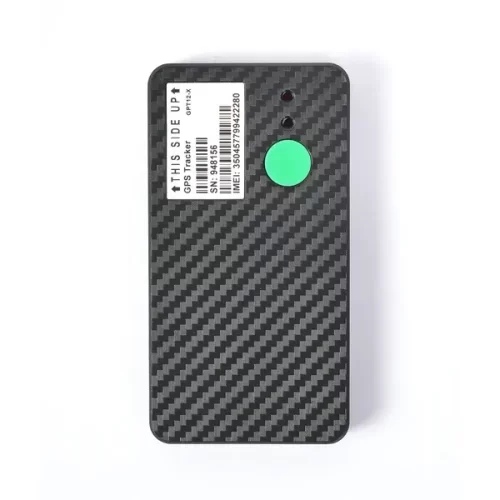
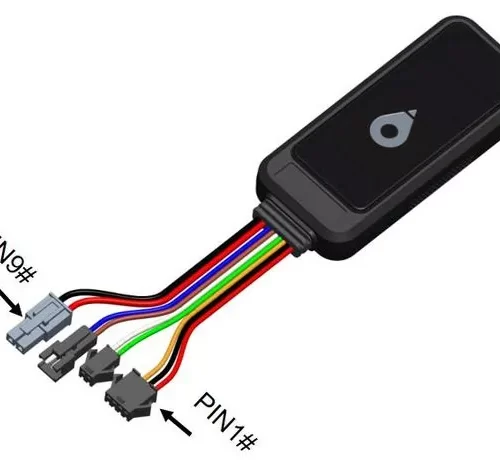
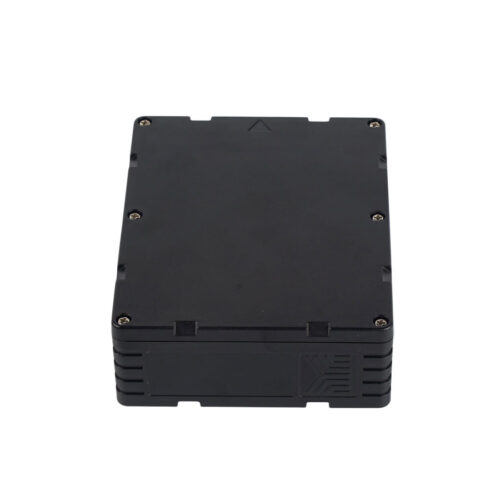
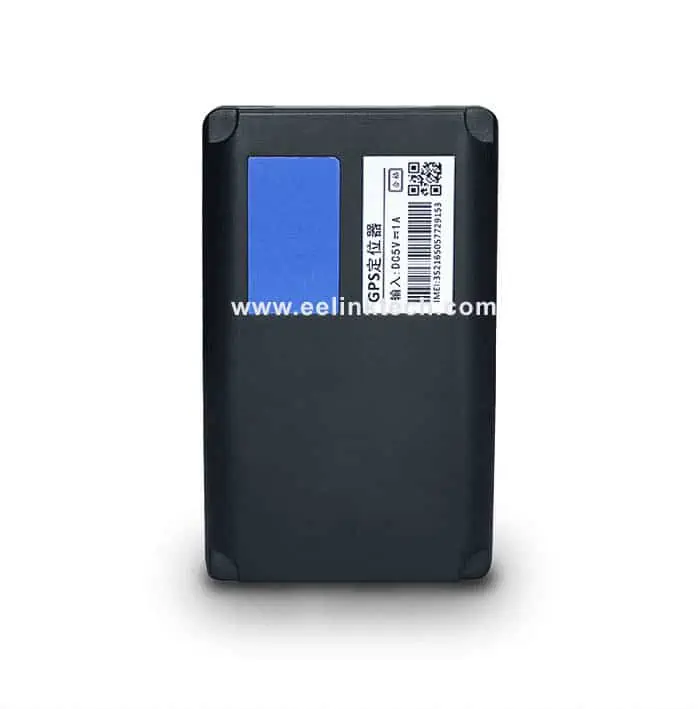
For vehicle tracking, hardwired devices like the TK417 provide continuous power and high-frequency reporting. For container and trailer tracking, battery-powered devices such as the GPT48-X offer multi-year standby with configurable reporting intervals. For pallet-level tracking, compact trackers like the GPT50 balance size, cost, and battery performance for high-volume deployments.
Level 4: Condition Monitoring + Location
Level 4 combines GPS positioning with onboard environmental sensors — temperature, humidity, shock/vibration, light exposure, and door open/close detection. This transforms tracking from where is it? to where is it and what’s happening to it?
This level is essential for:
- Cold chain compliance — Pharmaceutical, food, and biotech shipments that require continuous temperature documentation for FDA, FSMA, or EU GDP compliance
- Cargo security — Detecting unauthorized container access in transit or at intermediate storage
- Damage prevention — Identifying shock events that may compromise sensitive electronics or fragile goods
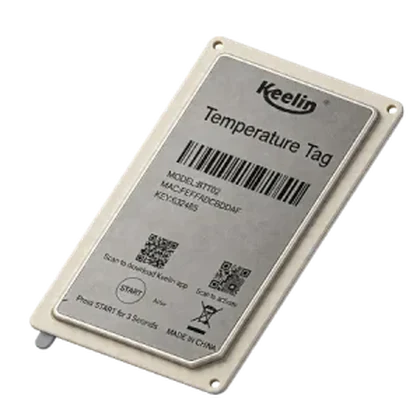
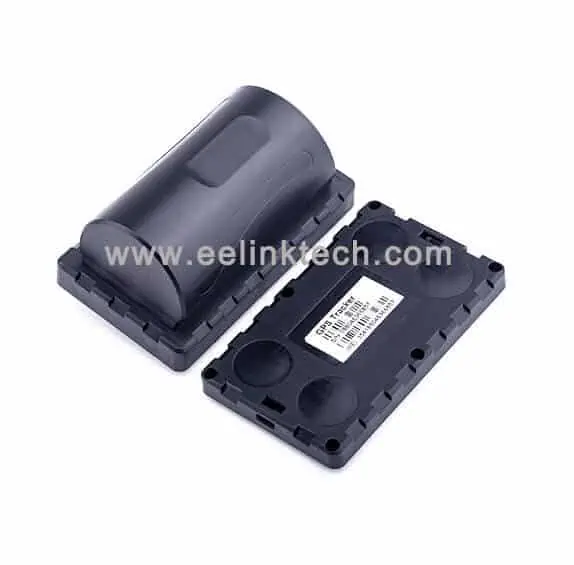
Dedicated cold chain monitoring devices like the GPT29 integrate calibrated temperature sensors with GPS tracking in a single unit, eliminating the need for separate data loggers and GPS devices. This reduces hardware cost, simplifies deployment, and ensures that temperature readings are automatically correlated with location data.
Level 5: Predictive Visibility
At the highest level, tracking data feeds into analytics and machine learning systems that predict outcomes rather than simply reporting status. Predictive ETAs incorporate weather patterns, port congestion data, and historical lane performance. Automated workflows trigger rerouting or escalation before a disruption reaches the customer.
Level 5 requires a solid foundation of Level 3 and Level 4 data. The prediction models are only as good as the real-time inputs they receive. Organizations that attempt predictive analytics without reliable, continuous tracking data produce unreliable predictions.
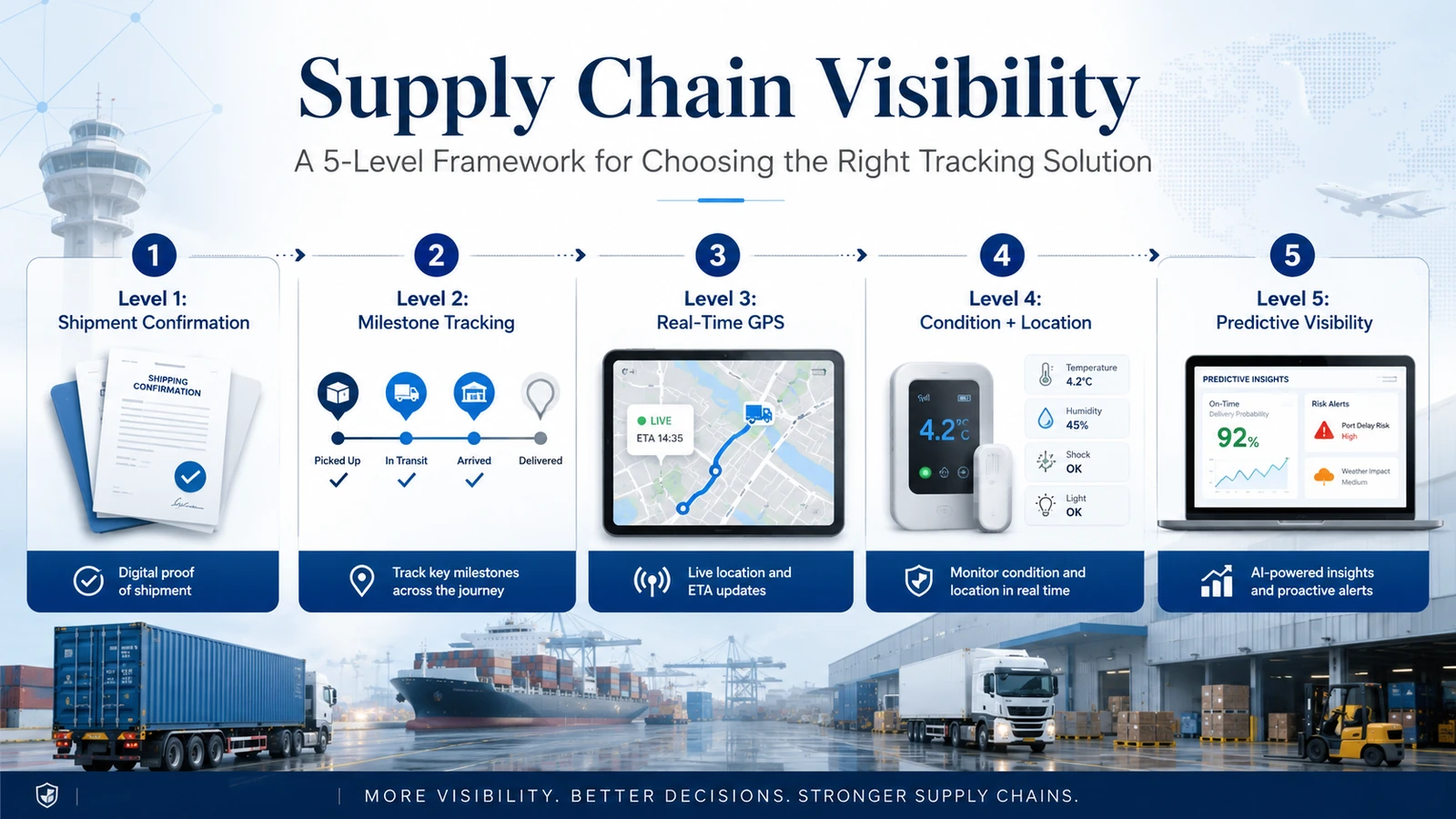
A 5-level framework for choosing the right tracking solution based on shipment risk, asset type, and visibility requirements.
Choosing the Right Level for Your Operation
Not every asset class requires the same level of visibility. A practical approach is to segment your fleet or cargo portfolio by risk and value:
| Asset Type | Recommended Level | Suggested Solution |
|---|---|---|
| Company vehicles, delivery fleets | Level 3 | Hardwired GPS tracker (e.g., TK417) |
| Shipping containers, trailers | Level 3–4 | Long-standby asset tracker (e.g., GPT48-X) |
| Pallets, returnable transport items | Level 3 | Compact pallet tracker (e.g., GPT50) |
| Cold chain / pharma shipments | Level 4 | Temperature-monitoring tracker (e.g., GPT29) |
| High-value or theft-prone cargo | Level 4 | Multi-sensor tracker with tamper detection |
Getting Started
The most common mistake in supply chain visibility projects is trying to instrument everything at once. Start with your highest-risk or highest-value asset class. Deploy Level 3 tracking, validate the data pipeline, train your operations team to act on real-time information, and then expand.
Eelink’s product portfolio spans the full range of tracking requirements — from vehicle-mounted GPS trackers to battery-powered asset trackers with multi-year standby to cold chain monitoring devices with integrated temperature sensors. With dual manufacturing facilities and certifications including IATF 16949, ISO 9001, and ISO 14001, our hardware is built for enterprise-grade reliability across global deployments.
Discuss Your Visibility Requirements
Eelink supports Level 3 through Level 4 tracking across vehicle, container, pallet, and cold chain asset classes. Contact our solutions team to determine which devices fit your deployment.