Event-Driven Telemetry vs. Periodic Heartbeats for Asset Tracking Hardware
In the world of IoT asset tracking, two approaches dominate how devices report their data: periodic heartbeats and event-driven telemetry. The periodic heartbeat model has devices send status updates at regular intervals (for example, every 5 or 15 minutes) regardless of whether anything significant has occurred. In contrast, an event-driven approach keeps the device mostly silent (in an ultra-low-power sleep state) and wakes it up only when specific events occur – such as a trailer door opening, a tilt or shock detected, or a temperature crossing a threshold. This event-driven telemetry (triggered by sensors like tilt, door, temperature, etc.) is increasingly recognized as a superior strategy for Supply Chain Visibility Solutions, especially in applications like cold chain logistics, equipment rental, and industrial sensing.

Why the shift toward event-driven tracking? In real deployments, battery life and data relevance are paramount. Wasting energy and bandwidth on constant “heartbeats” can drain batteries and flood systems with redundant data. By contrast, hardware-level triggers that initiate device wake-up only when something meaningful happens can dramatically extend battery life and provide higher-quality logs of asset conditions. In this article, we’ll explore why event-driven telemetry outperforms periodic polling in IoT tracking devices, how it works at the hardware level, and what advantages it brings in terms of energy efficiency, noise reduction, audit-grade logging, and exception alerts. We’ll also look at key use cases (cold chain, rental equipment, industrial IoT) and illustrate how EELINK’s ultra-low-power cellular trackers integrate flexible sensors to deliver reliable event-driven reporting (a core value of EELINK’s OEM/ODM hardware design).
By the end, technical stakeholders will understand how sensor-triggered telemetry can transform asset tracking deployments – minimizing maintenance, improving data quality, and ensuring that critical events are never missed. Let’s dive into the difference between periodic heartbeats and event-driven telemetry and why the latter is often the better choice for modern IoT tracking solutions.
Periodic Heartbeats vs. Event-Driven Telemetry: What’s the Difference?
To set the stage, let’s clarify these two approaches:
Periodic Heartbeat Reporting: The device wakes up on a fixed schedule (say every X minutes or hours), powers its sensors and modem, and transmits a status update (e.g. location, temperature, battery level). It does this regardless of any change in state. Heartbeats prove the device is alive and provide a constant stream of data. However, most of these reports may show “no significant change” in the asset’s status.
Event-Driven Telemetry: The device mostly remains in a deep sleep or ultra-low-power state. It continuously monitors certain sensors or conditions with minimal power draw. When a trigger event occurs – for example, a door opens, the device tilts or moves, or temperature goes out of range – the hardware trigger or interrupt causes the device to wake up immediately. The device then records the event (timestamp, relevant sensor readings, location, etc.) and transmits this data to the cloud. If no trigger happens, the device stays quiet (aside from perhaps infrequent check-ins for connectivity). Essentially, the device speaks only when there’s something important to say.
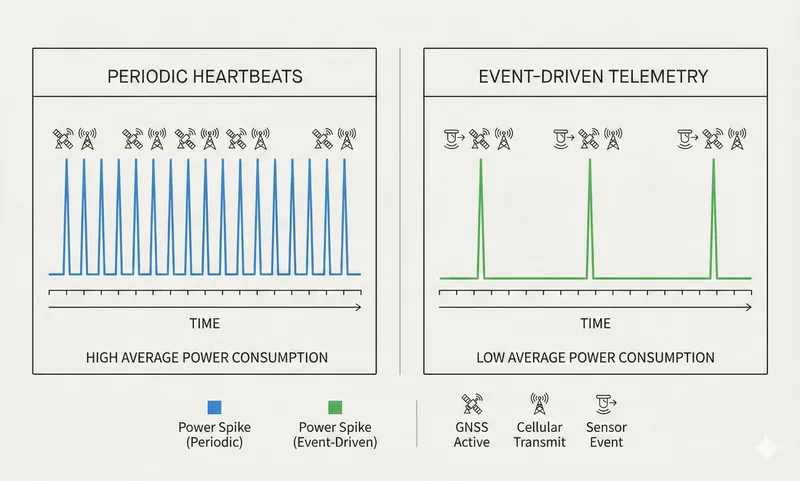
It’s worth noting that these approaches aren’t mutually exclusive. Many advanced trackers use a hybrid: primarily event-driven reporting with a fallback heartbeat once a day or week to assure the system that the device is still functional and in contact. But the key difference is when and why the device communicates. Periodic heartbeats communicate on a timer; event-driven telemetry communicates on conditions. In the following sections, we’ll examine why the event-driven model, when feasible, offers significant benefits over purely periodic updates.
The Hidden Costs of Periodic Heartbeats
Relying on periodic heartbeats for asset tracking may seem straightforward, but it comes with trade-offs and hidden costs:
Wasted Energy: Frequent scheduled transmissions force the device’s radios and sensors to power up even when nothing has changed. This constant polling and communication can drain the battery quickly. For battery-powered trackers meant to last months or years in the field, sending data “just in case” at high frequency is inefficient. Overzealous sampling or pinging “heartbeats” can starve batteries; in fact, one IoT engineering firm notes that “over-enthusiastic sampling can starve batteries,” whereas compressing data and using event-driven telemetry yields “better insight per joule than firehose streams”. In short, every unnecessary transmission shortens device life without adding new information.
Data Noise and Volume: With periodic updates, especially if the interval is short, you end up with a firehose of data points. Many of these are repetitive or uninteresting (e.g., “temperature still OK” every 5 minutes). This creates noise in your data platform that analysts or algorithms must sift through. Important signals (like an actual temperature excursion) might be buried in a sea of routine readings. More data also means higher cellular data costs and cloud storage/processing load. The data stream from heartbeats can overwhelm users with information that doesn’t necessarily yield insights – the device is talking a lot, but saying little of value.
Lack of Granular Event Detail: Paradoxically, a purely periodic system can miss critical moments. If something important happens just after a heartbeat was sent, the system might not find out until the next scheduled report. For example, if a refrigerator unit fails 2 minutes after a tracker’s 30-minute heartbeat, the temperature could be out of range for 28 minutes before anyone knows. By the time the next heartbeat arrives indicating a problem, it might be too late. To catch events sooner, one might increase heartbeat frequency – but that, again, sharply reduces battery life. This illustrates a core limitation of fixed schedules: there’s always a compromise between responsiveness and power consumption.
Battery Replacement & Maintenance: Because periodic trackers consume more energy, they require more frequent battery replacements or recharging cycles. In large-scale deployments (hundreds or thousands of trackers), this becomes a significant operational cost. The “battery line” in the maintenance budget grows with every unnecessary wake-up. As one IoT deployment expert cautioned, “Periodic polling ‘just in case’ … becomes the battery line everyone regrets”, advising to replace frequent polling with on-demand wake-ups and smarter policies. Essentially, every extra heartbeat not only uses energy in one device, but multiplied across fleets of devices, it means many more truck rolls or labor hours to service batteries over the years.
In summary, while periodic heartbeats are simple and ensure routine visibility, they are inherently inefficient for many asset tracking scenarios. They tend to waste energy and bandwidth on confirming the status quo, contribute to data overload, and can still leave gaps in awareness. These drawbacks set the stage for why event-driven telemetry is so attractive: it targets communication to the moments that truly matter.
Key Advantages of Event-Driven Telemetry
Event-driven telemetry flips the model: instead of speaking regularly regardless of relevance, the device mostly listens and only speaks up when something noteworthy happens. This brings several major advantages:
1. Ultra-Low Power Consumption
The most obvious benefit is dramatically improved energy efficiency. Since the device can sleep for long stretches and wake only on events, it spends far less time with its high-power components (CPU, GPS, cellular modem, etc.) turned on. Interrupt-driven wake-ups allow the microcontroller to remain in a deep sleep until an interrupt signal from a sensor is received, rather than continuously polling for changes. According to AWS IoT best practices, using interrupts in an event-driven firmware architecture “reduces processing and communication overhead, and helps reduce energy consumption”. The CPU can sleep until an event occurs instead of constantly checking, significantly cutting active time.
Real-world numbers bear this out. For instance, a wireless pressure sensor that “reports by exception” (only transmitting when an alarm threshold is crossed) can achieve battery life of 5–10+ years on a single battery. In one configuration, sampling pressure every 5 seconds but only reporting every 2 minutes (if no alarm) yielded over a decade of battery life. Such longevity is nearly impossible with frequent heartbeats. Simply put, waking only when needed keeps power draw minimal, which is crucial for remote or difficult-to-access assets. For asset trackers on containers, trailers, or rental equipment that might not see maintenance for months or years, event-driven designs ensure the device will still be alive and reporting when a critical event (e.g., theft, tampering, temperature spike) finally does occur.
2. Reduced Data Noise, Higher Data Quality
By sending data only when there’s something meaningful to report, event-driven telemetry filters out the noise and delivers a cleaner data stream. You’re not getting 10,000 “all is well” pings — you’re getting the handful of events that actually matter. This improves the signal-to-noise ratio of your telemetry. Analytics engines and operations teams can focus on actionable events (a door opened at an unscheduled time, a machine started up, a temperature excursion) rather than combing through mountains of trivial data.
Moreover, each transmitted data point tends to carry more information or “insight” since it is tied to a noteworthy context (e.g., “door opened at 2:03 PM, location X” is more informative than “still closed at 2:00, 2:05, 2:10…” every five minutes). Industry practitioners have observed that you get more insight per unit of energy (per joule) with this approach: “compression and event-driven telemetry often deliver better insight per joule than firehose streams.” In other words, every byte and every joule spent is more likely to convey useful knowledge about your operations, rather than being wasted on redundant status updates.
3. Comprehensive Event Logs (Audit-Grade Records)
When a device logs and transmits only significant events, it naturally creates a timeline of noteworthy changes – which can serve as an audit trail or incident log. Each event record is timestamped and typically includes the context (what triggered it, sensor readings, location, etc.). Over time, this yields a sequence of “chapters” in the asset’s story: when it moved, when doors opened, when environmental conditions went out of range, and so on. Such logs are incredibly useful for compliance and analysis, especially in regulated industries.
For example, in cold chain logistics for pharmaceuticals or food, regulators might require proof that temperatures stayed within safe limits throughout a shipment. A device that only reports exceptions might log “Temperature exceeded 8°C for 5 minutes at location X on date Y” and “Temperature returned to safe range at time Z”. Those specific records are far more audit-friendly than sifting through hourly readings. They highlight exactly when and what went wrong (or that nothing went wrong if no events are logged beyond normal check-ins).
4. Instant Exception Alerts and Responsive Reporting
Perhaps the biggest practical advantage for operations is the real-time alerting capability. With event-driven telemetry, as soon as an important event occurs, the device can wake and send an alert immediately, rather than waiting for the next heartbeat interval. This is crucial for exception management – those cases when something goes wrong or deviates from the norm.
Consider a few scenarios:
- A refrigerated truck’s door is opened mid-route outside of authorized delivery points. An event-driven tracker with a door sensor can detect the door opening and instantly transmit an alert to the cloud/platform, which then notifies the operations team. This could indicate possible theft or mishandling, prompting an immediate investigation.
- A construction equipment unit that’s supposed to remain at a job site starts moving (detected via an accelerometer). An event-driven device flags this motion and sends a text or email alert for potential unauthorized relocation or theft, letting the fleet manager respond or check in with the site.
- A temperature sensor in a cold storage warehouse detects that the temperature has risen beyond the safe threshold. The event-driven system wakes up the moment this threshold breach is detected and sends an alarm.
In summary, event-driven telemetry yields longer battery life, cleaner data, thorough event logs, and timely alerts – all critical advantages for industrial and logistics applications. Next, let’s see how these benefits play out in specific real-world use cases.
Real-World Use Cases Favoring Event-Driven Telemetry
Many industries that rely on asset tracking have begun embracing event-driven designs to meet their specific needs. Let’s look at how this approach shines in three key domains:
Cold Chain Logistics (Refrigerated Goods Tracking)
Cold chain refers to the transport and storage of temperature-sensitive goods (like food, vaccines, pharmaceuticals) where maintaining a certain temperature range is critical. Using specialized Cold Chain Monitoring Tracking Devices, businesses can ensure precise environmental control.
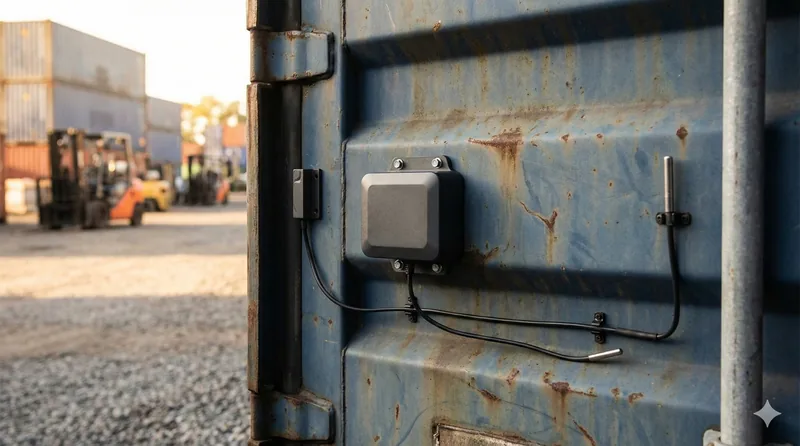
Event-driven telemetry is ideal here because most of the time, “no news is good news.” If the temperature remains within range and the container is unopened, there’s little need to constantly transmit data. A tracker can sleep to save power and perhaps send a brief heartbeat once or twice a day to log its presence. The important events to capture are exceptions: door openings, temperature excursions, deviations from expected schedule.
For example, EELINK’s cold-chain tracking devices can integrate a temperature probe and a magnetic door sensor. The device can be configured so that if the door is opened, it immediately wakes and sends a “door open” event (with location and time). This creates an auditable log of every time the container was accessed in transit – crucial for chain-of-custody records. Likewise, if the internal temperature goes above a preset threshold, the temperature sensor’s trigger will wake the device to report an alarm.
Equipment Rental & Construction Asset Monitoring
Companies that rent out equipment (generators, compressors, heavy machinery) or manage construction assets face a unique challenge: their assets may sit idle for long periods and then be used intensively for short bursts. Powering a tracker with periodic heartbeats on an idle machine means wasting energy when nothing is happening. Instead, an event-driven approach aligns well with usage patterns, which is a key feature of GPS Asset Tracking Devices for Rental Equipment.
Consider a portable rental generator at a jobsite. If it’s off and stationary, an event-driven tracker can remain in sleep mode, consuming virtually no power. The moment someone starts the generator (detected via a vibration sensor or an ignition wire trigger), the tracker can wake up and send a “usage start” event. It might then enter a higher reporting frequency while the generator is running. When the generator turns off and remains still for a certain time, the tracker logs a “usage stop” event and goes back to deep sleep. This pattern ensures the device records the utilization periods without draining power during the long idle stretches.
Industrial Sensing & Remote Monitoring
In industrial IoT scenarios – such as monitoring pipelines, tanks, or machinery in factories – you often have sensors that measure parameters like pressure, vibration, flow, or voltage. In normal operation, these values remain within a target range. Constantly reporting the same stable reading is unnecessary. What’s important is catching the anomalies: a pressure drop, a vibration spike, a machine cycle completed, etc.
Many industrial sensor systems thus adopt a “report by exception” philosophy. For instance, a pressure sensor might take readings locally every few seconds, but it will only transmit data if the pressure goes out of the acceptable band. This approach can yield extreme battery life. As noted earlier, a remote pressure monitor that is event-driven can last up to a decade on one battery pack.
EELINK’s Ultra-Low-Power Approach to Event-Driven Tracking
As an OEM/ODM manufacturer focused on low-power cellular trackers, EELINK builds hardware from the ground up to support event-driven telemetry in production environments. This capability is central to our GPS IoT Device OEM & ODM Services.
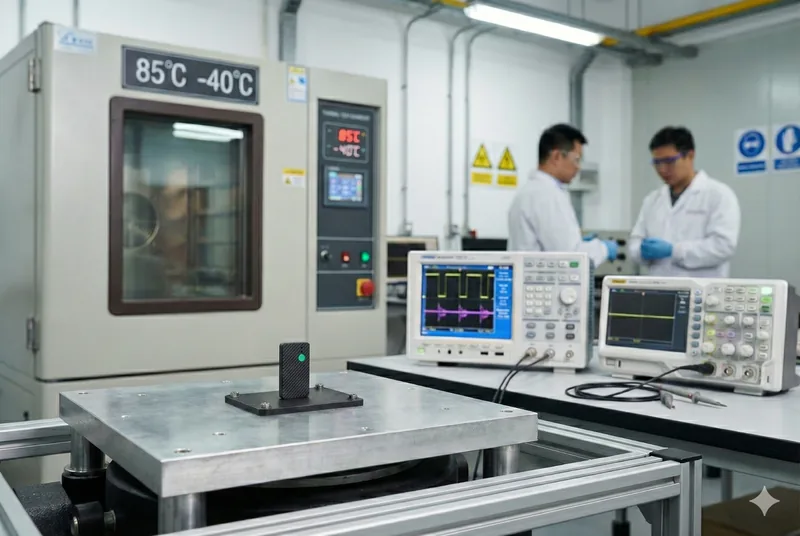
Here are some aspects of EELINK’s approach and how they enable the benefits discussed:
Hardware Interrupts & Smart Firmware: EELINK trackers employ microcontrollers and cellular modules that support low-power sleep modes and wake-on-interrupt. For instance, many EELINK devices use ARM Cortex-based MCUs and LTE-M/NB-IoT modems that can sleep at microamp currents. The firmware is designed such that sensors (accelerometer, gyroscope, temperature sensor, door switch, etc.) are tied to interrupt lines. When a sensor detects a condition, it generates an interrupt signal that instantly wakes the main processor.
Flexible Sensor Integration: EELINK provides devices with built-in sensors as well as interfaces for external sensors. This flexibility allows the same base device to be customized for different triggers. For example, the same tracker model could be used on a cargo pallet with a temperature probe for cold chain, or on a rental compressor with a vibration sensor attached – each configured with appropriate event triggers.
Dual-Mode Reporting (Heartbeat + Events): EELINK understands that completely eliminating periodic reports may not suit every scenario. Thus, devices often support a dual-mode logic: a very infrequent heartbeat combined with immediate event-driven updates when triggers occur. This strategy “balances predictability with responsiveness,” ensuring there’s a fallback schedule for data while still defaulting to event-driven tracking for day-to-day operations.
Reliability and Logging: EELINK devices often include non-volatile memory to log events even when the device is offline or out of coverage. If an event happens and the device cannot immediately transmit, it will store the event and attempt transmission later. This guarantees that no event is lost, preserving the audit trail.
EELINK’s overall philosophy can be summarized as delivering “always-on readiness” without the cost of always-on power draw. The devices are always listening for the right trigger – be it a physical event or a network command – but they are conserving energy when nothing needs to be said.
FAQ
Q: What exactly is event-driven telemetry in IoT, and how is it different from periodic reporting?
A: Event-driven telemetry means the device reports data only when specific events or conditions occur (e.g., motion detected, temperature threshold exceeded). Most of the time, the device stays in a low-power sleep. Periodic reporting (heartbeats) means the device wakes up at regular intervals regardless of any change.
Q: How do event triggers work without draining the battery – isn’t the device still “listening”?
A: The device “listens” in an extremely low-power way using hardware interrupts. Sensors draw only micro-power to monitor triggers. When triggered, the interrupt line wakes the processor from sleep. This avoids frequent polling by the CPU, resulting in very low average power consumption.
Q: What if no events occur for a long time? Do purely event-driven devices ever check in?
A: In practice, most event-driven devices still do an occasional check-in (heartbeat) (e.g., once a day) to reassure the system that the device is still alive and within network range. These infrequent heartbeats have negligible impact on battery life.
Q: How do I configure or use EELINK devices to leverage event-driven reporting?
A: EELINK devices typically come with configuration interfaces where you can set the parameters for both periodic and event-based reporting. You can enable various triggers: motion sensitivity, temperature thresholds, light sensor thresholds, etc.
When considering How to Choose an Asset Tracking Hardware Partner, it is crucial to evaluate their ability to deliver these flexible, event-driven solutions that balance data needs with battery longevity.
By adopting event-driven telemetry in your asset tracking strategy, you align your devices’ behavior with real-world events, rather than an arbitrary clock. The result is a more efficient, responsive, and intelligent tracking system. EELINK’s hardware, with its emphasis on ultra-low-power operation and flexible sensor triggers, is built to support this modern approach – helping you achieve multi-year battery life and high-quality data for your logistics, rental, or industrial IoT applications.