How to Design a BLE Temperature Logging Workflow for Cold Chain Logistics
Temperature logging should not be treated as a device-only decision. In cold chain operations, the logger is one part of a larger data workflow: placement, configuration, collection, exception review, export and record retention.
By Eelink Technical Team · Updated June 2026 · Estimated reading time: 9 minutes
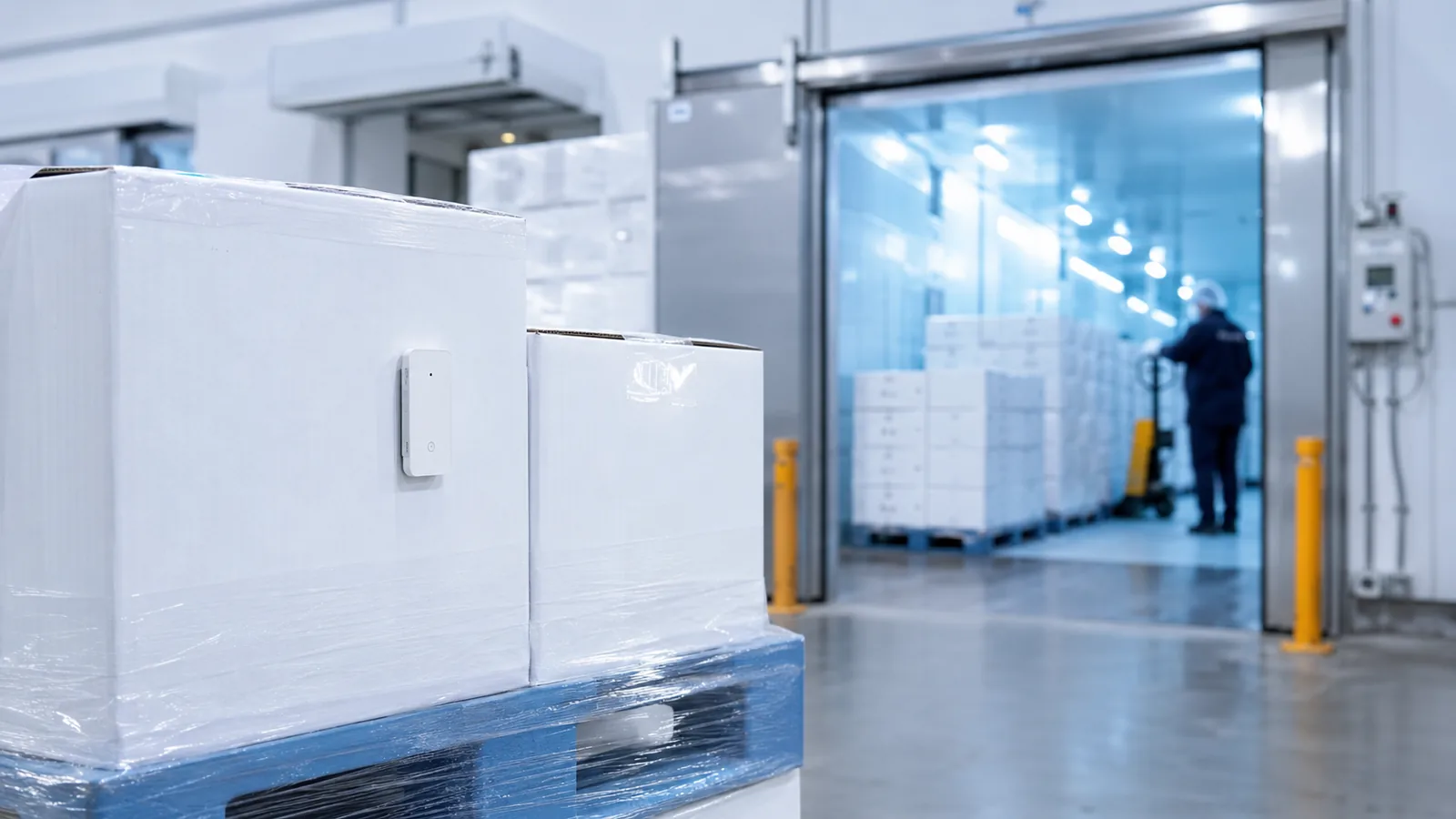
A BLE temperature logger deployed on cold chain shipment cartons in a refrigerated logistics environment.
Article summary
BLE temperature loggers are useful when the cold chain team needs lightweight, low-power and reusable monitoring at carton, pallet, room or vehicle level. The important design question is not only “Which logger should we use?” but “How will the temperature record be created, retrieved, reviewed and retained?”
- Use local storage to protect the temperature record during communication gaps.
- Use BLE broadcast for short-range data collection by phone or gateway.
- Configure intervals and alarms based on product risk, shipment duration and required evidence.
- Define an exception workflow before the first shipment starts.
- Treat PDF/CSV reports as quality records, not just device exports.
1. Start with the monitoring objective, not the device
A cold chain monitoring design should begin with a practical question: what decision will the temperature record support? For a logistics operator, the decision may be whether a route, refrigerated truck or warehouse zone performed within expected limits. For a pharmaceutical distributor, the record may support quality review after transportation. For food and perishables logistics, the record may support investigation of a rejected delivery, a spoilage claim or a supplier performance issue.
The logger only creates raw evidence. The operating process determines whether that evidence is usable. A good monitoring design should define the product or lane being monitored, the acceptable temperature range, the alarm thresholds, the logger placement method, the data collection method, the review responsibility and the retention location for exported records.
This is especially important in regulated or customer-audited supply chains. The FDA Food Traceability Rule focuses on Critical Tracking Events and Key Data Elements for certain foods; temperature logs do not replace those records, but they can provide additional environmental context when linked to the correct shipment, lot, pallet or facility record. In pharmaceutical distribution, EU Good Distribution Practice is concerned with controlling the distribution chain and maintaining product quality and integrity; temperature records are one element within a broader quality system.
2. Why BLE is useful in cold chain monitoring
Bluetooth Low Energy is well suited to reusable temperature logging because it allows a device to run for long periods while broadcasting short packets of sensor status. For many cold chain use cases, the value is not continuous cellular transmission from every carton. The value is reliable local recording, simple nearby reading and gateway capture when infrastructure is available.
A BLE logger can be placed inside a carton, attached to a pallet, installed in a cold room or used inside a returnable tote. It can store the temperature history locally, while broadcasting current status to a phone or gateway. This architecture is useful when shipment value, facility layout or operating cost does not justify cellular hardware on every handling unit.
BLE does have practical limits. Radio range depends on packaging, metal racks, insulation, liquid products, vehicle structure, gateway position and interference. Open-space range should not be treated as guaranteed range inside a loaded reefer or warehouse. For any serious deployment, teams should test signal coverage in the real operating environment.
3. Reference architecture: local logging, app reading and gateway upload
The simplest BLE temperature logging architecture has three data paths.
Path A: on-device logging
The logger records data at the configured interval and keeps the record locally. This is the baseline path. It is important because shipments and warehouses are not always connected environments. If a phone or gateway is not nearby, the device should still maintain the evidence trail.
Path B: mobile app reading
A supervisor, driver, warehouse operator or quality inspector connects to the logger from a mobile app. This path is useful for sample checks, receiving inspection, route completion review and ad hoc troubleshooting. It is also useful during initial configuration because interval settings, alarm limits and time synchronization can be controlled before deployment.
Path C: BLE gateway capture
A gateway receives BLE broadcasts and forwards readings to a cloud platform. This path is useful for unattended warehouse monitoring, refrigerated vehicles, high-value lanes, cross-dock areas and large deployments where manual app reading is not operationally efficient. Gateway density and placement should be designed around the facility or vehicle layout.
4. BTT02 as a reference BLE temperature logger
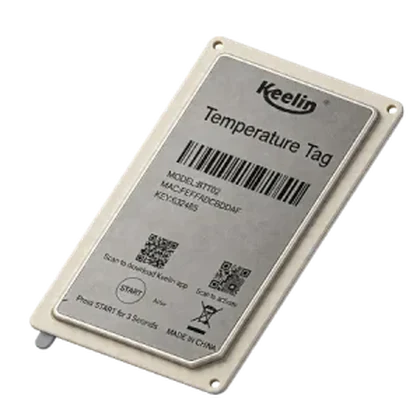
The Eelink BTT02 is a reusable BLE 6.0 temperature data logger designed for cold chain and logistics use cases. It is 2.4 mm thick, records up to 100,000 readings on device, supports BLE broadcast and Bluetooth connection, includes a built-in light sensor, and can export data through BeaconCloud in PDF or CSV format. Its published specifications include ±0.2°C accuracy across -20°C to +60°C, IP67 protection, up to 500 m open-space BLE broadcast range, and a 1000 mAh battery rated up to three years depending on configuration and operating conditions.
These specifications make the device suitable for workflows where the operator needs a thin logger that can be inserted into packaging, attached to cartons or distributed across warehouse zones. The light sensor is also useful when the monitoring requirement includes evidence of carton opening or unexpected exposure events.
| Capability | Operational use | Implementation note |
|---|---|---|
| Local storage | Maintains the temperature history when no phone or gateway is nearby. | Choose collection and storage intervals based on shipment duration and required record granularity. |
| BLE broadcast | Enables app reading and gateway capture without physical USB retrieval. | Validate range in the real environment; packaging and metal structures can reduce coverage. |
| Temperature alarm | Flags high/low excursions for operational or quality review. | Alarm thresholds should match product requirements and internal SOPs, not generic defaults. |
| Light sensor | Helps identify opening, exposure or handling events. | Define what light exposure means for each use case before treating it as an exception. |
| PDF/CSV export | Supports review, shipment documentation and record retention. | Store exported reports in the system of record with shipment, lot or location identifiers. |
5. Configuration choices that affect data quality
The three configuration settings that matter most are the collection interval, the storage interval and the broadcast interval. Shorter intervals provide more detailed data but consume more battery and create larger datasets. Longer intervals extend battery life and simplify reports but may miss short excursions. The right interval should be based on product risk, shipment duration, expected thermal inertia and the type of decision the record must support.
Alarm thresholds should be set after the business has defined what counts as an actionable exception. For example, a brief door-opening event at a dock may not have the same quality implication as several hours outside range. A technical alarm threshold is not the same as a product release decision. The alarm should trigger review; the SOP should define the decision.
Time synchronization is another critical detail. Temperature data without reliable timestamps is difficult to match to loading, departure, border delay, cross-dock, receiving or claim events. Each deployment should include a time sync step before shipment or facility monitoring begins.
6. Placement is part of the measurement
Logger placement affects the meaning of the data. A sensor placed near a door, evaporator outlet or pallet edge may show a different profile from a sensor placed near the product core. Neither reading is automatically “right” or “wrong”; each represents a different question.
For lane validation or risk assessment, it may be useful to place multiple loggers across a pallet, container or room to understand temperature gradients. For routine monitoring, a standard placement method should be documented so that each trip or zone can be compared consistently. For high-value or regulated products, placement should be justified in the quality procedure.
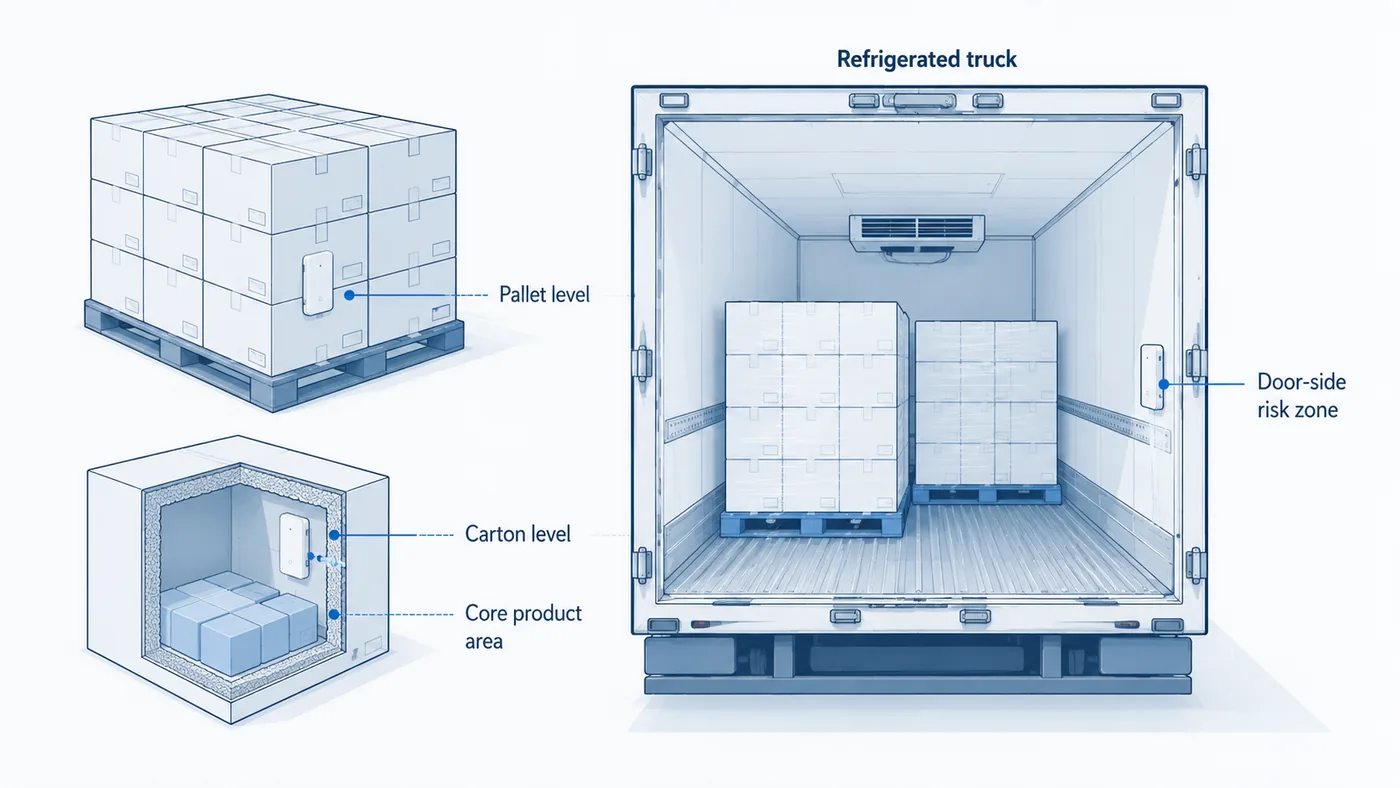
Logger placement affects the meaning of temperature data. Pallet-level, carton-level, core-product and door-side positions answer different operational questions.
7. Exception management: decide before the alarm happens
A temperature alarm is only useful when the organization knows what to do with it. Before deployment, the team should define who receives or reviews alarms, what information must be checked, what corrective actions are possible, and how the final decision is recorded.
A practical exception review normally includes the shipment or zone ID, device ID, alarm type, timestamp, duration, maximum or minimum temperature, product requirement, lane history, handling notes and any corrective action. If a gateway is used, the review can begin earlier. If the logger is read only at destination, the process should focus on receiving inspection and post-trip analysis.
8. Data model: what should be retained?
Retaining only a temperature curve is often not enough. For the record to be useful later, it should be connected to the asset, shipment or location it represents. At minimum, a practical data model should include the device ID, reading timestamp, temperature value, light status, battery status, alarm state, configuration version, deployment location and retrieval method.
When data is exported as PDF or CSV, the file should be named and stored in a way that links it to the shipment, batch, order, pallet, room or vehicle. This is where many temperature monitoring programs fail: the sensor works, but the record is not tied to the business event that matters.
9. How this relates to food and pharmaceutical requirements
Food traceability and temperature monitoring are related, but they are not the same. FSMA 204 requires certain food supply chain participants to maintain and share traceability records around defined Critical Tracking Events and Key Data Elements. A temperature logger can add environmental evidence to a traceability file, but it should be linked to the right lot, pallet, shipment or location record.
In pharmaceutical distribution, temperature monitoring normally sits inside a broader GDP quality system. The system should include qualification, approved procedures, personnel responsibilities, storage and transportation controls, deviation handling and record retention. BLE loggers can support this system by collecting and exporting temperature history, but the deployment must still be governed by quality procedures.
For air cargo healthcare shipments, IATA’s Temperature Control Regulations address temperature management requirements and standards for pharmaceutical transportation. In practice, this means sensor records should be handled as part of a broader shipment control process rather than as isolated files.
10. When BTT02 should be paired with other tracking devices
A BLE temperature logger is not a replacement for GPS or cellular tracking when real-time location is required. If the business needs vehicle location, route deviation alerts, geofencing, door status, cellular transmission or continuous cloud visibility across long distances, the BLE logger should be paired with a gateway-capable tracker or telematics device.
This combined architecture is often the most practical approach for logistics operators. The BLE logger records temperature close to the product. The gateway or GPS tracker provides connectivity and location context. The cloud platform then connects sensor events to route, vehicle, facility and customer workflows.
11. Deployment checklist
- Define the monitoring objective: shipment review, facility audit, lane validation, claim investigation or continuous exception detection.
- Define product limits: temperature range, allowed duration outside range and any light-exposure requirement.
- Choose logger placement: carton, pallet, reefer, cold room, return tote or multiple mapping points.
- Configure intervals: collection interval, storage interval and BLE broadcast interval.
- Synchronize time: confirm logger clock before deployment.
- Test data retrieval: confirm phone reading or gateway upload before operational use.
- Document responsibility: define who reviews alarms and who owns corrective action.
- Retain records: store PDF/CSV reports with the relevant shipment, lot, route or zone record.
12. Common mistakes to avoid
- Using default thresholds without product input. Alarm settings should reflect product requirements and business rules.
- Assuming open-space BLE range applies inside vehicles or warehouses. Always test in the real environment.
- Collecting data without a review owner. Unreviewed alarms do not improve cold chain control.
- Exporting reports without shipment context. A PDF or CSV must be tied to the relevant order, pallet, batch, lane or location.
- Treating a logger as a complete compliance system. Procedures, validation and records management are still required.
Conclusion
BLE temperature logging is valuable because it makes cold chain monitoring more scalable at the carton, pallet, vehicle and facility level. The strongest deployments are designed as workflows, not isolated devices. Local storage protects the record. BLE broadcast provides flexible reading. Gateways improve visibility. PDF and CSV exports support review and retention. The quality of the result depends on how well the logger is configured, placed, connected and governed.
For teams evaluating BTT02, the best starting point is to define one lane, facility zone or shipment type, document the monitoring objective, configure the logger accordingly and test the full workflow from placement to export before scaling.
References and technical resources
The following resources are useful for technical evaluation and regulatory context.
Technical FAQ
Q: Does a BLE temperature logger replace a cold chain quality procedure?
No. A BLE logger is a data source. Regulated cold chain operations still require documented procedures for logger placement, configuration control, time synchronization, alarm review, corrective action and record retention.
Q: When should a BLE logger be paired with a gateway?
A gateway is useful when operators need unattended monitoring, faster exception visibility, multi-zone warehouse monitoring or automated cloud upload. Local reading by phone can be sufficient for lower-frequency shipment review.
Q: What should be recorded besides temperature values?
Useful records include device ID, shipment or location assignment, timestamp, temperature, light status, alarm state, battery status, configuration version, data retrieval method and reviewer notes for exceptions.
BTT02 technical evaluation
Review the BTT02 specifications, data pathways and technical documentation before designing a pilot deployment.