How to Define Temperature Excursions for Cold Chain Compliance
This article complements the GPT29 Cold Chain White Paper.
Download the PDF: GPT29 Cold Chain Tracking for Freezers — Engineering & Compliance White Paper
Why excursions must be defined (not assumed)
Many cold chain programs fail because they treat raw sensor points as “truth” without defining what constitutes an actionable incident. In reality, temperature telemetry includes normal fluctuations: defrost cycles, door openings during planned handling, sensor placement artifacts, or transient warm air exposure during transfers.
If you trigger alerts on every fluctuation, teams stop trusting the system. If you filter too aggressively, you miss real incidents. The solution is a clear temperature excursion definition that is consistent with your SOPs and produces an audit-ready record.
Excursion definition = threshold + duration + hysteresis
A robust excursion definition typically contains three parts:
- Threshold(s): values that represent unacceptable conditions for a specific commodity or program.
- Duration rule: the condition must persist for N minutes (or N consecutive samples) before it is considered an excursion.
- Hysteresis / clear condition: the “return to normal” rule prevents oscillation and noisy open/close events.
For example, a frozen goods program might care about excursions relative to a target setpoint (often around -18°C in many operations), but thresholds must be defined by your product requirements and SOP—not by the device. The key is the structure: threshold + duration + clear condition.
Sampling strategy: you can’t define duration without consistent time semantics
Excursion duration requires time-consistent sampling. At minimum, define:
- Telemetry sampling interval (how often the sensor is read).
- Reporting interval (how often the device transmits data).
- Event interval (how often you transmit event summaries during an excursion).
A common best practice is to sample more frequently than you report. That allows the device (or your backend) to detect excursions accurately while keeping network transmissions economical for long missions. This ties directly into battery planning: Designing a 60+ Day Battery Mission (Reporting Strategy).
Implementation option A: detect excursions on-device
The device applies the threshold/duration logic locally and emits an event when an excursion starts and ends. This reduces payload size and makes incidents explicit, but it requires careful firmware validation.
Implementation option B: detect excursions in your platform
The device streams raw telemetry; your backend computes excursions. This offers flexibility for changing rules, but it requires consistent ingestion, deduplication, and robust handling of missing data during offline windows.
Many programs use a hybrid approach: device triggers a “possible excursion” signal, while the backend confirms and summarizes for reports.
Reducing false positives: smoothing, hysteresis, and minimum-event rules
Three techniques are commonly used to reduce noise:
- Hysteresis: define a different threshold for “end of excursion” than for “start of excursion,” so events do not flap at the boundary.
- Minimum duration: require the threshold violation to persist for a defined time window before opening an excursion.
- Optional smoothing: apply a short moving average or median filter to reduce single-sample anomalies (use with caution—do not hide real incidents).
Note: smoothing and filtering should be transparent to auditors. If you smooth data, document the method and ensure raw measurements remain available where required.

Filtering the noise. By applying intelligent smoothing and duration logic, raw sensor data is converted into trustworthy, verified incidents, reducing alert fatigue for operations teams
What an audit-ready excursion record should contain
Whether you compute excursions on-device or in your backend, an excursion event should contain fields that allow an investigator to reconstruct the story quickly. Recommended fields include:
- Excursion start timestamp and end timestamp (use a consistent timezone policy, typically UTC).
- Duration (seconds/minutes) and exceedance direction (above/below threshold).
- Max/min temperature observed during the excursion.
- Threshold definition reference (policy version or rule ID) for audit traceability.
- Context signals: location at start/end, exposure event flags, shock event flags, connectivity gaps.
Context signals are essential for root-cause analysis. A suspected door-open investigation may rely on light exposure events: Using Light Exposure Events for Door-Open/Exposure Analysis. Handling correlation may rely on shock events: Shock & Vibration Event Logging for Cold Chain.
Example: excursion event JSON (template)
Below is a simplified example payload you can adapt to your system. This is not a claim of a specific API format—rather, it shows the fields that make an excursion “explainable” and audit-friendly:
{
  "device_id": "GPT29-XXXXXX",
  "event_type": "temperature_excursion",
  "rule_id": "temp_rule_v3",
  "started_at_utc": "2026-01-12T03:14:00Z",
  "ended_at_utc": "2026-01-12T04:02:00Z",
  "duration_seconds": 2880,
  "threshold": {
    "direction": "above",
    "value": -18,
    "unit": "C"
  },
  "summary": {
    "max_temp_c": -12.7,
    "min_temp_c": -19.1,
    "samples": 48
  },
  "context": {
    "location_start": {"lat": -33.42, "lng": -70.65},
    "location_end": {"lat": -33.42, "lng": -70.65},
    "light_exposure_flag": true,
    "shock_event_flag": false,
    "offline_gap_detected": true
  }
}
If your team is integrating telemetry into an existing platform, make sure your ingestion pipeline handles duplicates and offline replays safely. Deep dive: Data Integrity for International Cold Chain IoT.
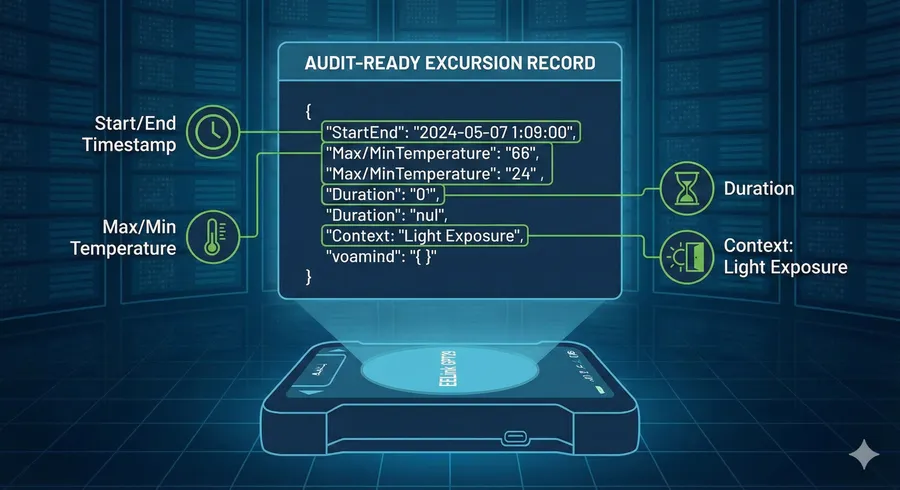
The structure of evidence. An audit-ready record requires more than just a temperature reading; it needs precise timestamps, duration context, and correlated sensor flags (e.g., light exposure)
Installation matters: define excursions only after measurement validity is addressed
Temperature data is only as good as the measurement point. In freezers and reefers, metal enclosure and airflow patterns can produce gradients. If your measurement point is not representative, your excursion logic will not match operational reality.
Review installation best practices here: Installing Trackers on Freezers and Reefer Containers: Practical Guide. For cold chain monitoring fundamentals, see: IoT Temperature and Location Sensor Tracker.
Download the white paper for the full methodology
The GPT29 cold chain white paper includes deeper guidance on reporting policies, event semantics, buffering/resend strategies, and pilot acceptance criteria.
Download (PDF): GPT29 Cold Chain Tracking for Freezers — Engineering & Compliance White Paper
Contact: Contact Us or [email protected].
FAQ
Should I alert on every threshold crossing?
Usually no. A duration rule and hysteresis are commonly used to avoid false positives. Alerts should map to operational actions, not raw sensor fluctuations.
Where should I store excursion rules?
Store rules in a versioned policy document (or configuration) so investigators can reference the exact definition used at the time of the event.