Shock & Vibration Event Logging for Cold Chain: From Accelerometer Signals to Actionable Incidents
Part of the GPT29 cold chain engineering series. For the full methodology, download: GPT29 Cold Chain Tracking for Freezers — Engineering & Compliance White Paper.
Resource page: GPT29 Cold Chain White Paper (Overview + Download)
Why handling incidents matter in cold chain investigations
In overseas cold chain operations, investigations often involve multiple hypotheses: refrigeration failure, prolonged dwell, exposure, or mishandling. Shock and vibration signals can help validate or eliminate the mishandling hypothesis:
- Did the asset experience a high-energy shock that could indicate a drop or collision?
- Did it experience sustained vibration that correlates with a transport segment?
- Did shocks occur near the same time and location as a temperature excursion?
Importantly, a shock event does not automatically mean product damage. It is an investigative signal that becomes valuable when combined with temperature and location evidence. For temperature evidence, see: How to Define Temperature Excursions (Audit-Ready).
Define your goal: alerting vs evidence
Before tuning thresholds, decide whether your program uses shock signals primarily for:
- Real-time alerting (rare; can be noisy and route-dependent), or
- Evidence logging for post-incident investigation and claims support (common and practical).
Evidence logging typically requires fewer false alarms and stronger summarization fields. Many programs use “notify only on severe shocks” and log moderate events for reporting.
Accelerometer basics: what you can measure
Accelerometers measure acceleration along axes (often X/Y/Z). From these signals you can derive:
- Peak acceleration (g-force) over a short window — useful for shocks.
- RMS acceleration or band-limited energy — useful for vibration characterization.
- Event duration and repetition — useful for differentiating a single impact from sustained vibration.
In practice, your “shock event” should be defined as an exceedance of a peak threshold plus a short time window; vibration can be defined as sustained energy over a longer window.
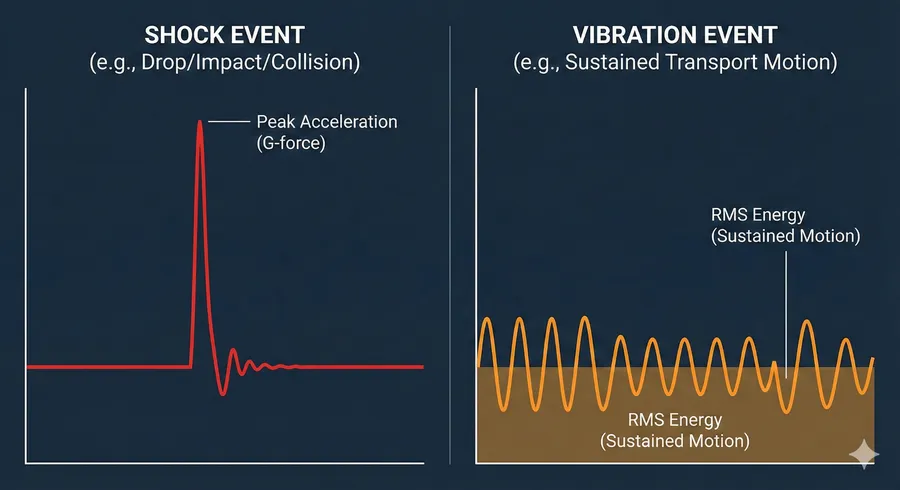
Distinguishing impact from motion. Shock events are characterized by sudden high-peak acceleration (G-force), while vibration is typically measured by sustained RMS energy over time
Threshold tuning: reduce false positives without missing meaningful incidents
Shock thresholds are often route- and installation-dependent. A structured tuning approach is:
Step 1: establish a baseline during normal handling
Record accelerometer metrics during typical moves: forklift handling, normal truck vibration, and terminal transfers. This defines what “normal” looks like for your environment.
Step 2: define severity bands
Instead of a single threshold, define multiple severity levels, such as:
- Informational: log only
- Moderate: log + flag for review
- Severe: alert + preserve high-resolution context (if available)
Step 3: apply simple filtering rules
Common filtering techniques include:
- Debounce: avoid repeated event triggers for the same incident window.
- Minimum separation: require time between severe events unless severity increases.
- Orientation robustness: use magnitude (vector norm) rather than a single axis when device orientation varies.
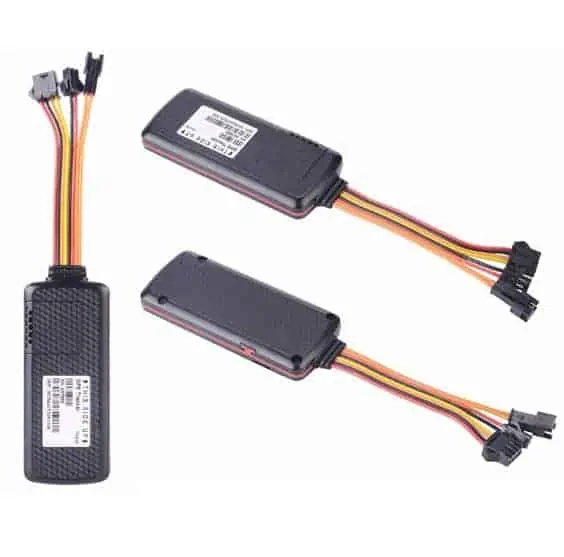
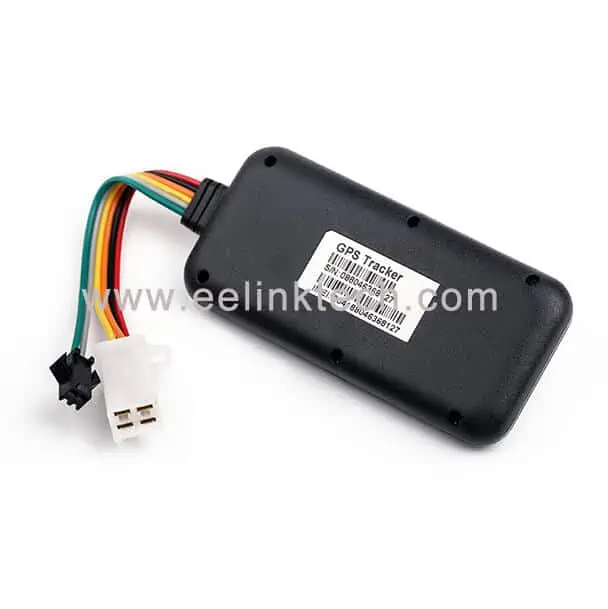
Installation affects signal quality. For practical mounting recommendations, read: Installing Trackers on Freezers and Reefer Containers (Practical Guide).
Event summaries: what to store for audit and claims
A shock/vibration event should be explainable. Recommended summary fields include:
- Event timestamp (UTC) and optional start/end window.
- Peak magnitude and optional per-axis peaks.
- Duration and repetition count (for vibration).
- Severity level mapped to your policy.
- Location context (where it happened) and motion state (moving/stationary, if available).
- Correlation flags: nearby temperature excursion, nearby light exposure, offline gap presence.
These fields allow investigators to connect handling incidents to other evidence without requiring raw accelerometer waveforms in every case.
Correlation patterns that improve incident investigations
Shock events become operationally meaningful when correlated:
- Shock → temperature change: a high-severity shock may coincide with equipment displacement or partial door opening.
- Shock + light exposure: handling and exposure together can indicate door-open during transfer.
- Shock in high-risk location: terminal areas often have different handling patterns than inland legs.
For exposure correlation, see: Using Light Exposure Events for Door-Open/Exposure Analysis.
Data integrity matters: don’t lose the incident window
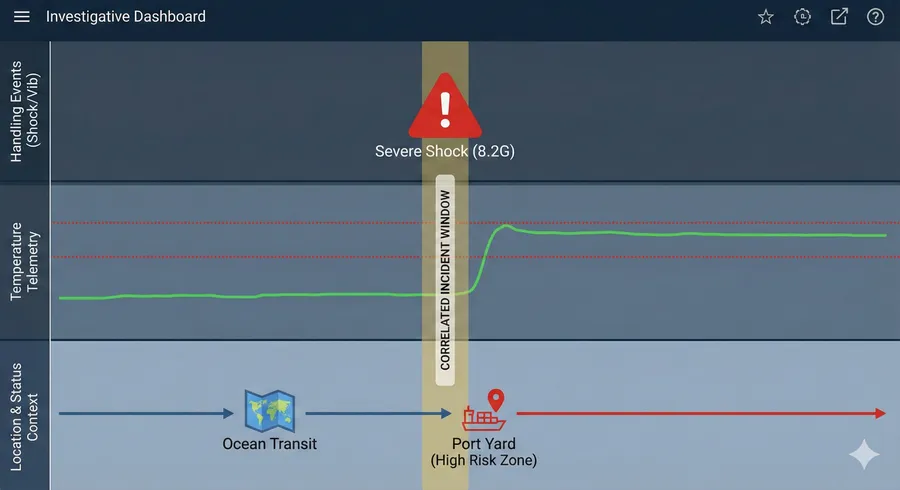
The power of correlation. A shock event becomes critical investigative evidence when the timeline shows it coinciding with a temperature excursion and a specific high-risk location context
Handling events often occur during coverage transitions (yard-to-warehouse, vessel-to-terminal). Ensure your system handles offline buffering, resends, and deduplication so you do not “lose” the incident window: Data Integrity for International Cold Chain IoT.
Download the white paper for complete implementation guidance
The GPT29 cold chain white paper provides a deeper blueprint for reporting policy, event definitions, installation realities, and integration patterns.
Download (PDF): GPT29 Cold Chain Tracking for Freezers — Engineering & Compliance White Paper
Contact: Contact Us or [email protected].
FAQ
Does a shock event prove cargo damage?
Not by itself. Shock events are investigative signals. They are most useful when correlated with temperature excursions, exposure signals, and location/handoff context.
Should I store raw accelerometer data?
In many deployments, event summaries are sufficient and more scalable. If your program requires forensic depth, store high-resolution data selectively for severe events.