RedCap-Ready Tracker: BOM & Compliance Checklist for Faster EVT to PVT
A hardware-only path to de-risk certification, logistics, and scalable manufacturing before firmware freeze.
When teams talk about “RedCap-ready” trackers, the discussion often starts with module selection and ends with a rushed certification timeline. In practice, schedule slip usually comes from hardware realities: RF surprises, power peaks, battery shipping paperwork, enclosure repeatability, and late-stage BOM changes.
This article is intentionally hardware-only. It focuses on:
- BOM essentials for a RedCap-ready tracker
- A market-aware compliance map
- Evidence-grade artifacts that de-risk EVT→DVT→PVT
- Manufacturing readiness so your “working prototype” becomes a scalable industrial product
1. Why RedCap Now (and What “RedCap-Ready” Should Mean)
3GPP’s NR RedCap (Reduced Capability) feature set is designed to lower UE complexity through measures such as fewer RX/TX antennas, reduced bandwidth usage, lower power consumption, and relaxed data rates and processing capability. That makes RedCap a practical connectivity option for industrial devices that do not need full-feature 5G NR performance.
From an industrial perspective, RedCap is often positioned to close the gap between high-end NR devices and LPWA options such as NB-IoT / LTE-M. It is also being discussed as a fit for mobile trackers and industrial sensors—while acknowledging that real-world adoption depends on network evolution (e.g., SA readiness) and certification planning.
A useful engineering definition of “RedCap-ready” is not a logo. It means:
- Your RF + power + enclosure architecture has been validated early enough that certification and manufacturing risks are visible before firmware freeze.
- Your BOM, compliance matrix, and evidence pack are structured so engineering, compliance, procurement, and manufacturing can make decisions using traceable artifacts.
2. BOM Essentials (Hardware-Only, Scale-First)

A RedCap-ready tracker BOM should be built for industrialization, not only for a demo. Eelink’s hardware engineering services approach ensures that every component selection supports both prototype validation and volume manufacturing.
Cellular & RF (RedCap Path)
- RedCap modem/module selection aligned to target bands and intended markets
- RF front-end strategy (filters, switches, matching network, layout constraints)
- Antennas: Primary cellular antenna, diversity strategy, keep-out zones, isolation, and cable/connector discipline
- SIM / eSIM architecture: nano-SIM or eUICC, ESD protection and test access
- Testability by design (DFT): RF test strategy, antenna tuning/matching accessibility
Positioning Chain
- GNSS antenna and front-end planning
- Grounding/shielding strategy and coexistence with cellular RF
- Noise control and layout discipline (especially around high-di/dt power blocks)
Power Tree (The Usual Root Cause of “Surprise” Failures)
- Cell/pack strategy aligned to temperature range and shipping constraints
- Protection and charging (if rechargeable)
- Peak current behavior: attach/registration bursts, transmit events, voltage droop margin
- Measurement hooks: current measurement points, temperature sensing near hotspots
Sensors & Memory
- Accelerometer for motion/wake logic
- Temperature/humidity where cold-chain or condition monitoring is required
- Tamper/light sensing for removal detection
- Non-volatile memory sized for buffering and traceability requirements
Security & Identity (Hardware-Anchored)
- Secure element (or architecture supporting secure boot and protected key storage)
- Controlled physical access to debug/programming pads
Enclosure & Deployment (Industrial Reality)
- IP target backed by sealing design and measurable process controls
- Gaskets, adhesives, and mounting methods validated for fleet operations
- Connector minimization in harsh environments; validate mating cycles if used
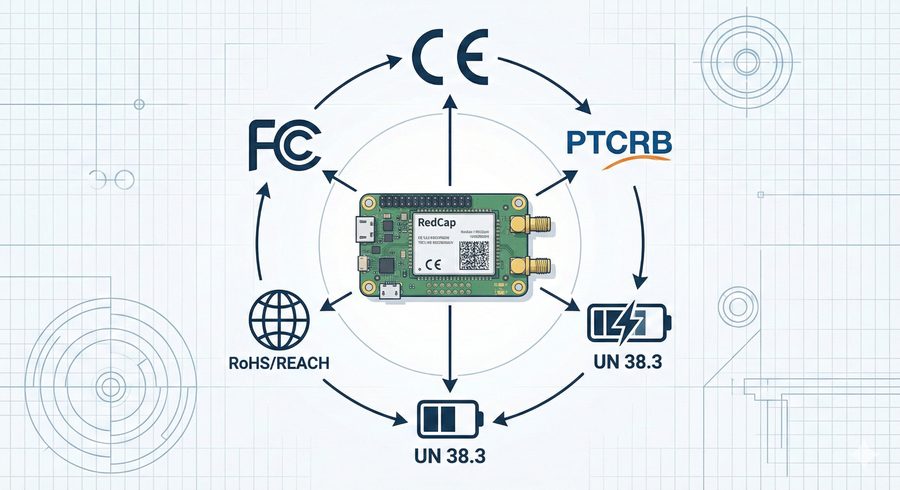
3. Compliance & Certification Map
Certification is a stack, and the stack is market-dependent.
North America (Typical Cellular Trackers)
- PTCRB pathway and carrier acceptance planning
- FCC equipment authorization requirements for RF devices
- ISED requirements for Canada (labeling and documentation)
EU / EEA Markets
- CE marking under the Radio Equipment Directive (RED)
- Supply-chain material compliance: RoHS (restricted substances), REACH (SVHC obligations)
Batteries & Logistics
- UN 38.3 test compliance for lithium cells/batteries
- Complete, traceable test documentation pack for logistics partners
Environmental & Durability Claims
- IP rating verification aligned to IEC 60529
- Vibration/impact plans reflecting real deployment: vehicles, containers, pallets, assets
Practical Note: Early pre-compliance RF scans and battery logistics checks are usually cheaper than late hardware redesign.
4. Evidence-Grade Artifacts
To accelerate EVT→PVT, treat the evidence pack as a deliverable—not a by-product. Our testing and QA framework structures evidence collection from the first EVT build through production validation.
Power Evidence
- Current profiles across key modes: sleep baseline, attach/registration peaks, report/transmit bursts
- Battery life projection with documented assumptions (interval, temperature, coverage)
Thermal Evidence
- Chamber logs across the operating range
- Correlation between temperature, peak current events, and voltage margins
RF Evidence
- Conducted sweeps and antenna matching logs
- OTA sanity checks early enough to avoid enclosure-driven surprises
- Clear “pre-scan → formal lab” bridge: what failed, what changed, what retest proved
Mechanical / Ingress Evidence
- Vibration, drop, and ingress test logs by phase: EVT (design intent), DVT (robustness), PVT (process repeatability)
Traceability Evidence
- Build history: PCB rev, enclosure rev, antenna rev, battery lot, adhesive lot
- Serialization policy tied to test data
- Golden sample definition and controlled storage
5. Manufacturing Readiness (EVT → DVT → PVT)
A design that passes a lab once is not the same as a design that ships reliably at scale.
EVT Phase
- Golden sample definition
- Early jigs and repeatable measurement workflows
- Identify process-sensitive parameters: antenna placement, sealing compression, torque windows, adhesive cure
DVT Phase
- ICT/FCT coverage definition and sampling rules
- SPC focus areas: battery consistency, sealing consistency
- Incoming QA plans for risk items: cells/packs, adhesives, gaskets, antennas
PVT Phase
- Repeatability proof and yield learning loop closure
- Packaging validation aligned with shipping and logistics constraints
Multi-Site Manufacturing: Verify process portability—consistent jigs, calibration, work instructions, traceability fields, and acceptance criteria across sites.
6. Procurement & Risk
- Second-source strategy for risk components: cells/packs, adhesives, antennas, connectors
- EOL watchlist and validated alternates
- MOQ/lead-time buffers set before DVT
- Variant matrix discipline for bands, carrier requirements, labels, and region-specific documents
Closing
A RedCap-ready tracker is not a platform story. It is a hardware evidence story—and an industrialization story.
In Eelink’s overseas B2B customization programs, we structure BOM decisions, compliance mapping, and evidence packs so teams can assess risk early and convert prototypes into stable, traceable, scalable industrial products. Our IoT hardware edge combines OEM/ODM capabilities with dual-site manufacturing operations across China and Vietnam, designed for process portability and supply-chain resilience.
If you would like a blank “artifact pack” template (BOM checklist, compliance matrix, and evidence log formats), we are happy to share it.