Using Light Exposure Events to Investigate Door-Open or Cargo Exposure in Cold Chain Tracking
This post is part of the GPT29 cold chain engineering series. For the full methodology, download: GPT29 Cold Chain Tracking for Freezers — Engineering & Compliance White Paper.
Resource page: GPT29 Cold Chain White Paper (Overview + Download)
Why light exposure matters in freezer and reefer investigations
Many cold chain incidents involve an “exposure hypothesis”: the freezer or reefer was opened, left ajar, or otherwise exposed to warmer ambient air. The problem is that exposure is often hard to prove after the fact—especially across handoffs and third parties.
Light exposure telemetry can help answer practical questions:
- Did the asset experience a plausible door-open / exposure event near the time of a temperature excursion?
- Was the exposure event short (planned handling) or prolonged (risk incident)?
- Did it happen at a known high-risk location (port, terminal, yard, cross-dock)?
Light exposure events are most valuable when they correlate with other evidence signals—temperature excursion semantics and location context. See: How to Define Temperature Excursions (Threshold + Duration).
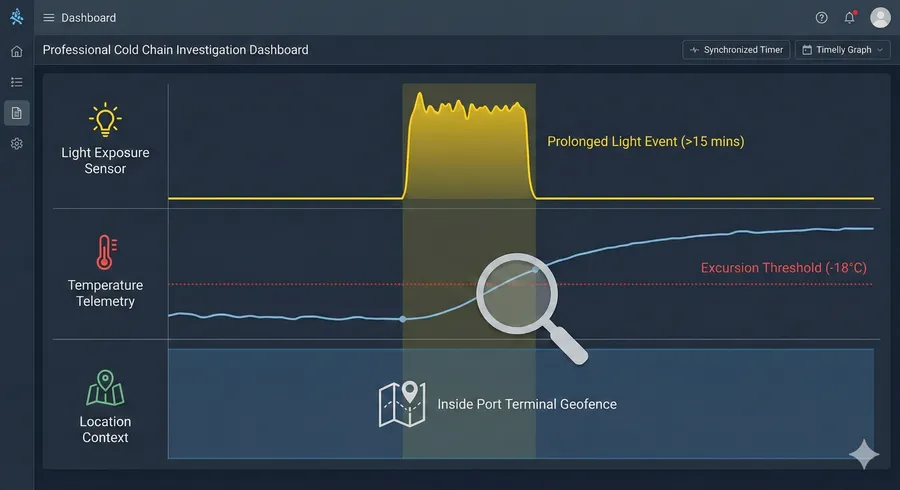
Evidence correlation is key. A light exposure event becomes a strong investigative signal when it aligns with a subsequent temperature rise and specific location context (e.g., a port terminal)
Important limitation: light ≠ door open (treat it as a signal)
A light sensor measures incident light at the sensor location. A door-open event may or may not generate a strong light signal depending on:
- Device placement (inside vs outside, near seams vs deep interior).
- Ambient lighting (night operations, covered yards, or enclosed warehouses).
- Physical obstructions (covers, packaging, mounting orientation).
- Container design (light leakage characteristics).
For engineering-grade deployments, you should define light exposure events as “potential exposure indicators” and combine them with other signals (temperature slope, movement, geofence, shock).
Installation principles for meaningful light exposure events
Light event quality is highly installation-dependent. For freezer and reefer deployments, a practical set of principles is:
- Place the sensor where light changes are meaningful (often near door seams or areas that receive ambient light when opened).
- Avoid constant ambient exposure if the device is mounted outside (otherwise the light signal is always “high”).
- Protect the sensor from accidental covering (labels, tape, insulation, or packaging material).
- Document the placement so investigators can interpret signals correctly.
For a broader deployment SOP covering signal shielding and mounting reliability, read: Installing Trackers on Freezers and Reefer Containers: Practical Guide.
How to tune thresholds: reduce false positives without hiding real exposure
A common failure mode is to set a single threshold and trigger alerts on every crossing. In real environments, that will produce noise. Instead, treat tuning as a structured process:
Step 1: establish a baseline in “closed” conditions
Capture light readings during normal closed operation across different times of day and locations. Identify a baseline range and variability.
Step 2: perform controlled “door open” tests
In a controlled setting, open the door for short and long durations. Record how quickly the light signal rises and falls and whether it saturates.
Step 3: set a two-stage rule: detection + persistence
Use a rule such as:
- Trigger condition: light exceeds threshold or rises rapidly above baseline.
- Persistence condition: the condition persists for N seconds/minutes, or repeats across N samples.
The persistence rule is critical because it filters out transient spikes (e.g., brief reflections or accidental sensor exposure).
Step 4: define event severity based on duration
Not all exposure is equal. A short event during planned handling may be informational; a prolonged event may indicate risk. Define severity bands by duration so operations can respond appropriately.
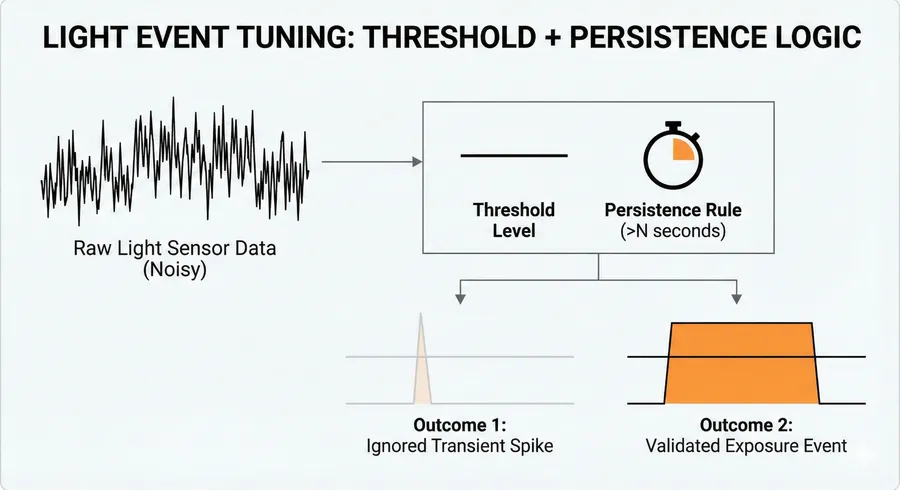
Filtering the noise. To avoid false alarms from brief handling, engineering teams should implement a two-stage rule that requires light levels to exceed a threshold for a defined persistence duration.
Best practice: correlate light exposure with temperature and location
A light exposure event becomes more meaningful when correlated:
- With temperature slope: a door-open event that is followed by a warming trend is more significant than one without thermal impact.
- With location: if exposure happens in a geofenced risk zone (port yard, terminal), it strengthens the investigation timeline.
- With handling signals: a shock event can indicate a transfer or drop scenario that may coincide with exposure.
For handling signals, see: Shock & Vibration Event Logging for Cold Chain. For data continuity (ensuring you do not miss exposure windows), see: Data Integrity for International Cold Chain IoT.
Example: exposure incident scoring (template logic)
In many programs, the goal is to classify a likely exposure incident rather than alert on every light change. A simple scoring model can be:
- +1 if light exposure persists beyond the “brief handling” band.
- +1 if temperature begins trending toward an excursion threshold within a defined window.
- +1 if exposure occurs in a high-risk geofence (terminal/yard).
- +1 if a shock event occurs near the exposure timestamp.
If score ≥ 2, classify as “investigate”; if score ≥ 3, classify as “high-risk incident.” This is not a universal rule—use it as a structured starting point for pilot calibration.
Download the white paper for full implementation guidance
The GPT29 white paper expands on event modeling, policy design, and pilot acceptance criteria for light exposure and related cold chain signals.
Download (PDF): GPT29 Cold Chain Tracking for Freezers — Engineering & Compliance White Paper
Need pilot advice? Contact us via Contact Us or [email protected].
FAQ
Can light exposure detect door-open in every case?
Not reliably in every installation. Lighting conditions, placement, and container design matter. Use light exposure as a signal and correlate it with temperature and location.
Should I alert on every light exposure event?
Usually no. Use persistence rules and severity bands to separate brief handling from prolonged exposure risk.