How to Choose an Asset Tracking Hardware Partner
Introduction
Imagine a logistics team hastily starting a cold chain pilot with off-the-shelf asset tracking devices. Eager to show quick results, they deploy a dozen trackers to monitor refrigerated shipments. A few weeks in, problems emerge: batteries die far sooner than expected once the trackers face sub-zero temperatures, and several devices drop offline at international borders due to missing network approvals.
In another scenario, an equipment rental company rushes into a pilot using a consumer-grade tracker. It works fine in the lab, but on the field, the housing cracks on heavy machinery and the mounting falls off during transit. These setbacks share a common root cause – in the rush to pilot, the teams overlooked critical hardware factors (battery performance, certifications, ruggedization, etc.) that only became painfully apparent later.
Such situations are all too common. Choosing an asset tracking hardware partner isn’t just about grabbing the first device that “works” in a demo. It requires a systematic evaluation of the partner’s technology and capabilities. This guide walks through five key areas – battery life, certifications, customization, manufacturing quality, and long-term availability – that B2B IoT project managers, product leads, and system integrators should scrutinize before committing to a hardware partner. By proactively vetting these aspects, you can avoid pilot failures and ensure your asset tracking solution will scale reliably from trial to full deployment.
(For a deeper dive on deployment considerations, see our LTE-M tracker deployment guide which covers network planning and rollout tips.)
1.Battery and Lifetime
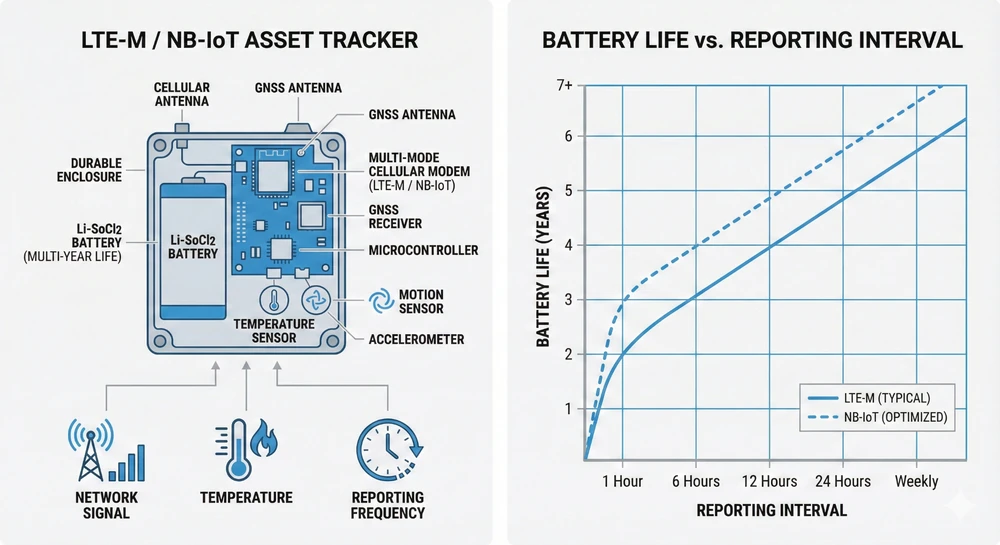
One of the first questions any buyer asks is: “How long will the tracker’s battery last?” The answer is more complex than a spec sheet rating. Often, there’s a stark difference between the theoretical battery life printed on a datasheet and real-world results once the device is in the field.
On paper, a tracker might claim “5-year battery life,” but that number is usually based on ideal, static conditions (e.g. one location report per day, room temperature, strong network signal). In reality, battery life varies significantly with usage patterns and environment. For example, if a device reports its location frequently, its power draw increases dramatically – switching from hourly updates to per-minute updates can shrink battery life from months to mere days or hours. Likewise, poor cellular coverage causes the modem to work harder and drain power faster.
Environmental conditions also play a huge role. Cold chain deployments illustrate this clearly. Batteries perform worse in low temperatures – chemical capacity drops and internal resistance rises. A tracker that lasts 3 years at 20°C might last half that in a freezer unit at -20°C. In one test, a lithium-ion device specified to operate down to -20°C failed to even start at -10°C because the cold so severely impacted the battery. In outdoor asset tracking, temperature swings or extreme heat can similarly degrade battery output. Vibration from equipment or shock can momentarily disrupt battery connections as well.
The key takeaway is real-world testing. Do not rely solely on the vendor’s theoretical specs. Request empirical battery performance data from potential partners. A credible hardware partner should provide battery life curves or test results for various scenarios – for example, a graph showing remaining capacity over time at different reporting intervals (e.g. 15-minute vs 60-minute updates), and under different conditions (room temperature vs cold storage, stationary vs moving asset). Look for data on how the device behaves as the battery ages too. If possible, obtain references or case studies from similar use cases (e.g. a cold chain asset tracker deployment) to validate battery longevity in the field. Finally, ask if the device’s firmware offers power-saving modes or configurability (like adaptive reporting intervals based on motion) to extend battery life. A partner focused on ultra-low-power design will be upfront about the trade-offs and will help you optimize settings for maximum life.
2.Certifications
When tracking assets across borders or deploying at scale, regulatory and network certifications are non-negotiable. Regulatory certifications ensure the device meets legal requirements in each region – the big ones are FCC certification for the United States and CE marking for the European Union. FCC approval confirms the tracker’s radio emissions won’t interfere with other devices, while CE compliance covers safety and electromagnetic standards in Europe. Without these, you might literally have your shipments stopped at customs or be barred from operating in those markets.
Beyond basic regulatory certs, cellular network certifications are critical for any LTE-M / NB-IoT trackers. In North America, the PTCRB certification (PCS Type Certification Review Board) is effectively required by carriers for LTE-M/NB-IoT devices. PTCRB testing verifies that the device meets the technical network standards (per 3GPP specs) so that it can reliably function on carrier networks.
Carrier approvals often build on PTCRB – many carriers (like AT&T, Verizon, T-Mobile) have their own certification programs or labs. If a device isn’t on a carrier’s approved list, the carrier can refuse to activate it on their network. In Europe, an equivalent to PTCRB is the GCF (Global Certification Forum) certification, ensuring compliance with European operator requirements.
For truly global deployments, you will need to navigate a patchwork of certifications: FCC for USA, IC for Canada, CE for EU, UKCA for the UK, MIC/Telec for Japan, RCM for Australia, etc., plus any needed RF emission or safety certifications in other target countries. Similarly, confirm the device supports the necessary LTE-M/NB-IoT frequency bands for each region (e.g. Band 8 or 20 in Europe, Band 12 or 13 in USA, etc.).
What to ask a potential hardware partner: “Which certifications do your devices already have, and for which regions?” and “Which cellular carriers have approved your device for LTE-M or NB-IoT?”
A strong partner will be able to list specific approvals – for example, they might say a tracker is FCC and CE certified, PTCRB certified, and already approved on AT&T and Verizon in North America, and on Deutsche Telekom’s NB-IoT network in Europe. If a vendor has not pursued these certifications, that’s a red flag – obtaining certifications can take months and significant expense, so an uncertified device could delay your project or limit where you can operate. In short, insist on seeing current certification documents. Remember that without proper network certification, some operators will simply not allow the device on air. It’s far better to choose a partner whose hardware is already compliant and carrier-approved in your key markets than to gamble on getting approvals later.
3.Customization
No two IoT deployments are exactly alike. The question is whether an asset tracking hardware partner can accommodate your specific needs or if you must shoehorn your project into a one-size-fits-all device. It’s important to understand the spectrum of offerings: from fully off-the-shelf devices (no changes possible) to semi-customizable platforms to fully custom hardware design.
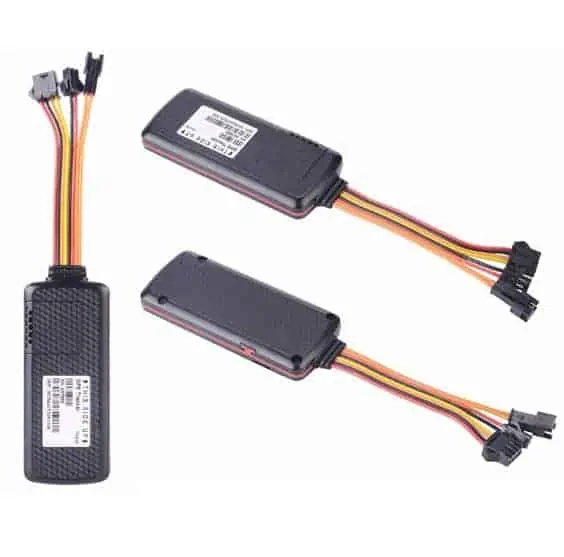
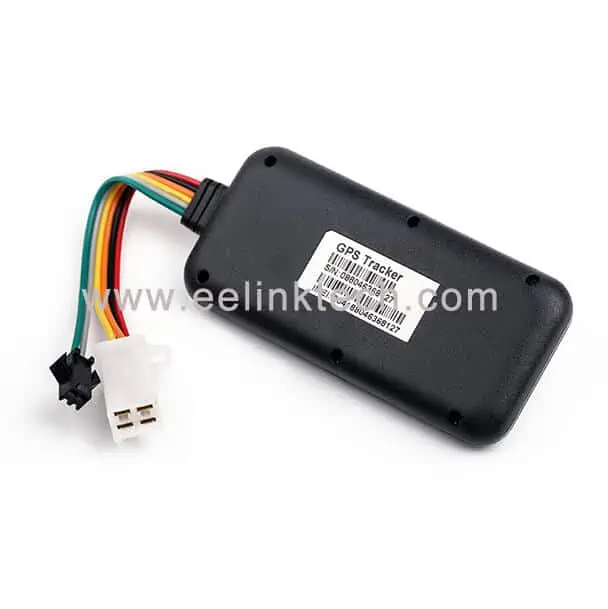
Off-the-shelf asset trackers are ready-made and usually the fastest path to pilot. Reputable vendors will have a range of models – perhaps a compact battery-powered tracker for pallet tracking, a rugged magnetic tracker for containers, a wired tracker for powered assets, etc. If one of these fits your requirements closely, it can save time and cost. However, off-the-shelf solutions might not tick every box. For example, maybe you need a specific sensor integrated (temperature for cold chain, or a humidity sensor, or a tilt sensor for detecting orientation). Or perhaps the standard housing isn’t suitable – you might need a different ingress protection (IP) rating for harsher environments, or a flatter form factor to embed in a pallet. Mounting needs can differ too: one project might require magnetic mounting on metal containers, another might need screw mounts on wooden crates, or strap/zip-tie options for irregular shapes.
This is where a partner’s customization capability matters. Some hardware providers offer modular options or minor custom tweaks – for instance, they may offer an extended battery pack accessory, or a version of the device with an additional sensor. Others, typically those who are the OEM/ODM manufacturers, can do deeper modifications or even design a new device to spec. When evaluating partners, ask if they provide OEM/ODM services and what the process and minimum order quantities (MOQs) are for custom hardware. A capable partner should say something like: “Yes, we can customize the tracker’s functions and design based on your needs, whether that’s modifying an existing device or designing a new one from scratch”. In fact, many manufacturers will advertise that they can modify existing standard devices or develop a fully new tracker to meet a client’s requirements.
Consider examples of customization: adding a temperature probe to an asset tracker for cold chain monitoring, or swapping in a higher-capacity battery to extend life. It could involve changing the casing to meet IP68 waterproofing, or using a reinforced enclosure for a construction equipment tracker. Even seemingly small tweaks like a different mounting bracket or an LED indicator can make a big difference in deployment.
The key is to align on these needs early. Make a list of “must-have” customizations and discuss them with each potential partner. How they respond will tell you a lot. Do they have in-house engineering to support firmware or hardware changes? Have they done similar custom projects before? What is the lead time and cost overhead? A partner unwilling or unable to customize might push you to accept compromises that hurt your project’s outcome. On the other hand, be wary of over-customizing if an off-the-shelf solution with minor tweaks can suffice – fully bespoke hardware takes time and introduces development risk. The ideal partner will help balance these trade-offs, offering the flexibility to tweak or extend their product (for example, adding your company’s branding or a specific sensor) without reinventing the wheel unnecessarily.
4.Manufacturing and Testing

The reliability of asset tracking devices in the field is directly tied to the quality of manufacturing and testing behind the scenes. When choosing a hardware partner, you are also choosing their supply chain and production standards. What does a qualified manufacturing process look like? In short, it should resemble modern automotive or industrial electronics production, not a garage workshop. Here are some aspects to evaluate or ask about:
SMT Production Lines: The partner should have a proper Surface Mount Technology (SMT) assembly line for PCB manufacturing. This includes pick-and-place machines, reflow ovens, automated optical inspection (AOI), and X-ray inspection for quality control of solder joints. A company with ISO 9001-certified facilities and robust process control will gladly walk you through their manufacturing setup. For example, check if they have standards like IPC-A-610 for workmanship, ESD-safe handling environments, and traceability of components. Consistent, automated assembly is crucial for scale – it reduces human error and ensures each device gets built to the same spec.
Quality Assurance (QA) Testing: A professional hardware partner performs testing at multiple stages. In-circuit testing (ICT) and functional testing (FCT) are commonly done on each unit or each batch to catch any assembly defects or component failures before devices leave the factory. ICT uses test probes to check that every circuit and connection on the board works, while FCT powers up the device to verify it boots, charges, connects to the network, etc. You’ll want to know if every device is functionally tested or if sampling is used for cost reasons.
Batch Reliability Testing: Beyond making sure a device works out-of-the-box, leading manufacturers conduct reliability tests on sample units from each production batch – often called ongoing reliability testing (ORT). This is critical to ensure that subtle changes in materials or processes haven’t introduced a reliability issue. For example, a good partner might take a few units from each batch and put them through stress tests: multi-hour temperature cycling (e.g. cycling from -20°C to +60°C repeatedly), high/low temperature storage tests, and perhaps humidity exposure if the devices might face moisture. They may also perform vibration and mechanical shock tests, especially if the trackers will be mounted on vehicles or heavy equipment that introduce constant vibration. These tests simulate the harsh conditions the devices will experience over years. If a batch fails a stress test (say, a solder joint cracks under vibration), the partner can halt shipments and correct the issue, rather than you discovering a problem months after deployment.
Certification and Lab Capabilities: Some vendors have in-house reliability labs or work with third-party labs for more advanced testing. For instance, they might do battery abuse tests, UV exposure (for plastic durability in sunlight), drop tests (dropping the device from certain heights), and so on. Ask what kind of reliability tests are done per batch or per design. You might be surprised by the thoroughness of a top-tier manufacturer, who could mention tests like “24-hour burn-in test at 60°C” or “10,000 cycle insertion test for the SIM card slot”. This level of QA indicates a mature process. Many companies will also do a final AQL inspection (Accepted Quality Limit sampling) on outgoing products, checking assembly quality, labeling, packaging, etc., to ensure consistency.
When talking to potential partners, don’t hesitate to request details on their manufacturing and QA processes. A trustworthy partner will be transparent about how they ensure quality. They might cite certifications (e.g. “Our factory is ISO 9001 and ISO 14001 certified”), and they should be able to describe their testing methodology (for example, “we do 100% functional testing, and run reliability stress tests on 5 units from every lot”). You can even ask for examples of past failure analysis – how do they handle it if a device in the field fails? The goal is to gauge if the partner’s manufacturing is robust enough to deliver thousands of devices with minimal defects and if they have the processes to catch issues early. Picking a hardware partner with strong manufacturing QA will save you headaches by ensuring the trackers you deploy are consistent and durable from day one.
5.Long-term Availability
An often overlooked but crucial aspect of choosing a hardware partner is the long-term availability and support for the device. IoT deployments, especially in industries like supply chain or asset tracking, often span many years. You might start with a 100-unit pilot and scale to thousands of devices over several years as the project grows. The last thing you want is to discover mid-way that your chosen tracker is being discontinued or that a key component inside it went end-of-life, forcing a redesign. Unfortunately, this scenario happens if lifecycle planning isn’t considered up front.
End-of-Life (EOL) risks come in a few forms:
Component EOL: IoT devices are built from many electronic components (cellular modules, GNSS receivers, microcontrollers, sensors, etc.). Technology advances quickly, and suppliers regularly discontinue older components. For example, many 2G and 3G cellular modules have been retired as networks sunsetted those technologies, and even LTE-M/NB-IoT module models can phase out in favor of newer 5G-capable ones. A good hardware partner keeps tabs on all critical components’ lifecycles. They should ideally choose industrial or automotive grade components that have longevity commitments (some component makers guarantee availability for 5+ years for their parts). Ask the partner: “How do you monitor and handle component end-of-life?” A strong answer would be that they continuously monitor component EOL notices and have a plan to either last-buy and stockpile parts or smoothly migrate to the next-gen component before the old one runs out. Vendors that monitor component EOL statuses can proactively redesign or notify you in advance, avoiding nasty surprises.
Product longevity and support: Aside from components, what is the vendor’s commitment to the device itself? Some IoT device makers frequently release new models and may only fully support a given model for a couple of years. Others design for longevity – meaning they intend to produce and support that tracker model for, say, 5-7 years. If you plan to deploy devices that need to remain in the field, you also need support for them (firmware updates, spare units, etc.) for the life of the project. Discuss with the partner how long they plan to manufacture the device and whether they have a roadmap. If the device’s cellular technology (Cat-M1/NB-IoT) might evolve, will they offer an upgrade path? For instance, if in three years a new network standard or band is needed, will they have a variant available or a new model ready?
Supply Chain Resilience: The global chip shortage of recent years taught many the pain of supply chain fragility. In evaluating a hardware partner, consider their supply chain strength. Do they have multiple sourcing options for key components? Are they a sufficiently high-volume player to allocate components even in shortages? Smaller or less-established vendors might struggle to fulfill orders if parts get scarce. You might ask, “How did your production handle the recent semiconductor shortages?” – their answer can reveal how robust their operations are.
In essence, choosing a hardware partner is not only about the now but also the future. You’re entering into a relationship. To protect your project, include long-term questions in your evaluation. For example, add to your checklist: “What is the expected lifespan of this product line?”, “Have any components been marked EOL, and what is the plan for them?”, and “Will you commit to notifying us at least X years in advance of any product discontinuation?”. An ethical, well-prepared partner will have ready answers (they might even have an official product lifecycle document). If a vendor seems unaware of these concerns or dismissive (“We’ll worry about that when the time comes”), be cautious. It could mean at the first EOL event or market shift, your project might be left scrambling for new hardware.
Finally, consider the vendor’s track record. Have they been in business long enough to have managed product transitions? Do they list long-term clients or deployments? Longevity in the industry can be a reassuring sign that they know how to weather changes and support their devices over time.
Conclusion
Selecting an asset tracking hardware partner is a decision that can make or break the success of your IoT initiative. By systematically evaluating the five areas above, you can move forward with confidence instead of blind spots. In summary, here’s a practical checklist of questions to guide your choice of hardware partner:
Battery life in real conditions: What real-world battery life can you expect for your use case, and can the vendor provide empirical data or profiles (e.g. at certain reporting intervals, temperatures)?
Certifications and networks: Does the device have all required certifications (FCC, CE, etc.) for your deployment regions, and is it approved by the necessary carriers or network authorities (LTE-M/NB-IoT in North America, Europe, etc.)?
Customization options: Can the hardware (or firmware) be customized to meet any special requirements (additional sensors, different housing or mounting, ruggedization)? What is the process and MOQ for customization if needed?
Manufacturing quality: What does the partner’s manufacturing and QA process look like? Do they use modern SMT assembly lines, and what testing (ICT, functional, environmental stress tests) do they perform on each batch to ensure reliability?
Long-term availability: How long will the device and its components be available and supported? How does the vendor handle component or product end-of-life, and will they be able to support your deployment for the years you need?
By obtaining clear answers to these questions, you’ll be well-equipped to choose an asset tracking hardware partner that not only meets your immediate project needs but also stands the test of scale and time.
At EELINK, we design and manufacture ultra-low-power LTE-M/NB-IoT trackers and sensors, and we encourage teams to use this checklist whether they work with us or with any other vendor. The right hardware partner will happily address all the points above – resulting in a smoother pilot, a faster scale-up, and a successful asset tracking deployment that delivers value for years to come.
FAQ
Q: How can I accurately estimate the battery life of an asset tracking device?
A: To get a true picture of battery life, test the device under real-world conditions that match your use case. Don’t rely only on the datasheet. Consider factors like how often the device reports its location, the network signal strength, and the operating temperature. Good hardware partners will provide empirical battery test data (such as discharge curves for different reporting intervals and temperatures). By simulating your expected usage pattern (for example, one GPS upload every 15 minutes in a cold environment), you can estimate how long the tracker’s battery will last in practice and plan accordingly.
Q: What certifications should an asset tracking device have for global deployment?
A: At minimum, the device should have FCC certification for use in the United States and CE marking for Europe, which cover legal RF and safety requirements. If you operate in Canada, look for IC certification, and other regions may have their own (like UKCA for the UK, RCM for Australia, etc.). Importantly, for cellular-based trackers, ensure the device has cellular network certifications: PTCRB certification is crucial for North American LTE-M/NB-IoT networks, and GCF certification is common for European networks. Additionally, ask the vendor which specific carriers the device is approved on (for instance, AT&T or Verizon in the US, or Vodafone in Europe). Having both regulatory and carrier approvals in place means the tracker can be legally imported and will function reliably on the mobile networks in your deployment regions.
Q: Can I customize an asset tracking device to fit my project’s needs?
A: In many cases, yes – if you choose a partner that offers OEM/ODM or customization services. Common customizations include adding or changing sensors (for example, integrating a temperature or humidity sensor for cold chain monitoring), modifying the housing (such as using a more rugged or waterproof enclosure, or changing the form factor), and altering the mounting method (providing options like magnetic mounts, screw brackets, or strap mounts to suit different assets). Some vendors allow firmware customization as well – for instance, custom data reporting formats or sensor calibration. Keep in mind that customization may require a minimum order quantity and additional development time/cost. It’s wise to discuss your specific requirements with the vendor: a good partner will tell you what’s feasible and suggest the most efficient way to meet your needs, whether it’s a minor tweak to an existing product or a fully custom device design.
Q: How do I ensure the tracking hardware will be available and supported long term?
A: To ensure long-term availability, you should ask the vendor about the product’s lifecycle and their component sourcing strategy. Find out how many years they plan to manufacture and support the device model – reputable partners might guarantee availability for 5+ years or have a roadmap for future models. Inquire if any key components (like the cellular module or GPS chip) are nearing end-of-life. A solid partner will have strategies for component EOL, such as last-time buys or drop-in replacements, and they will proactively update the design if needed. It’s also useful to ask how they handled past technology shifts (for example, the sunset of 2G/3G networks) – this can reveal their approach to product longevity. Finally, ensure they offer ongoing support such as firmware updates and technical assistance throughout the device’s life. Choosing a vendor with a strong track record and clear commitment to long-term support will protect your deployment from unwanted surprises.