Designing a 60+ Day Battery Mission for Freezer & Reefer Tracking (An Engineering Blueprint)
This article complements the GPT29 Cold Chain White Paper and is written for engineering and operations teams designing deployments for freezers and reefers on overseas routes.
Download the PDF: GPT29 Cold Chain Tracking for Freezers — Engineering & Compliance White Paper
Why “battery life” is a system property (not a single spec)
For overseas cold chain programs, the question is rarely “What is the maximum battery life?” The real question is: Can the device complete the mission window while capturing the right evidence? Battery life is shaped by a set of interacting design choices:
- Reporting cadence (baseline interval and exception interval).
- Connectivity conditions (signal quality, coverage gaps, roaming behavior).
- Sensor workload (sampling frequency and event logic for temperature, humidity, light, shock).
- Payload size and protocol overhead.
- Retries/resends during unstable networks.
- Environmental conditions (including temperature’s effect on battery chemistry).
The right way to plan for 60+ days is to treat power consumption as a duty-cycle budget and align it to operations: stable ocean legs, terminal dwell, and inland moves.
Step 1: Define the mission and its “evidence requirements”
Before setting any reporting interval, define what you must prove if something goes wrong. For freezers and reefers, evidence requirements typically include:
- Where/when a temperature excursion began and ended (start time, end time, duration).
- Whether the asset was exposed (light exposure signal) around the incident window.
- Whether a handling shock occurred before or during the incident window.
- Continuity signals (offline periods, low battery, reconnection).
If you only need “periodic proof” for compliance, a lower baseline interval may be acceptable. If you need rapid operational response during exceptions, your policy should increase frequency only when it matters.
Step 2: Use a two-speed reporting policy (baseline + exception)
A simple and effective pattern for long voyages is a two-speed policy:
- Baseline mode: low-frequency location + telemetry reporting during stable conditions.
- Exception mode: temporarily higher-frequency reporting when a risk rule triggers (excursion, exposure, shock, geofence, prolonged dwell).
This preserves battery during normal operations while still producing dense data when investigators need it most. In the white paper, we describe how to structure exception triggers so they are audit-friendly (e.g., temperature threshold + duration). See: How to Define Temperature Excursions (Threshold + Duration).
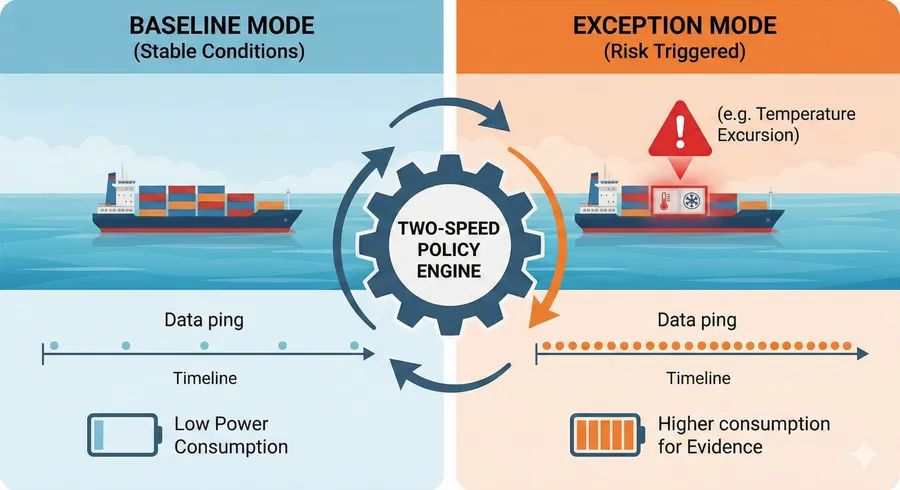
Figure 2: The core reporting strategy. A “two-speed policy” balances battery longevity in stable conditions with high-resolution data capture during risk events, ensuring evidence is captured when it matters most.
Practical example policy (adapt to your SOP)
The following is a conceptual template for policy design. You should calibrate exact intervals during a pilot:
| Operational Segment | Baseline Reporting | Exception Escalation | Why it works |
|---|---|---|---|
| Ocean leg (stable) | Lower frequency (e.g., hourly) | Increase if excursion/exposure/shock | Preserves battery when risk is low |
| Terminal dwell / port yard | Moderate frequency | Increase on dwell/door/excursion | Handoffs are higher risk |
| Inland trucking | Moderate frequency | Increase on shock/excursion | Movement makes incidents time-sensitive |
In other words: you do not need a single interval for the entire journey. You need an interval policy aligned to risk.
Step 3: Budget the power using a duty-cycle model
Without claiming any single “battery life spec,” you can still plan systematically using a duty-cycle model. A simplified view is:
- Sleep current × time spent idle
- + Sensor sampling cost × sampling frequency
- + GNSS acquisition cost × position fixes
- + Radio uplink cost × transmissions (including retries)
The engineering principle is straightforward: reduce expensive operations (GNSS + uplink) when you are not learning anything new, and increase reporting only when conditions indicate risk.
Common battery “killers” to watch for
- High retry rates caused by poor signal inside metal enclosures.
- Overly frequent GNSS fixes during periods with minimal movement.
- Verbose payloads (too many fields, too often) instead of event summaries.
- Unbounded exception mode (never returning to baseline after an alert).
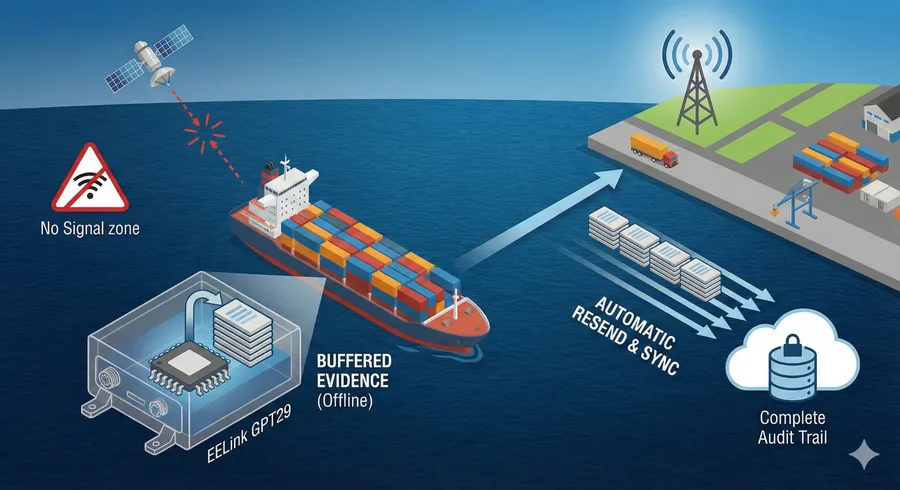
Step 4: Plan for coverage gaps (buffering + resend + idempotency)
International routes inevitably include coverage gaps. If you don’t design for this, your data will look “random” and your audit trail will be incomplete. A robust approach includes:
- On-device buffering of telemetry and event summaries during offline windows.
- Resend logic on reconnection with backoff to avoid draining the battery.
- Idempotency keys (or sequence numbers) so your ingestion system can deduplicate safely.
Deep dive: Data Integrity for International Cold Chain IoT (Buffering, Resends, Idempotency).
Step 5: Validate with a pilot and measurable acceptance criteria
A 60+ day mission target should be validated via a pilot designed around acceptance criteria, not anecdotes. Recommended criteria include:
- Mission window success: the configuration completes the route window with sufficient battery margin.
- Data completeness: % of expected reports received after accounting for known offline gaps.
- Event quality: excursions and exposure/shock events are meaningful and not noisy.
- Integration readiness: telemetry ingests cleanly into your platform (units, timestamps, dedupe).
Installation quality strongly affects mission success. If your deployment involves freezers or metal reefer containers, review: Installing Trackers on Freezers and Reefer Containers (Practical Guide).
Recommended next step
If you are engineering a freezer/reefer monitoring program for overseas routes, the fastest path is to align on an evidence requirement, select a reporting policy, and validate via a short pilot with clear acceptance criteria.
Download the white paper: GPT29 Cold Chain Tracking for Freezers — Engineering & Compliance White Paper
Contact EELink: Contact Us or email [email protected].
FAQ
Can I get “real-time” updates for 60+ days?
“Real-time” should be defined as a policy. A practical approach is baseline low-frequency reporting with exception-driven escalation. This preserves battery while still capturing high-resolution evidence when incidents occur.
Does cold temperature reduce battery life?
Battery chemistry can be impacted by temperature. In freezer and reefer scenarios, installation placement and duty-cycle policy become even more important. Use pilots to calibrate the configuration for your specific route and conditions.