

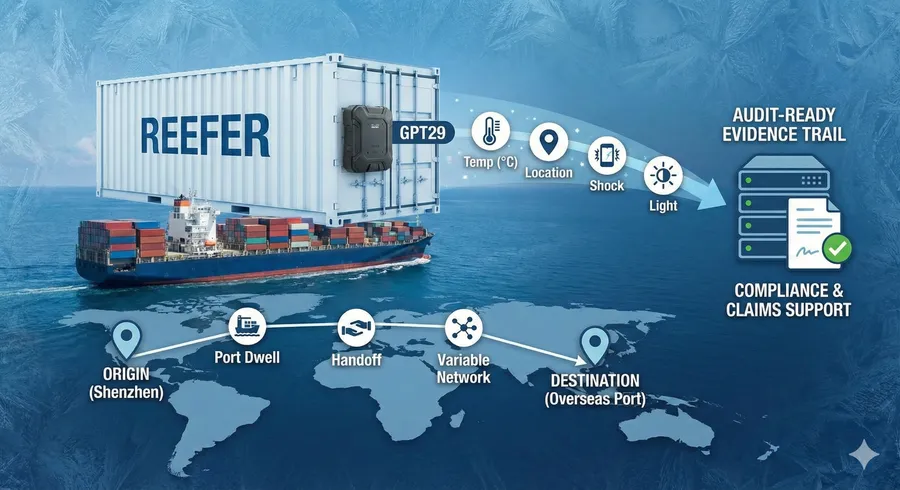

between handoffs: at ports, in consolidation yards, during customs holds, or when assets sit in uncertain conditions for days. Without an engineering-grade
evidence trail, teams are forced to manage exceptions using assumptions—until a claim, a customer escalation, or a compliance audit demands proof.To support overseas shippers, 3PLs, and supply chain operators, we’ve published a new technical white paper focused on the GPT29 in-transit monitoring device
for freezers, reefer containers, and temperature-sensitive cargo. The white paper is written for engineering and compliance stakeholders and covers
practical implementation details: reporting strategies for long voyages, event semantics for audit trails, installation constraints around metal enclosures, and
integration patterns for organizations that manage visibility in their own platforms.
Download the White Paper (PDF):
GPT29 Cold Chain Tracking for Freezers — Engineering & Compliance White Paper
Why this white paper exists: cold chain is an evidence problem, not just a sensor problem
“Cold chain visibility” is often described as a dashboard feature, but in real operations it is a data integrity and process traceability problem.
When a freezer or reefer shipment experiences a temperature excursion, the follow-up questions are rarely limited to a single data point. Teams need to answer:
- When did the excursion start, and how long did it persist?
- Where did it happen—at origin, in transit, at a terminal, or during a handoff?
- Was there a related door-open / exposure indicator (often inferred from light exposure events)?
- Was there a related handling incident (shock/vibration event) that correlates with the anomaly?
- Is the data complete, time-consistent, and suitable for audit / claims documentation?
This is exactly why the GPT29 white paper focuses on the practical engineering steps required to produce a defensible evidence trail—especially on
global routes where network conditions, dwell time, and handoff complexity are unavoidable.
What you’ll get from the GPT29 cold chain white paper
The PDF is intentionally detailed. If you’re evaluating a freezer tracking device or designing a cold chain visibility program, the white paper provides:
- Mission planning for long voyages: how to design reporting intervals that balance “near real-time” requirements with multi-week battery goals.
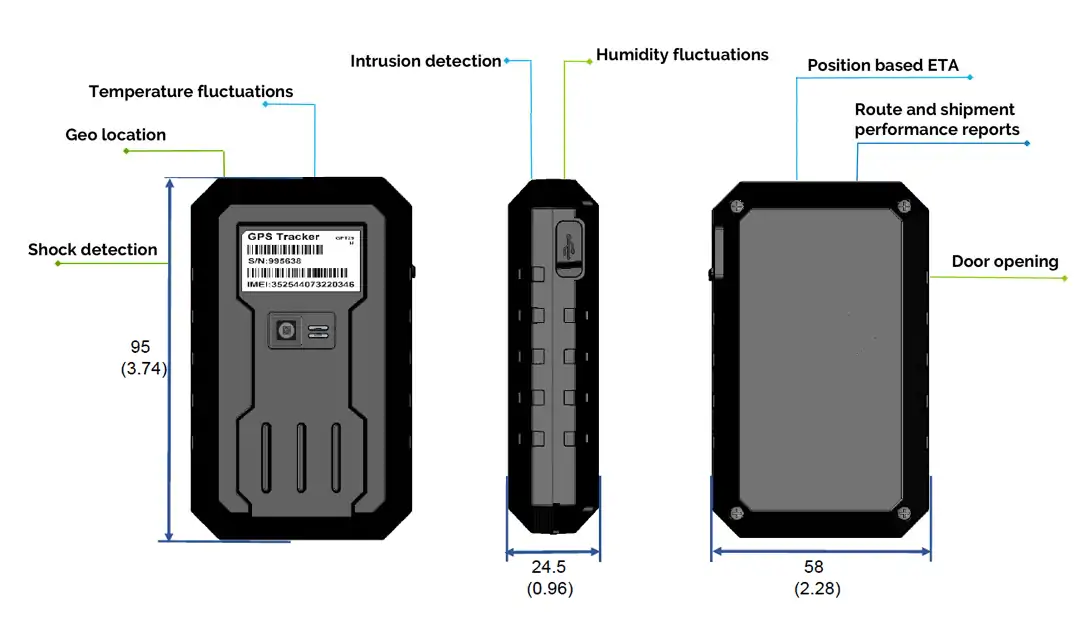
- Event modeling: turning raw sensor readings into actionable, audit-friendly events (temperature excursion, exposure/light, shock/vibration, offline/low battery).
- Data continuity methods: buffering, resend logic, and idempotency concepts to support reliable ingestion into your system.
- Installation guidance for metal enclosures: practical placement patterns for freezers and reefer containers to improve signal reliability.
- Integration without a proprietary platform: recommended API patterns and data contracts so you can own your visibility stack.
- Compliance-minded recordkeeping: how to structure telemetry for internal audits, quality workflows, and claims support.
If you are new to EELink’s cold chain product family, you may also want to review our cold chain overview page:
Cold Chain Monitoring Tracking Device.
Key concept: “near real-time” is an engineering choice (and it impacts battery life)
In cold chain operations, “real-time” is frequently interpreted as continuous or very frequent reporting. But for long-haul international shipments, that interpretation
creates a battery and cost profile that may not match operational reality. The white paper therefore uses the term near real-time to emphasize that
reporting cadence is configurable and should be aligned to risk.
A practical engineering approach is an adaptive reporting strategy:
- Low-frequency baseline reporting during stable conditions (to preserve battery and reduce data overhead).
- High-frequency exception reporting when a rule is triggered (e.g., temperature excursion, exposure/light event, shock event, geofence event).
- Evidence-first persistence rules so excursions are recorded with start/end timestamps and duration thresholds, not just “spikes.”
This matters for overseas routes such as LATAM ↔ North America and LATAM ↔ Europe, where dwell times and variable coverage are common. The white paper
outlines a framework for configuring GPT29 to meet a 60+ day mission window depending on reporting intervals, environment, and event frequency.
From sensor readings to audit-ready events: a compliance-friendly data model
One of the fastest ways to lose trust in cold chain telemetry is to treat every reading as equal and expect downstream teams to interpret the truth manually.
The white paper recommends an event-driven layer that converts raw data into clear, reviewable events such as:
- Temperature Excursion: threshold + duration logic to avoid false alarms from momentary fluctuations.
- Humidity Deviation: support for monitoring condensation risk indicators (where relevant).
- Light Exposure Event: used to support “possible door-open / exposure” investigations (with installation-aware thresholding).
- Shock / Vibration Event: used to correlate handling incidents with later temperature anomalies or product damage claims.
- Offline / Low Battery: operational reliability signals that matter during long voyages.
The goal is not just alerting. The goal is to make post-incident investigations faster and more objective—especially when teams need to share evidence with
internal quality groups, insurance providers, or customers.
Integration-first design: GPT29 is built to plug into your platform
Many overseas operators already run a logistics technology stack—TMS, WMS, data lakes, BI dashboards, or a proprietary visibility portal. For this reason,
the GPT29 program is presented with an integration-first posture.
EELink does not require you to adopt a proprietary SaaS platform; instead, the white paper focuses on practical steps to integrate telemetry into your system:
- Data contracts: consistent field naming, units, timezones, and timestamps.
- Ingestion reliability: buffering and resend strategies to protect data continuity.
- Idempotency guidance: avoiding duplicate records when networks are unstable.
- Security posture: principles for transport security and access control appropriate for cross-border operations.
If you’re exploring EELink’s broader device portfolio for integrated deployments, see:
Real Time GPS IoT Trackers Device
and
Supply Chain Trackers.
Installation reality: freezers and reefers are metal enclosures (plan for shielding)
Freezers and reefer containers impose a different installation reality than standard asset tracking. Metal surfaces can attenuate signals; placement decisions
determine whether telemetry is stable or intermittent. The white paper provides deployment guidance that emphasizes:
- Separation of concerns: place the device for connectivity stability, and place the temperature measurement point for thermal validity.
- Probe strategy (where applicable): how to think about measurement location vs. ambient location.
- Mounting reliability: securing the device to withstand vibration, handling, and environmental exposure.
- Threshold calibration: tuning light/shock thresholds to the installation to reduce false positives.
For product background on GPT29 itself, you can reference:
GPT29 Global Supply Chain Visibility Tracker (LTE Cat-M1)
and
GPT29 In-Transit Monitoring Device.
GNSS positioning vs. “satellite communication”: clearing up a common confusion
A frequent engineering question in international deployments is: “Are you using BeiDou or a foreign satellite system?”
The precise answer depends on the GNSS module configuration, but it’s also important to separate two concepts:
- GNSS positioning: satellites used for determining location (multi-constellation support may include BeiDou among other constellations).
- Data uplink: how telemetry is transmitted back to a server (commonly via cellular IoT networks on supported routes).
The white paper explains how to handle route planning assumptions so operations teams avoid unrealistic expectations around “always-on” connectivity during
global voyages.
Recommended pilot plan: how to evaluate GPT29 without guessing
If you are evaluating freezer or reefer monitoring for overseas routes, we strongly recommend a pilot that is designed around measurable acceptance criteria.
The white paper includes a pilot checklist that can be adapted to your operating model. Typical evaluation dimensions include:
- Battery mission success: did the configuration meet the target voyage window?
- Data completeness: percent of expected reports received (accounting for coverage gaps).
- Event accuracy: were temperature excursion events meaningful (threshold + duration), not noisy?
- Operational usability: were events easy to map to handoffs, dwell points, and exception workflows?
- Integration effort: time-to-ingest, data quality, and downstream alerting effectiveness in your platform.
For practical background on cold chain monitoring concepts, you may also find this helpful:
How Cold Chain Monitoring Can Revolutionize Your Supply Chain.
Download the GPT29 cold chain white paper
If your team is responsible for global cold chain operations, compliance recordkeeping, or engineering integration, this white paper is designed to be immediately useful.
It is written for overseas deployments and focuses on the practical decisions that determine outcomes: reporting strategy, event definitions, installation constraints, and
system integration patterns.
Get the PDF here:
Download: GPT29 Cold Chain Tracking for Freezers — Engineering & Compliance White Paper
Have questions about deployment planning, integration, or a pilot design? Please contact us:
Contact EELink.
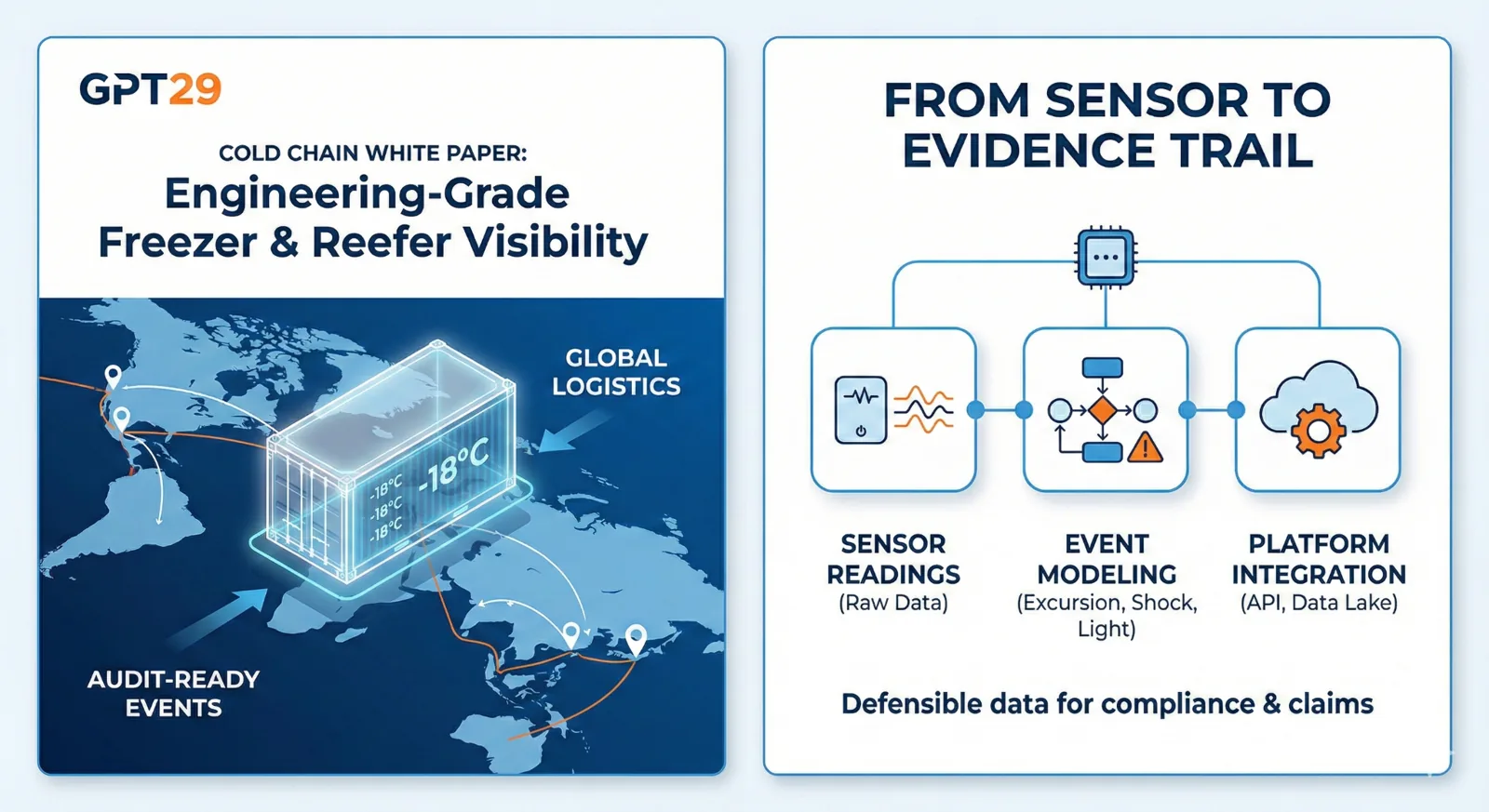
How raw sensor data is converted into defensible, audit-ready event records for compliance and claims.
FAQ (Quick Answers for Engineering & Compliance Teams)
Is GPT29 suitable for long overseas routes?
Yes—when configured with an adaptive reporting strategy. The white paper outlines how to plan reporting cadence and exception triggers to support multi-week voyages
and a 60+ day mission window depending on conditions and requirements.
Do we need to use a proprietary platform?
No. The GPT29 white paper is written for integration-first deployments. You can ingest telemetry into your existing platform using a defined data contract and
reliable ingestion patterns.
Can it support temperature, humidity, light exposure, and shock/vibration?
GPT29 is positioned for in-transit monitoring use cases that rely on multi-sensor evidence. The white paper explains how to model these sensor signals into
audit-friendly events and how to tune thresholds based on installation.
Where can I find general support and warranty information?
Please refer to our support FAQ here:
EELink FAQ – Support & Warranty.