Three Signals Reshaping Supply-Chain Telemetry — A Hardware View from EELINK
The last five years have not been a story of one magic platform. The most durable progress has come from three very different directions moving at the same time:
-
dry containers are no longer opaque boxes;
-
responsible-AI practices have moved from discussion to auditable management;
-
cold chains are converting temperature logs into real-time interventions.
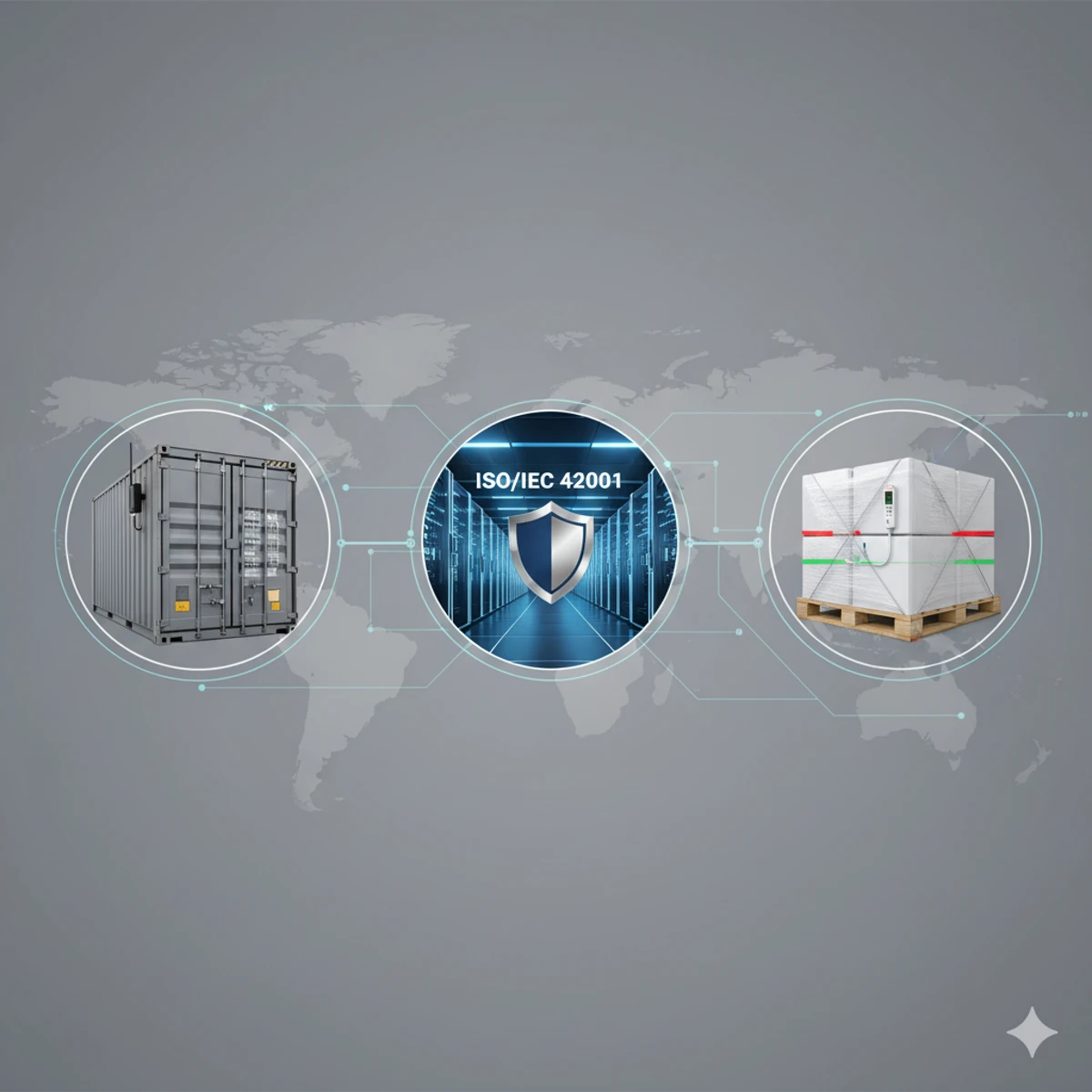
The news headlines put names to each direction—Evergreen’s smart dry containers supplied by ORBCOMM; Samsara earning ISO/IEC 42001 certification for AI management; Cold Chain Technologies and ParkourSC connecting temperature and location from plant to patient—but the engineering questions underneath are the same ones logistics teams have wrestled with for decades: What should we measure, how do we measure it reliably, how do we prove it, and how do we act on it without wasting battery or people’s time?
Below is a practitioner’s view, written for engineers and operations leaders who have to select devices, design telemetry semantics, and justify budgets. It is not a vendor pitch. Where EELINK is mentioned, it is to clarify design choices we believe matter on the hardware layer: ultra-low-power design, high reliability, industrial-grade construction, and a data model that gives customer platforms trustworthy evidence rather than noise.
1) What changed at the edge?
Two shifts made the present moment different from the last decade:
-
Evidence over dashboards. Telemetry is now expected to survive audits, not just appear in a map. That means time synchronization, calibration plans, tamper evidence, and event semantics that are agreed upfront.
-
Battery budgets are explicit. Budgets are planned around the question you want to answer, not around a default “report every 10 minutes.” A device that claims five years without specifying sample, filter, and transmit rules is not serious.
A good way to test whether a design is modern is to ask for three numbers: the cost of one transmission (in mAs), the cost of one GNSS fix, and the typical quiescent drain. If those numbers are on the table, you can design around the mission rather than around a brochure.
2) Instrumenting dry containers: the boring work that matters
Evergreen’s program with ORBCOMM drew attention because it marked a fleet-scale transition. Under the lid, the hard parts are the same ones every team faces.
2.1 The wall is a Faraday cage
Steel attenuates. A practical antenna layout considers:
-
Diversity for cellular and GNSS to survive stacking and crane proximity.
-
Cable runs that do not wick moisture into enclosures; grommets and potting matter more than datasheets.
-
Ground planes that keep the radiation pattern sane rather than “lucky.”
Quick check: if the design requires opening the door to upload data at the terminal, it is not a design; it is a workaround.
2.2 Events instead of streams
What the operations team cares about is rarely a raw stream. For containers, semantics usually include:
-
door open/close with confidence,
-
first motion after prolonged dwell,
-
shock above a damage investigation threshold,
-
temperature crossing a band for longer than
tminutes, -
location at custody points, not at every minute marker.
A useful pattern is sample fast, report slow: sample accelerometer at, say, 50–100 Hz for a few seconds on “impact suspicion,” compute energy in band, and only transmit when the score exceeds the threshold. That gives evidence of an impact without wasting radio time at every bump.
2.3 Battery math you can defend
A container-mounted node sees long dwell, brief handling, then weeks of motion. A back-of-envelope budget might look like:
-
baseline quiescent: 8 µA → ~70 mAh/year
-
periodic network check: 1200 mAs each, once/week → ~62 mAh/year
-
door event (wake + detect + one transmission): 400 mAs, assume 30/year → 12 mAh/year
-
high-G impact (rare): 800 mAs, assume 6/year → 4 mAh/year
For a 19 Ah primary cell, even a conservative plan leaves plenty of headroom for cold-weather derating and aging—if the firmware defaults remain event-centric and not timer-centric. If a proposed device cannot show this math (with its own measured mAs), stop the meeting.
2.4 Evidence is a chain, not a graphic
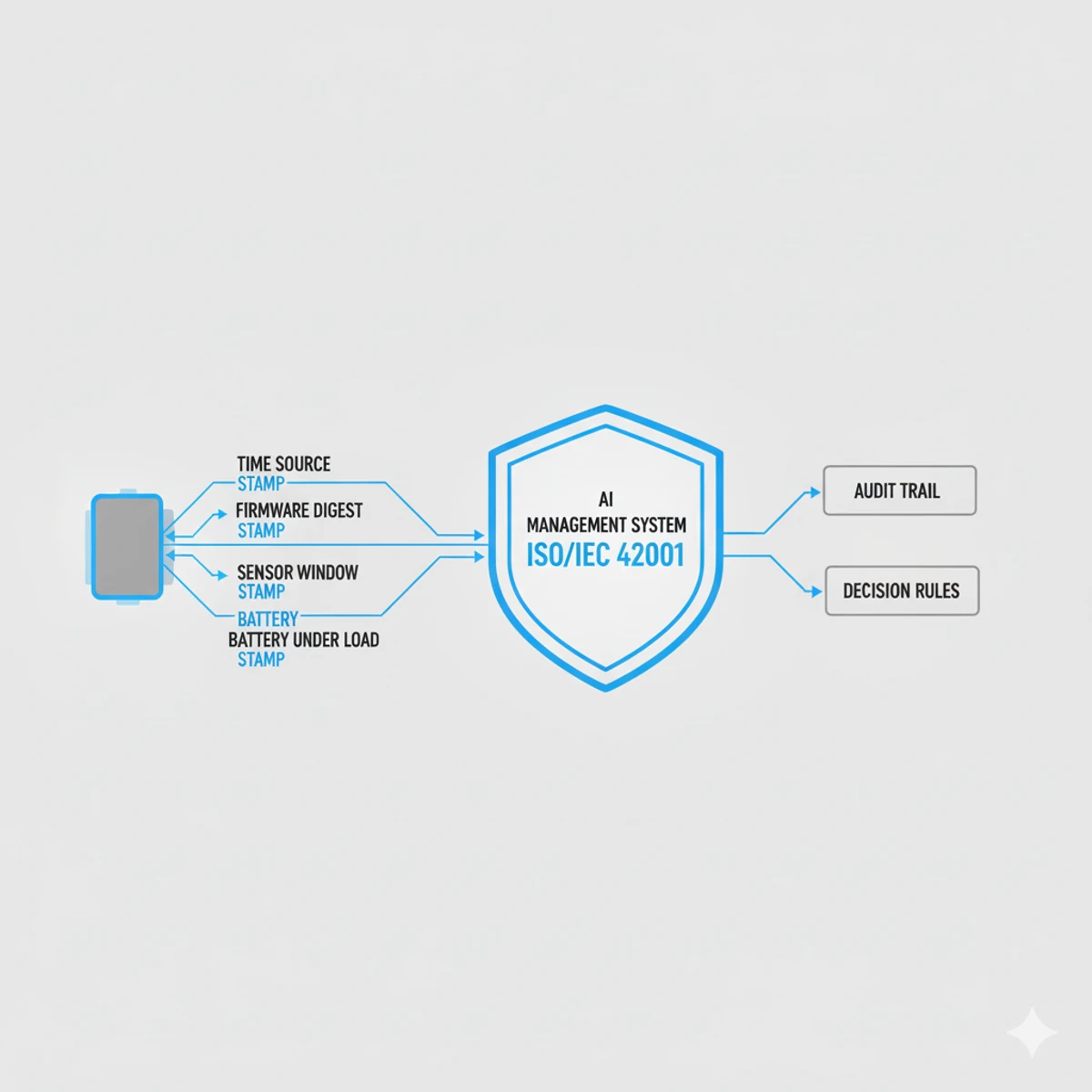
An operations team will eventually be asked: “Why was the door open at 02:11?” The answer should include:
-
event timestamp with monotonic counter,
-
reason for wake, with a copy of raw sensor energy window,
-
last network and GNSS status,
-
firmware version and configuration digest that was active then,
-
tamper or case-open status,
-
battery voltage under load.
Graphics are helpful. Evidence wins claims.
3) AI governance from the device’s vantage point
Samsara’s ISO/IEC 42001 certification is important because it treats AI as a managed system rather than a novelty. Hardware teams are part of that system. From the device side, three things end up mattering more than slogans:
-
Provenance
Where did the measurement come from, under what calibration plan, and at what uncertainty? A location derived from Wi-Fi fingerprints has different status than a cold-start GNSS fix—your platform should know the difference. -
Explainable events
A door-open derived from magnetometer thresholding and a reed switch disagreeing should not be averaged; it should be reported as an inconsistency with both sensors attached. The model downstream can learn from it. Hiding disagreement is how you create ghosts. -
Lifecycle controls
AI/ML models improve, but the device that feeds them must not change behavior without trace. That is why EELINK advocates configuration digests and signed, staged firmware—your AI team cannot be responsible for drift introduced by uncontrolled device updates.
If your AI governance plan demands explainability, the device has to emit enough context to make that possible without draining its battery. That is a real engineering constraint, not an ethics paragraph.
4) Cold chain telemetry: intervention, not logging
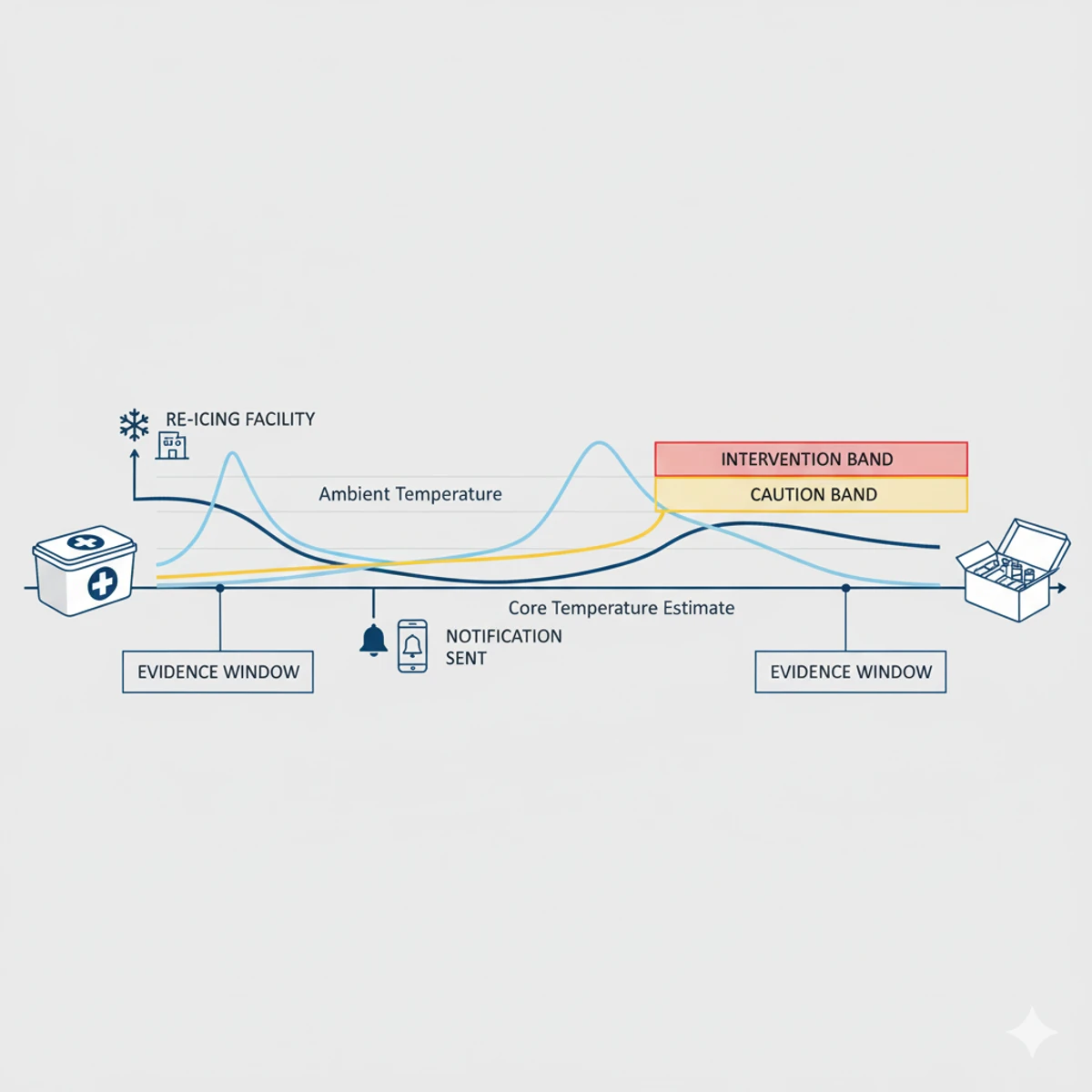
The Cold Chain Technologies and ParkourSC case studies are notable because they moved the conversation from compliance to action window. The sensors are not interesting unless they drive a decision while the product is still salvageable.
4.1 The thermal mass problem
Air temperature moves quickly; product core does not. There are three pragmatic approaches:
-
Product-adjacent probe (or gel pack mimic) to approximate core;
-
Model-based estimate from ambient history and pack design;
-
Direct probe for clinical shipments that allow it.
Whatever you choose, specify whether the threshold applies to ambient or core. Many “excursions” are never real because the threshold and the sensor are mismatched.
4.2 Decide thresholds as bands, not numbers
A sensible cold chain rule has at least two bands:
-
caution band (e.g., −0.5 °C to 8.0 °C for 30 min) — send push notification;
-
intervention band (e.g., > 8.0 °C for 10 min or > 2.0 °C for 60 min) — trigger playbook.
The device should evaluate bands locally to avoid uplink latency and only transmit summaries and the minimal evidence window needed for audit. Again: sample fast, report slow.
4.3 Playbooks are part of the spec
A cold-chain telemetry plan that cannot name the nearest re-icing facility by lane is just a dashboard. Define:
-
who gets the call/text for a given lane,
-
what constitutes salvage vs. quarantine,
-
how a carrier documents action in the system of record,
-
how events close automatically when temperature returns to band.
Tip: put the playbook IDs directly in the device configuration so that the downstream system has a stable join key.
5) Semantics before integrations
People often ask which platform to integrate first; the better question is what are the event and measurement semantics? Once semantics are stable, the plumbing is straightforward. A compact field-tested semantic set looks like:
-
measurements: temperature (with sensor model and placement), humidity (if used), battery under load, GNSS fix with quality, network registration type;
-
events: door open/close w/ confidence, start-motion after dwell, dwell-breach, impact over investigation threshold, temperature band transitions, custody points (with operator ID if available);
-
context: firmware version, configuration digest, device health (brown-out counts, resets), time source (GNSS/NITZ/RTC drift).
Lock these semantics before building dozens of integrations. It prevents “semantic erosion” where different systems guess at meaning.
6) A 90-day playbook that does not waste money
-
Days 1–10 — clarify questions
Two or three questions per lane. Examples: “How many unscheduled door opens occur between terminal A and B?” or “What is the true dwell distribution at customer C?” Resist vague goals. -
Days 11–25 — instrument the minimum
Pick enough assets to cover variation (not just the easiest). Devices ship with known configuration digests and events mapped to playbooks. Document antenna placement. -
Days 26–50 — run and prove
For each question, verify that the events are arriving as defined, not just visualized. Save evidence windows for three representative cases per event type. -
Days 51–70 — cost and battery checks
Recalculate budgets from actual event frequencies. Adjust local detection thresholds and transmission intervals to hit the battery target. If the math breaks, fix it now. -
Days 71–90 — action and audit
Walk through two closed-loop incidents with all stakeholders: one door incident and one temperature incident. Confirm that records include the people and time windows involved.
This schedule turns telemetry from a pilot into a practice.
7) Where EELINK stands (without the brochure)
From the hardware layer, EELINK’s contribution is deliberately unglamorous:
-
Ultra-low-power by design. Devices are designed around events; firmware exposes sampling and reporting schedules as first-class settings; “sample fast, report slow” is not a slogan but an architecture.
-
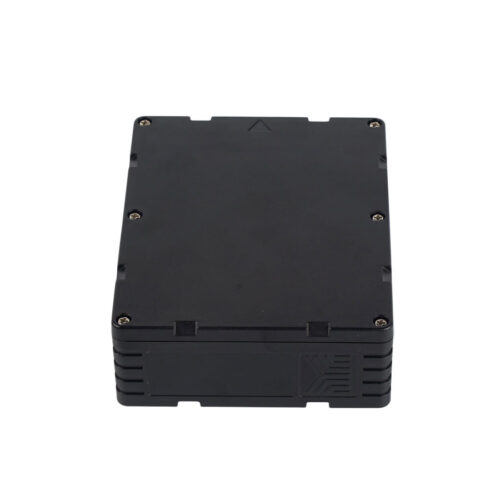
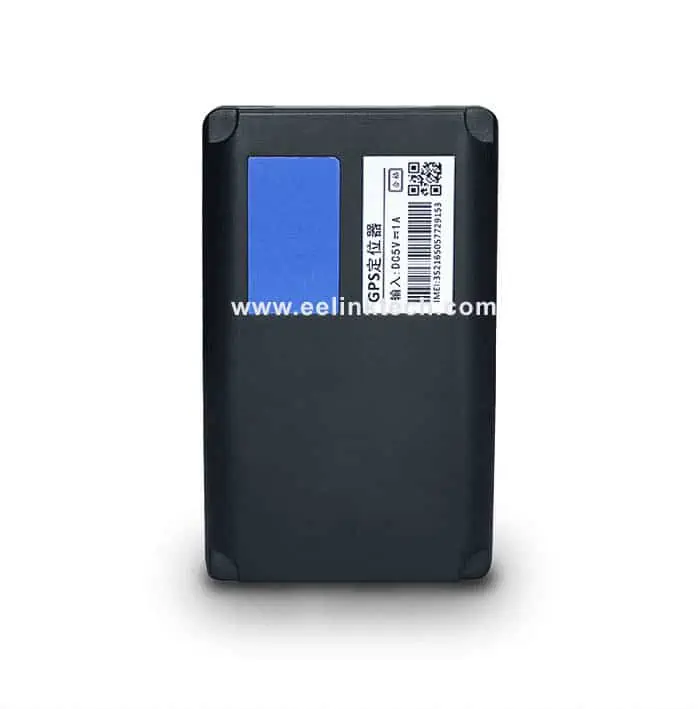
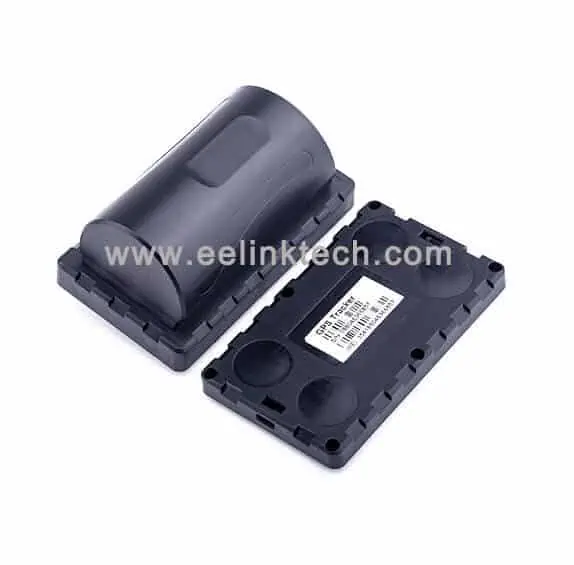
High reliability. Antenna placement and enclosure design are treated as system problems, not part numbers. We test for moisture ingress, door-edge cable stress, and temperature derating that marketing rarely mentions.
-
Industrial-grade construction. Shock and vibration are design inputs; enclosures are chosen to survive the forklift and the rain, not just the lab.
-
Trustworthy data as a substrate. We emit configuration digests, time sources, evidence windows, and health counters because platforms need evidence, not pretty lines.
That is how hardware should serve platforms: provide a trustworthy substrate of measurements and events so that customer systems can sense, reason, and execute with confidence. Jobs get easier when the device never surprises the platform.
8) Procurement questions that save months
If you are evaluating devices for any of the three signal areas, asking the following uncovers reality faster than a demo:
-
What is the mAs cost of one transmission, one GNSS fix, and quiescent drain?
-
How are door events detected and de-bounced? Show raw windows.
-
What time sources are used and how is drift corrected?
-
How are firmware updates staged and verified; can we pin a version in production?
-
What evidence is included for an impact or temperature event (sensor window, thresholds, time source, configuration digest, network at time)?
-
Where are antennas placed and how was the ground plane validated in the intended mounting location?
A vendor that answers these clearly—and shows the test data—will usually save you six months.
9) Putting the three signals together
-
Dry containers teach us that a once-silent asset becomes manageable when local semantics replace noisy timer-based reporting.
-
AI management reminds us that explainability is not a feature you buy later; it is a by-product of measurement provenance and change control in the device fleet.
-
Cold chains prove that telemetry is only valuable at the speed of the slowest human and facility in the loop—documentation of interventions and playbooks belongs in the spec, not the launch party.
They are different fronts of the same movement: visibility is no longer a dashboard; it is a chain of evidence that ends in a decision.
For our part, we continue to design devices as if they are going to be questioned by an auditor rather than admired at a booth—that is what ultra-low-power, high reliability, industrial-grade build, and trustworthy data really mean in practice.
Appendix A — A quick battery sanity check for a cold-chain logger
Suppose a logger must last 90 days at 4 °C with:
-
ambient sampling every 2 min: 1.2 mAs/sample
-
core-estimate calculation every 10 min: 0.3 mAs/event
-
two daily network sessions: 1200 mAs each
-
8 temperature-band transitions per week needing evidence windows: 500 mAs each
-
quiescent: 10 µA (~8.6 mAh/1000 h → 18.6 mAh/month)
Rough budget:
-
sampling: 1.2 mAs × 720/day × 90 ≈ 77,760 mAs ≈ 21.6 mAh
-
estimate calc: 0.3 mAs × 144/day × 90 ≈ 3,888 mAs ≈ 1.1 mAh
-
sessions: 2400 mAs/day × 90 ≈ 216,000 mAs ≈ 60 mAh
-
band windows: ~8/week × 13 weeks × 500 mAs ≈ 52,000 mAs ≈ 14.4 mAh
-
quiescent: ~56 mAh
Total ≈ 153 mAh. With a 2 Ah cell, even a 50 % derating leaves comfortable headroom. If your budget cannot be shown at this granularity, measurement promises will not survive winter.
Q1. What makes smart container telemetry credible during audits?
A: Stable event semantics, synchronized time source, raw sensor evidence windows, and signed/staged firmware with configuration digests.
Q2. How does ISO/IEC 42001 change device requirements?
A: It formalizes provenance and lifecycle control: devices must emit enough context (time, FW, sensor windows, battery under load) for explainable decisions.
Q3. How do we budget batteries for multi-year deployments?
A: Design around events. Quantify mAs for transmission, GNSS, quiescent drain; adopt “sample fast, report slow”; simulate with real event frequencies.
Q4. What is the difference between ambient and core in cold chain?
A: Ambient moves fast; product core does not. Specify whether thresholds apply to ambient or core-estimate, and attach intervention playbooks.
Q5. Why emphasize industrial-grade design for telemetry?
A: Real deployments face vibration, rain, stacking, and cable stress. Antenna layout, sealing, and mechanical protection decide whether the data exists.